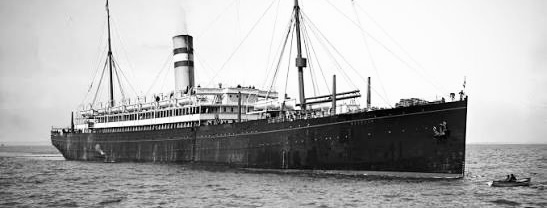
SS Noordam
Holland America Line · 1902 · Ship Guide
Overview
SS Noordam was a Holland America Line passenger and emigrant steamer built by Harland & Wolff at Belfast and completed in 1902. Designed for the Rotterdam–New York route, she was a near-sister of Rijndam and belonged to the same broad group as the larger Potsdam. Her commercial purpose combined cabin travel, mail and cargo with accommodation for approximately 1,800 third-class passengers at the height of European migration to North America.
Her career included two separate mine incidents during the First World War, a postwar return to Dutch service, and a 1923–26 charter to Swedish American Line under the name Kungsholm. Restored to her original name for a final period with Holland America Line, she completed her last North Atlantic voyage in 1927 and was broken up in the Netherlands in 1928–29.
Identification note: this guide concerns the first Holland America Line ship named Noordam, launched in 1901 and entering service in 1902. It should not be confused with the company’s later motor liner of 1938 or subsequent cruise ships carrying the same name.
Key Facts
Design & Construction (Context)
Noordam was a steel, one-funnel, two-masted liner whose machinery and passenger arrangement closely followed those of Rijndam. Her twin-screw installation offered redundancy and dependable handling, while her approximately 15-knot speed suited Holland America Line’s preference for regular and economical crossings rather than competition for speed records.
Contemporary descriptions emphasized electric lighting, refrigerated spaces for provisions, substantial cargo-handling equipment, and decorative work related to that of her sister. The balance of accommodation is especially revealing: several hundred cabin berths were accompanied by space for roughly 1,800 third-class travelers, making migration rather than luxury alone central to her design.
Service History (Summary)
1902: Entry into service. Completed at Belfast on 29 March, Noordam left Rotterdam on 1 May 1902 for Boulogne-sur-Mer and New York. She joined Holland America Line’s principal North Atlantic service and carried passengers, emigrants, mail, and cargo between continental Europe and the United States.
Prewar operation. During the years before 1914, Noordam maintained regular Rotterdam–New York sailings, generally via Boulogne. By the early 1910s she had been equipped with submarine-signaling apparatus and Marconi wireless telegraphy, reflecting the gradual modernization of established liners.
24 November 1911: Channel collision. In fog off the Isle of Wight, the schooner Alida collided with Noordam. The sailing vessel suffered damage to her bowsprit, but both ships were able to continue their voyages.
14 April 1912: Ice warning. Noordam transmitted a wireless warning reporting sea ice in the North Atlantic. The message was relayed by the Cunard liner Caronia to RMS Titanic, placing the Dutch ship within the wider network of ice reports exchanged during Titanic’s maiden voyage.
17 October 1914: First mine incident. While returning from New York toward Rotterdam, Noordam struck a mine in the North Sea. She survived the damage, was repaired, and resumed sailing on 26 March 1915.
3 August 1917: Second mine incident. Noordam was damaged by another mine. This time she was laid up for the remainder of the war rather than immediately restored to commercial operation.
1919–1923: Postwar Holland America service. The liner resumed service on 9 March 1919 between Rotterdam, Plymouth, Brest, and New York. She continued on the Atlantic until beginning her last pre-charter Rotterdam–New York voyage on 24 January 1923.
1923–1926: Swedish American Line charter. Chartered by Rederi AB Sverige-Nordamerika, she was refitted to carry approximately 478 cabin-class and 1,800 third-class passengers and renamed Kungsholm. She began Gothenburg–New York service on 15 March 1923 and later included Halifax in her route.
1926–1927: Final return as Noordam. Returned to her original name in October 1926, the ship resumed Holland America Line service between Rotterdam and New York. By December she was operating as a third-class-only vessel. Her final voyage on the route began on 16 April 1927.
1928–1929: Demolition. After withdrawal, Noordam was sold for breaking and dismantled at Hendrik-Ido-Ambacht in the Netherlands. Sources differ slightly on whether the final disposal date should be recorded as 1928 or 1928–29.
War, Mines, and Interrupted Neutral Service
Noordam's First World War career was defined less by formal naval conversion than by the hazards of maintaining Dutch commercial service in mined waters. On 17 October 1914, while returning toward Rotterdam, she struck a British mine roughly 80 nautical miles from the Hook of Holland. Although her stern was badly damaged, she survived and eventually returned to service.
A second mine incident followed on 3 August 1917 near the Terschelling Bank. The ship again remained afloat; 237 passengers were taken off by tugs before Noordam was escorted to Rotterdam. Holland America Line then laid her up for the remainder of the war. These two survivals form an important part of her chronology and help explain the irregularity of neutral North Atlantic service during the conflict.
Kungsholm Charter and Final Years
In March 1923 Holland America Line placed Noordam on bareboat charter to the Swedish American Line, which renamed her Kungsholm. She served under Swedish colors until late 1924 with cabin and third-class accommodation before returning to her Dutch owners and regaining the name Noordam.
Her final Holland America service was increasingly oriented toward third-class traffic. She began her last Atlantic crossing in April 1927 and was sold for demolition in 1928. Breaking began at Rotterdam and continued at Hendrik-Ido-Ambacht, with the work not completed until 1929.
Interpretive Notes
Noordam is best understood not as a prestige liner but as durable migration infrastructure. Her very large third-class capacity placed her among the ships that carried the demographic movement of the early twentieth-century Atlantic, while her cabin accommodations, cargo spaces, and mail service made her commercially versatile.
Her two mine incidents demonstrate the precarious position of Dutch neutral shipping during the First World War. Survival did not imply safety: even vessels operating under a neutral flag remained exposed to minefields, disrupted routes, and the broader hazards created by submarine warfare.
The Kungsholm charter also shows how an aging liner could be repositioned within a different national market. Rather than being immediately discarded after the war, Noordam was refitted and temporarily became part of Sweden’s transatlantic passenger system before returning to the company and name for which she had been built.
Evidence-first ship guideSources (Selected)
Published tonnage and passenger figures differ slightly between builder’s records, registers, and later compilations. Rounded figures are used where appropriate, and formal publication should cite the measurement system and date of the underlying record.
- Ocean Liner Curator — Sources (master bibliography)
- The Yard — Harland & Wolff construction record, Yard No. 338
- GG Archives — SS Noordam passenger lists and ship particulars
- GG Archives — SS Noordam menu collection
- SS Noordam (starting index; corroborate key facts)
- Stichting Maritiem-Historische Databank — SS Noordam chronology