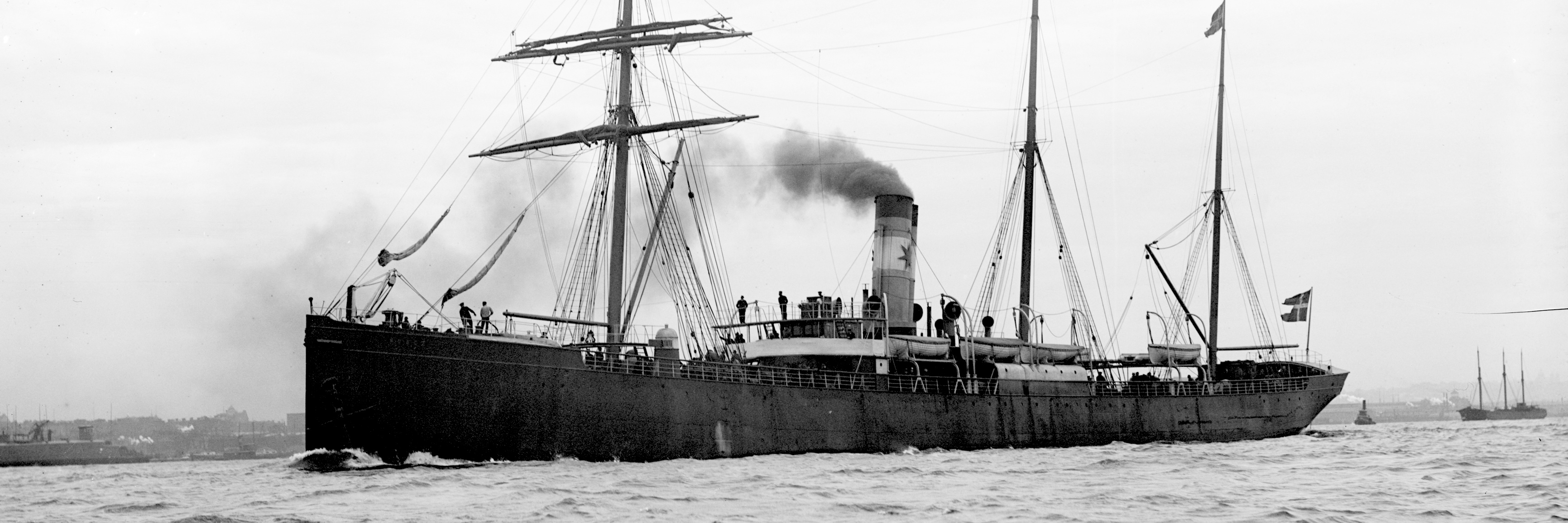
SS Norge
Thingvalla Line / Scandinavian America Line · 1889 · Ship Guide
Overview
SS Norge was a Scandinavian emigrant liner whose historical importance rests less on luxury or speed than on migration, route geography, and maritime tragedy. Built in 1881 in Scotland as the Belgian ship Pieter de Coninck, she was sold into Danish service in 1889, renamed Norge, and became part of the well-established Scandinavian passenger route linking Copenhagen, Kristiania, Kristiansand, and New York.
In collecting and interpretation, Norge is especially important because her story spans more than one identity: Pieter de Coninck, Thingvalla Line Norge, and later Scandinavian America Line Norge all refer to the same hull. Artifacts should therefore be cataloged under the printed name and operator actually shown on the piece, rather than under a simplified single-name biography.
Key Facts
Technical details for Norge vary somewhat across secondary summaries, especially regarding later machinery descriptions and passenger totals. For museum-level catalog work, preserve the exact figures used by the source or artifact being cited rather than silently harmonizing them.
Design & Construction Context
Norge was not an express Atlantic showpiece. She belonged instead to the highly important category of practical emigrant steamers that linked regional European ports to New York through regular, culturally familiar service. That role was commercially and socially significant. For many emigrants, especially Scandinavians, ships like Norge were more relevant than the celebrated record-breakers of the major British and German lines.
Her long service life also reflects the transitional nature of late-19th-century passenger shipping. Built in 1881, she was already an older ship by the time of her loss in 1904, serving in a market increasingly shaped by newer twin-screw liners and stronger safety expectations. In that sense, Norge represents both continuity and strain within the emigrant trade: durable utility on the one hand, growing obsolescence on the other.
Service History (Summary)
1881–1889: Built as Pieter de Coninck for Theodore C. Engels & Co. of Antwerp. This is the ship’s pre-Scandinavian identity and should be distinguished from later Norge material.
1889: Sold to the Danish Thingvalla Line and renamed Norge. She entered the Scandinavian emigrant service linking Copenhagen and Norwegian ports with New York.
1890s: Continued in Atlantic service for the Scandinavian migration trade. Surviving schedules and voyage listings show repeated Kristiania–Kristiansand–New York sailings, often with Copenhagen in the broader route pattern.
1898: Thingvalla Line was absorbed into DFDS, and the service continued under the Scandinavian America Line structure. By this stage, Norge was still commercially useful, but she was not representative of the more modern liners the line would soon introduce.
June 1904: Departed Copenhagen under Captain Valdemar Johannes Gundel, then took on emigrants at Kristiania and Kristiansand before heading west for New York. On June 28, in fog, she struck Hasselwood Rock near Rockall. The damage was catastrophic, lifeboat launching went badly, and the ship sank within minutes.
Historical significance of the loss: the sinking became one of the great emigrant-era maritime disasters. It was, by common later summary, the largest loss of life involving a Danish merchant ship, and one of the worst civilian Atlantic disasters before Titanic.
Emigrant Ship Rather Than Prestige Liner
Norge was a working emigrant ship. Her Copenhagen–Norway–New York service carried large numbers of Scandinavian and eastern European migrants, and her historical importance lies primarily in that movement of people rather than in luxury or speed.
The ship's earlier Belgian identity as Pieter de Coninck is therefore a genuine attribution boundary, not merely an alternate name in a fleet list.
28 June 1904: Rockall
On 28 June 1904, in reduced visibility near Rockall, Norge struck the reef known as Helen's Reef. The damage opened the hull, and the ship sank within roughly twenty minutes.
Store norske leksikon gives a death toll of 635. The disaster became the worst North Atlantic passenger-ship loss before Titanic and remains one of the defining tragedies of Scandinavian emigration history.
Lifeboat Capacity and Survival
Danish historical sources emphasize that the ship's eight lifeboats could accommodate only about 250 people—far fewer than the number aboard. Some boats were damaged or lost during launching, and survivors in the boats endured prolonged exposure before rescue.
This makes the casualty story inseparable from contemporary lifesaving standards. The ship may have complied with the regulations of its era, but regulatory compliance did not mean that every person aboard had a place in a conventional lifeboat.
Interpretive Notes
Name and line discipline matter: Norge artifacts should not be collapsed into a single generic “Scandinavian liner” category. A Thingvalla-era piece and a Scandinavian America Line-era piece may refer to the same ship but belong to different branding, chronology, and route contexts.
Migration context is central: Norge is best understood as an emigrant liner rather than a prestige passenger ship. Passenger lists, agency notices, route pamphlets, and emigrant guidance material may be more historically representative than luxury-menu type survivals.
The disaster can distort collecting focus: because the ship is now remembered chiefly for her 1904 loss, sellers and summaries sometimes flatten her earlier service life. Good cataloging practice preserves both the routine migration-service years and the final-voyage significance.
Older ships often have layered specification records: with vessels of this age and service type, quick-reference figures may shift depending on whether the source is describing original construction, later service, or migration-era accommodation. Curator practice should document the source form rather than over-smoothing the record.
Evidence-first ship guideSources (Selected)
- Ocean Liner Curator — Sources (master bibliography)
- SS Norge — overview chronology, specifications, ownership history, and sinking summary
- Norway Heritage — ship history, route listings, dimensions, and service notes for Norge
- Norway Heritage — Scandinavian America Line route and fleet context
- Wrecksite — loss summary and basic technical particulars
- Store norske leksikon — D/S Norge history and 1904 loss
- Lex.dk — Norge emigrant ship and lifesaving-capacity context