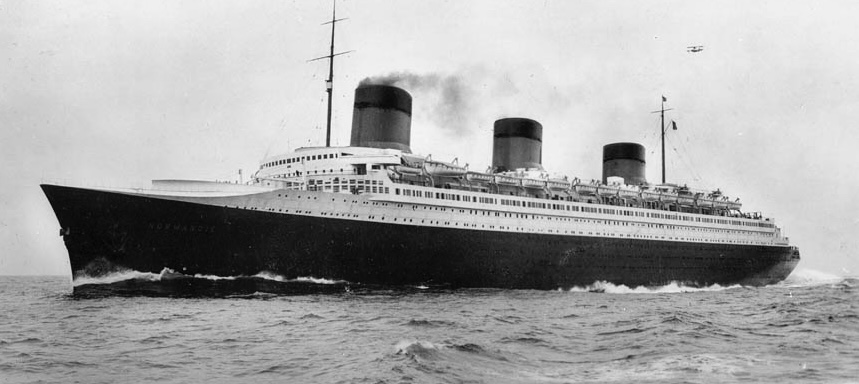
SS Normandie
Compagnie Générale Transatlantique (French Line) · 1935 · Ship Guide
Overview
SS Normandie was the Compagnie Générale Transatlantique (CGT / “French Line”) answer to the interwar prestige race: a transatlantic liner designed to be unmistakably modern—fast, technically ambitious, and visually decisive. Entering service in 1935 on the Le Havre–Southampton–New York route, she quickly became a reference point for Art Deco at sea and for the idea that a ship could function as national advertising in steel.
For collectors, Normandie is a “high myth / high documentation” ship: many authentic artifacts and images exist, but so do a large number of later souvenirs, reproductions, and story-driven claims. The safest approach is to treat “Normandie” as a label that must be earned by evidence—date, format, print provenance, and a plausible chain of custody—rather than accepted because the design looks French or Art Deco.
This page is a reference doorway: it summarizes widely documented facts, flags uncertainty where it exists, and avoids turning repeated anecdotes into “record” without evidence.
Key Facts
Note on numbers: published specs for Normandie can differ slightly across sources because tonnage was revised after changes, and some measurements are reported “overall” vs “between perpendiculars.” For object attribution, the goal is not a single perfect number—it’s matching an artifact’s era to the correct ship configuration.
Design & Construction (Context)
Normandie is often discussed as a synthesis of French industrial ambition and decorative modernism. The ship’s public image was tightly managed: posters, brochures, onboard stationery, and press photography helped create a recognizable “Normandie look.” That identity is part of why so much later material imitates the style—sometimes honestly as tribute, sometimes opportunistically as “from the ship.”
Collecting implication: when a seller leans heavily on “Art Deco” as proof, treat that as a prompt to investigate, not a conclusion. Better anchors include: printer/line marks, CGT formatting conventions, known menu and letterhead layouts by period, bilingual patterns, and date-locked voyage context.
Service History (Summary)
Entering service in 1935, Normandie became one of the defining liners of the late interwar Atlantic. She is commonly credited with capturing the Blue Riband on her maiden westbound crossing, reinforcing the ship’s identity as both luxury object and speed statement. Like many prestige liners, her career is best understood as a short, intensely documented commercial run followed by wartime disruption.
With the outbreak of World War II, major passenger ships were laid up, requisitioned, or redirected to state needs. Normandie ended up in New York and was later taken over for conversion into a troop transport, renamed USS Lafayette—a transition that produced a distinct “conversion era” paper trail that is not the same category as prewar CGT passenger material.
Blue Riband (Evidence Note)
The Blue Riband is one of the most frequently repeated “headline facts” attached to Normandie. In collecting descriptions, it often gets used as a credibility halo: “Blue Riband ship” becomes a substitute for proof. If an object’s value depends on a speed-record claim, insist on period documentation: dated menus, voyage souvenirs with route/date, press clippings that can be matched to archives, or an attribution chain that ties the item to a known crossing.
1942 Fire and Capsizing (Provenance Caution)
Normandie’s dramatic end—fire and capsizing in New York during conversion work in February 1942—creates a magnet for “salvage stories.” Some items genuinely can be associated with the ship’s final chapter, but the evidentiary bar should rise sharply for anything described as “recovered,” “from the pier,” or “from the wreck.” Strong examples typically include dated paperwork, named individuals, institutional transfer records, or a traceable collection history—not just a narrative.
Collecting Profile (What Tends to Survive)
Material associated with Normandie often falls into a few broad buckets: (1) CGT passenger ephemera (menus, stationery, brochures, baggage labels), (2) corporate and promotional print tied to the ship’s brand, (3) press photography and magazine coverage, and (4) later commemorative material. The challenge is sorting “period CGT” from “later homage.”
Practical method: try to anchor items to (1) a date range (prewar 1935–39 vs wartime conversion era), (2) a production context (CGT onboard print vs shore-side promotion vs later publication), and (3) a verifiable style system (typography, paper stock, printers, and consistent layout conventions). When those anchors are missing, use restrained labeling—e.g., “CGT, Normandie attributed”—instead of stating certainty.
Interpretive Notes (What to Avoid)
A common failure mode in Normandie collecting is collapsing the ship into a single aesthetic: “French Art Deco.” But the ship’s documentation is richer—and more specific—than that. When you can, prefer evidence statements (“menu dated ___,” “CGT letterhead with ___ address format,” “photo credited to ___”) over vibe statements (“feels like Normandie”).
Evidence-first ship guideSources (Selected)
This list is intentionally conservative.
- Ocean Liner Curator — Sources (master bibliography)
- SS Maritime — French Line: S.S. Normandie (service history overview)
- Hudson River Maritime Museum — The S.S. Normandie Fire (context and interpretation)
- Atlantic Liners — SS Normandie (specs and compiled references)
- Wikipedia — SS Normandie (use as a pointer map; verify key claims in primary sources)
- Wikipedia — Blue Riband (context for record claims; verify specifics with period sources)