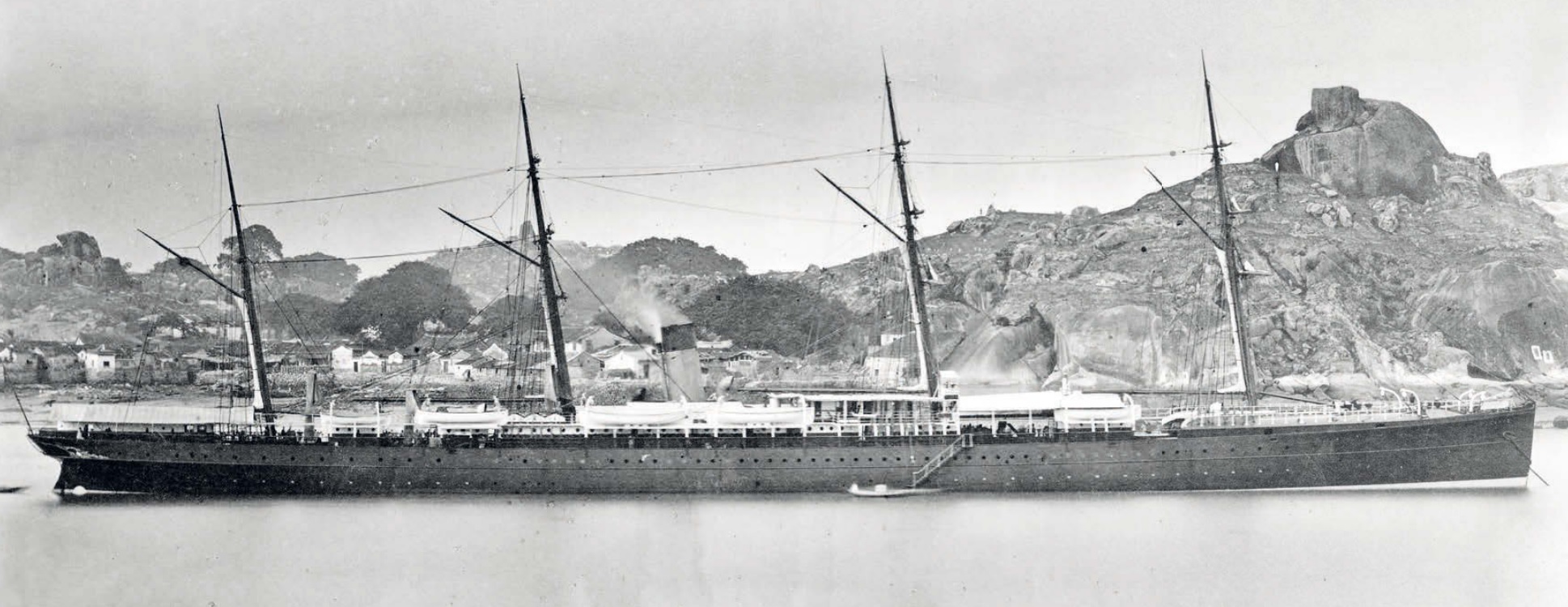
SS Oceanic (1871)
White Star Line · entered service 1871 · Ship Guide
Overview
SS Oceanic was the ship that announced the revived White Star Line to the North Atlantic. Built by Harland & Wolff at Belfast, launched on 27 August 1870, and entering Liverpool–New York service on 2 March 1871, she became one of the defining early examples of a liner designed around passenger comfort and proportion rather than machinery alone.
Her importance is foundational. Oceanic helped establish the visual and commercial language White Star would develop for decades: long balanced hull form, a comparatively modern passenger arrangement, and a reputation built around steadiness and comfort as much as speed. She was not simply the first ship of a successful series; she was the vessel that made the new White Star identity legible to the traveling public.
Key Facts
A New Design Philosophy
Oceanic's reputation rested on more than novelty. White Star and Harland & Wolff approached the ship as a passenger environment, paying unusual attention to proportion, accommodation, ventilation, and the placement of public spaces. Later writers often summarize this as “comfort over speed,” but that phrase is too simple. The deeper change was that passenger experience became part of the engineering brief itself.
This mattered commercially. A line competing on the North Atlantic needed more than a technically competent ship; it needed a recognizable identity. Oceanic gave White Star one, and the company's early fleet repeated enough of her visual and operational language to create a coherent brand.
Steam, Sail, and Transition
The ship was still unmistakably transitional. She carried four masts and auxiliary sail even as steam had become the commercial foundation of the voyage. That combination can look contradictory from a later perspective, but in 1871 it reflected prudent practice: steam reliability was improving rapidly, yet sail remained part of the redundancy and operating culture inherited from an earlier generation.
For image attribution, the rig is useful evidence. Early White Star ships can appear visually closer to large sailing steamers than to the twin-screw liners of the 1890s, and that difference should be preserved rather than modernized away.
Passenger Service and Migration
Oceanic's first-class spaces drew much of the contemporary attention, but her very large third-class capacity is equally important. The ship belonged to the mass migration system of the nineteenth-century Atlantic, carrying people whose journeys were often tied to settlement, labor, family networks, and onward rail travel.
That social history survives in passenger lists, tickets, advertisements, and immigration records as much as in photographs of the ship. A full account of Oceanic therefore needs both the prestige narrative and the ordinary transport narrative.
Early White Star Fleet Context
Oceanic should be interpreted alongside the first generation of White Star steamers—ships such as Atlantic, Baltic, and Republic. Together they created the operating rhythm and public image of the company in the 1870s. The family resemblance matters because the historical significance lies partly in repetition: White Star did not build one unusual ship and stop; it established a fleet system.
This also helps explain why individual early ships can be difficult to distinguish in weakly labeled images. A confident attribution should rely on more than general resemblance whenever possible.
Pacific Service
From 1875, Oceanic entered Pacific service under charter to the Occidental and Oriental Steamship Company. This later career moved the hull into a very different route system and corporate context from White Star's Atlantic world.
That transition is a hard provenance boundary. A White Star Liverpool–New York artifact and an Occidental and Oriental Pacific artifact may concern the same ship, but they belong to different operating cultures, routes, and documentary traditions.
Why Oceanic Matters
Later White Star giants tend to dominate public memory, but Oceanic is one of the true foundation ships of the line. Her significance lies in establishing a design language, a passenger-service philosophy, and a recognizable corporate identity at the very beginning of White Star's steam era.
She also shows how influence can outlast size. By later standards she was modest, but the ideas associated with her—balanced proportions, attention to accommodation, and consistent fleet identity—became far more important than the raw tonnage figure.
Interpretive Notes
Name discipline is essential because White Star reused Oceanic in 1899. “Oceanic” alone is insufficient for serious cataloging. Date, route, company style, hull form, and source context should all be checked.
The Atlantic and Pacific phases should remain distinct, and early White Star material should be read on its own terms rather than through the visual expectations created by Olympic and Titanic.
Evidence-first ship guide