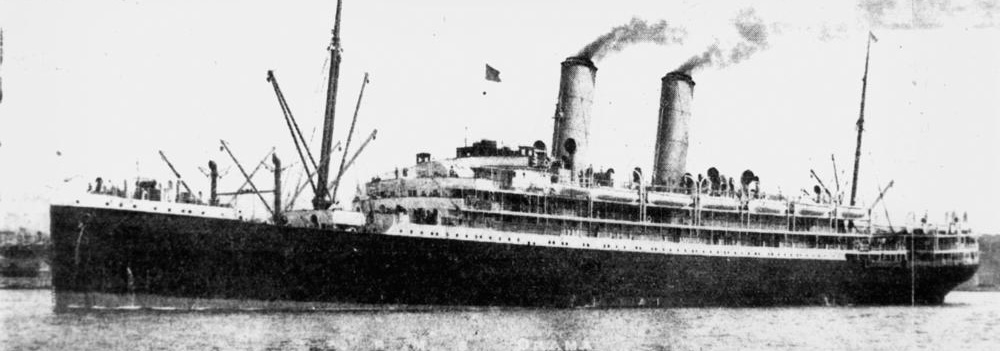
SS Orama
Orient Line · 1924 · Ship Guide
Overview
SS Orama was one of the major interwar Orient Line passenger liners built for the long England–Australia route by way of the Mediterranean and Suez. She belonged to the renewed post-First-World-War generation of large imperial-route liners that combined long-haul passenger service, mail carriage, and a substantial commercial presence within the British–Australian connection. Her career also reflects the abrupt vulnerability of that world, since a relatively short peacetime life was followed by wartime troopship service and destruction in 1940.
In collecting and interpretation, Orama is best divided into three main phases: interwar passenger service, interwar cruise and special-voyage service, and wartime troopship service. Material from those phases should be cataloged carefully rather than treated as a single undifferentiated ship identity.
Key Facts
Published figures for passenger accommodation and speed vary somewhat across fleet summaries, commercial descriptions, and later ship references. For cataloging purposes, preserve the exact wording used by the original source or artifact when possible, especially when distinguishing scheduled liner service from wartime use.
Design & Construction Context
Orama was one of the important postwar ships through which the Orient Line re-established a modern passenger identity after the First World War. She belonged to the imperial-route world of long-distance service to Australia rather than the Atlantic express-liner tradition. That distinction matters: her significance lies in steady, prestigious Britain–Australia service via the Mediterranean and Suez, not in speed-race comparisons with North Atlantic liners.
As one of the first large new Orient liners of the interwar period, she also helps mark a fleet-renewal moment. In curatorial terms, she belongs to the same broad modernizing phase that later produced other substantial Orient Line ships of the late 1920s and 1930s.
Service History (Summary)
1924: Built at Barrow-in-Furness by Vickers-Armstrong, Orama entered service in 1924 and began her maiden Australia voyage in November of that year. She was the first major new Orient Line vessel built after the First World War.
Interwar route service: In peacetime she served the long England–Australia route by way of the Mediterranean and Suez. This is the primary interpretive setting for passenger lists, brochures, menus, luggage labels, deck plans, and other commercial ephemera tied to her civilian identity.
Cruise and special-voyage associations: Like several large interwar liners, Orama also developed a cruise-related identity in addition to regular route work. Material from that phase should be distinguished from ordinary Australia-run printed matter whenever possible.
Late 1930s context: Publicity for Orama in the later interwar period increasingly presented her within a refined passenger-travel world that was already beginning to feel transitional. She belongs to the final mature phase of the classic Britain–Australia liner system before wartime disruption.
1940 wartime conversion: During the Second World War, Orama was converted into a troopship. At that point, references to the vessel increasingly belong to a military transport framework rather than a passenger one.
8 June 1940: During the Norwegian campaign, she was attacked west of Narvik by the German heavy cruiser Admiral Hipper. The ship was shelled and torpedoed, then lost.
Loss and aftermath: The sinking cost lives and led to the capture of survivors. Because the ship’s destruction came so early in the war, Orama belongs to the category of interwar passenger liners whose commercial careers were abruptly cut short by wartime service.
A New Orient Line Generation
Launched at Barrow on 20 May 1924 as yard no. 598, Orama was the first large new Orient liner built after the First World War. She became the opening ship in a sequence that included Oronsay, Otranto, Orford, and Orontes, establishing the visual and commercial character of the company’s late-1920s Australia fleet.
The two-class arrangement—first and third rather than a conventional three-class hierarchy—was part of a deliberate Orient Line policy intended to broaden accommodation while lowering fares in the emigrant and tourist market.
Norwegian Campaign and Loss
In 1940 Orama was taken into troop-transport service for the Norwegian campaign. On 8 June, while west of Narvik and without troops aboard, she encountered German naval forces and was attacked by the heavy cruiser Admiral Hipper. Gunfire and a torpedo sent the ship down.
Nineteen members of the crew were killed. Roughly 280 survivors, including the captain, were picked up by German warships and became prisoners. Royal Museums Greenwich preserves an Orient Steam Navigation Company manuscript specifically devoted to the sinking, giving the loss a strong company-archive foundation.
Why Orama Matters
Orama matters as both a fleet-reset ship and a wartime casualty. She helped define Orient Line’s post-1918 Australia service, then disappeared before the later postwar passenger era could reshape her identity. Civilian route material and 1940 loss documentation therefore form two sharply separated archives.
Interpretive Notes
This is an Australia-route liner first: Orama should be understood chiefly within the Orient Line’s Britain–Australia service world, not through North Atlantic assumptions.
Interwar passenger material and wartime records belong to different interpretive worlds: commercial onboard ephemera, route literature, and passenger photography should be kept separate from military transport and loss documentation.
She marks a postwar fleet-renewal moment: Orama was important not merely as an individual ship but as part of the Orient Line’s rebuilding of a modern liner presence after 1918.
Her short career heightens her curatorial interest: unlike ships that lived into the postwar passenger era, Orama represents a substantial interwar liner whose civilian identity was cut off relatively early by war.
Be careful with class and capacity language: accommodation figures and class descriptions may differ from source to source, so exact wording should be preserved where possible when dating or attributing surviving artifacts.
Evidence-first ship guideSources (Selected)
- Ocean Liner Curator — Sources (master bibliography)
- Orient Line fleet context
- Museums Victoria — publicity brochure context for Orama
- Australian War Memorial — wartime image and loss context
- Royal Museums Greenwich — Orient Line manuscript, sinking of Orama, 8 June 1940
- The Allen Collection — Orama construction and service particulars