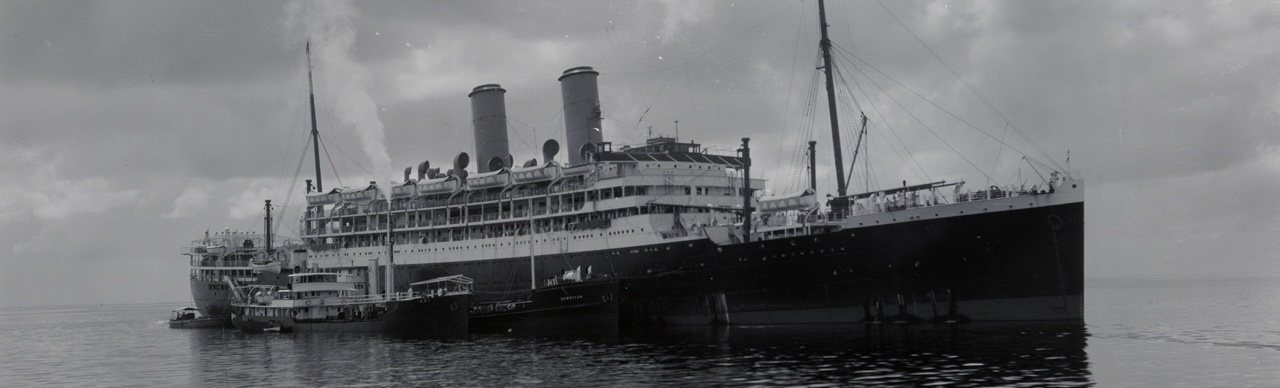
SS Orford
Orient Line · 1928 · Ship Guide
Overview
SS Orford was a substantial interwar Orient Line liner built for the long England–Australia route by way of the Mediterranean and Suez. She belonged to the later generation of large imperial-route passenger ships that combined regular route work with a growing cruise identity, especially in European waters. Her career bridges peacetime liner service, interwar cruising, and wartime troop transport, ending not in ordinary retirement but in bombing, fire, and eventual disposal after the Second World War.
In collecting and interpretation, Orford is best divided into three main phases: interwar Orient Line passenger service, peacetime cruising service, and wartime troopship service. Material from those phases should be cataloged carefully, since route identity, passenger presentation, and operational meaning changed over time.
Key Facts
Published measurements and service descriptions can vary slightly depending on whether a source emphasizes registered dimensions, conversion-era descriptions, or cruise-era publicity. For cataloging purposes, it is best to preserve the wording used by the original source or artifact being cited.
Design & Construction Context
Orford belonged to the mature interwar Orient Line world of Britain–Australia liner travel, a system defined by long-distance imperial connections rather than Atlantic speed competition. Ships of this type were designed for sustained service via the Mediterranean and Suez, balancing route regularity, passenger comfort, and long-haul endurance. In that respect, Orford should be interpreted primarily as an imperial-route liner rather than measured against the North Atlantic express-liner tradition.
She was one of the large Orient Line ships delivered in the second half of the 1920s, a family that gave the company a renewed interwar passenger identity. Compared with some earlier sisters, Orford also reflected the increasing overlap between liner work and cruising, a distinction worth tracking when interpreting onboard literature and photographic material.
Service History (Summary)
1927–1928: Built at Barrow-in-Furness by Vickers-Armstrong, Orford was launched in September 1927 and completed in March 1928. Her maiden voyage was not immediately an Australia passage but a Mediterranean cruise in April 1928, after which she spent time in European cruising service before beginning her first Australia sailing in October 1928.
Late 1920s–1930s route service: In peacetime she served the England–Australia route by way of the Mediterranean and Suez. This is the primary interpretive setting for brochures, menus, deck plans, passenger lists, luggage labels, and route ephemera tied to her commercial liner identity.
Cruising role: Orford was also used for cruises, especially in European waters. Material from this phase should not always be treated as interchangeable with regular Australia-route service, since cruise presentation often differed in emphasis and itinerary language.
1932: She is remembered for leading the ship parade associated with the opening of Sydney Harbour Bridge, a useful detail for contextualizing dated photographs and commemorative references from that period.
1934 voyage associations: She is also associated with notable passenger travel in the 1930s, including outward travel connected with Australian sporting figures and teams. Such references add cultural context but remain secondary to her main identity as an Orient Line imperial-route liner.
1939–1940 wartime conversion: With the outbreak of the Second World War, Orford was converted for troopship duties. At that point, references to the vessel increasingly belong to a military transport framework rather than a civilian passenger one.
1 June 1940: While off Marseille during the crisis phase of the war in France, she was attacked by German aircraft, bombed, and set on fire. Fourteen people were killed, and the vessel was beached and abandoned.
Aftermath: Unlike some liners that returned to service after wartime damage, Orford never resumed a commercial career. Her wreck remained until after the war and was finally broken up at Savona in 1947.
Cruising Before the Australia Run
Orford's maiden voyage was not a through sailing to Australia but a Mediterranean cruise in April 1928. Only later that year did she begin the long Britain–Australia service for which she is best remembered.
That sequence is a useful reminder that cruising was already an important commercial use for large interwar liners. The ship was designed for regular imperial-route work, but her passenger spaces could also be marketed for leisure voyages when schedules and demand allowed.
Wartime Damage at Marseille
Requisitioned as a troopship, Orford was attacked by German aircraft off Marseille on 1 June 1940 during the collapse of Allied positions in France. Bomb damage caused a severe fire, and the ship was beached and abandoned.
The wreck survived the war years and was ultimately broken up after the conflict. Her loss therefore belongs to the violent interruption of the interwar Australia-service fleet rather than to ordinary commercial retirement.
Interpretive Notes
This is an Australia-route liner first: Orford should be understood chiefly within the Orient Line’s Britain–Australia service system, not through North Atlantic prestige assumptions.
Cruise and line-voyage material should be distinguished: because Orford had both route and cruise identities in peacetime, printed matter and photography should be cataloged with attention to itinerary context.
Peacetime and wartime records belong to different interpretive worlds: passenger-service ephemera reflects commercial travel culture, while troopship references concern military logistics, evacuation, and wartime loss.
The Marseille bombing ended the career abruptly: unlike ships whose histories conclude in orderly scrapping after long postwar service, Orford belongs to the group of interwar liners whose operational life was cut short by wartime destruction.
Interwar Orient Line modernization matters: Orford helps illustrate the company’s renewed liner identity in the 1920s and the gradual blending of long-haul service with destination cruising.
Evidence-first ship guideSources (Selected)
- Ocean Liner Curator — Sources (master bibliography)
- General arrangement and service notes for Orford
- Royal Museums Greenwich — photographic record of Orford in cruise service
- Royal Museums Greenwich — photographic record of Orford in Norwegian waters
- Wrecksite — wartime damage and loss summary
- Orient Line fleet context
- Wrecksite — SS Orford loss and wreck chronology