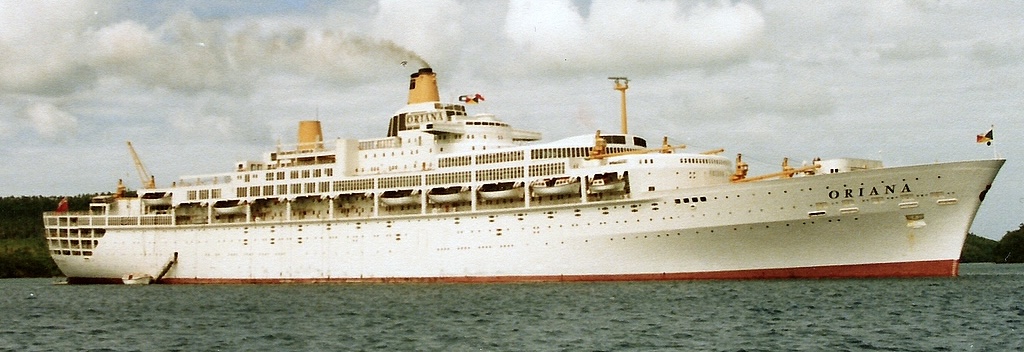
SS Oriana
Orient Line · 1959 · Ship Guide
Overview
SS Oriana was one of the best-known British postwar liners, built for the Orient Steam Navigation Company (Orient Line) at a moment when the traditional liner world was still trying to retain glamour and commercial relevance in the face of changing travel patterns. She combined modern postwar styling, high speed, and dual-purpose flexibility, serving both the Britain–Australia passenger trade and the increasingly important cruise market.
In collecting and interpretation, Oriana is especially significant because she sits at the threshold between the classic liner era and the cruise-oriented passenger world that followed. Material associated with scheduled Australia service should be distinguished from later cruise-era material, even when the ship name and branding remain broadly similar.
Key Facts
Published figures for passenger totals, speed language, and “last” or “final” distinctions can vary depending on whether a source emphasizes British construction, regular mail service, or major long-distance liner status. For stricter catalog work, preserve the wording used by the cited source or the artifact itself.
Design & Construction Context
Oriana emerged from a late phase of British ocean-liner building when shipowners still believed there was room for stylish, high-capacity passenger service to Australia, even as air travel was beginning to challenge the economics of long-distance sea passages. She was built as a modern prestige ship rather than a pure relic of prewar practice, with cleaner lines, updated accommodation, and a stronger awareness that seasonal cruising could help support passenger operations.
This matters interpretively. Oriana belongs to the final generation of ships that still carried the cultural weight of the classic liner tradition while already pointing toward the cruise market. She is therefore useful not only as a late Orient Line flagship, but as evidence of how British passenger shipping adapted the liner model during the increasingly integrated P&O–Orient era.
Service History (Summary)
1959–1960: Built at Barrow-in-Furness for the Orient Line, launched in 1959, and entered service in 1960. She was conceived as a major modern vessel for the Britain–Australia trade, arriving at a moment when long-distance sea travel still retained ceremonial and commercial importance.
1960–1966: Operated for the Orient Line on the Australia run and quickly established a reputation for speed and style. During this period P&O and Orient increasingly marketed services together, but Oriana remained an Orient Line ship. This is a principal liner-era collecting phase, reflected in brochures, cabin ephemera, passenger lists, menus, baggage labels, and Orient Line or joint P&O–Orient printed matter.
1966 onward: Ownership passed to P&O when the Orient Line identity was absorbed. Oriana thereafter continued in P&O service, with her presentation and branding changing accordingly.
Dual-purpose role: Like a number of postwar passenger ships, she increasingly combined scheduled route service with cruising. This dual identity is important because artifacts may look broadly similar while belonging to very different voyage contexts.
1970s: As commercial liner travel declined under pressure from aviation, Oriana became more closely associated with cruising and leisure travel rather than the older mail-and-passenger framework that had justified her construction.
1980s: She remained in service far longer than many classic liners, but by the mid-1980s the economics of maintaining such a ship had turned decisively against her. She was withdrawn in 1986.
End of career: After withdrawal she entered a brief and unsuccessful afterlife outside normal passenger service before being broken up. That long span from prestige liner to obsolete survivor gives her a wide documentary record across several distinct collecting phases.
Official P&O Technical Baseline
P&O’s preserved ship fact sheet gives a useful as-built baseline: 41,915 gross register tons, 804 ft overall length, 97.1 ft moulded breadth, 65,000 shaft horsepower, and a service speed of 27.5 knots. Those values are preferable to rounded later summaries when cataloging technical material.
From Liner to Full-Time Cruise Ship
Oriana’s transition was gradual rather than instantaneous. She was built for UK–Australasia and Pacific service with cruising as a secondary employment, then increasingly shifted toward leisure voyages as the long-distance passenger market weakened. By 1973 she was operating as a full-time cruise ship.
That date is a useful interpretive breakpoint. A 1960s Australia-service passenger list and a late-1970s cruise program document the same hull but not the same commercial product.
Retirement and Afterlife
P&O withdrew Oriana on 27 March 1986. She then became a stationary hotel and tourist attraction, first in Japan and later in China. Severe storm damage at Dalian in 2004 caused her to sink at her berth; after refloating, the ship was sold for demolition and broken up in 2005.
Official P&O Afterlife Chronology
P&O’s preserved fact sheet gives unusually precise dates for the ship’s post-service life. Withdrawal had been announced on 7 August 1985; Oriana docked at Sydney for the last time on 27 March 1986 and was sold on 30 April to Daiwa House Sales for use as a floating cultural attraction in Japan.
She was later transferred to Chinese owners, arriving at Dalian on 30 June 2002. Severe storm damage on 17 June 2004 left her flooded and partly sunk. She was towed to a shipyard in May 2005, and demolition commenced on 9 August 2005.
Technical Baseline and Later Measurement
The same P&O fact sheet records 41,915 gross register tons and 65,000 shaft horsepower as a useful original-service baseline. Later remeasurement and static-use descriptions should not be substituted for the liner’s as-built technical identity without a date.
Why Oriana Matters
Oriana is one of the clearest ships for studying the liner-to-cruise transition because she lived both identities fully. Her archive should be divided into Orient Line liner service, P&O transitional service, full-time cruising, and static afterlife rather than treated as one continuous undifferentiated career.
Interpretive Notes
Oriana belongs to the late liner-transition era: she should not be read purely as a classic pre-jet liner, nor purely as a modern cruise ship. Her significance lies in occupying both worlds.
Route context matters: an artifact from the Britain–Australia service belongs to a different interpretive frame than a later cruise item, even if the ship name and line branding are visually similar.
P&O branding can flatten chronology: seller descriptions sometimes retroactively treat Oriana as a P&O ship throughout her career. Material from her early service should instead be read in the context of the Orient Line and the transitional P&O–Orient relationship. Voyage date, printed class designation, and itinerary evidence are important for keeping pieces properly placed.
She is a useful case study in liner afterlife: Oriana illustrates how postwar prestige ships could survive operationally into the 1980s while no longer occupying the same commercial world that had originally justified them.
Evidence-first ship guideSources (Selected)
- Ocean Liner Curator — Sources (master bibliography)
- P&O Heritage — Oriana (1960) ship fact sheet
- SS Oriana (1959) — service chronology and published bibliography
- SS Maritime — historical overview and service context for Oriana
- Norway Heritage — passenger liner database
- Museums Victoria — P&O–Orient Line Pacific Services pamphlet and Oriana chronology
- GG Archives — P&O fleet and route context
- P&O Heritage — SS Oriana ship fact sheet