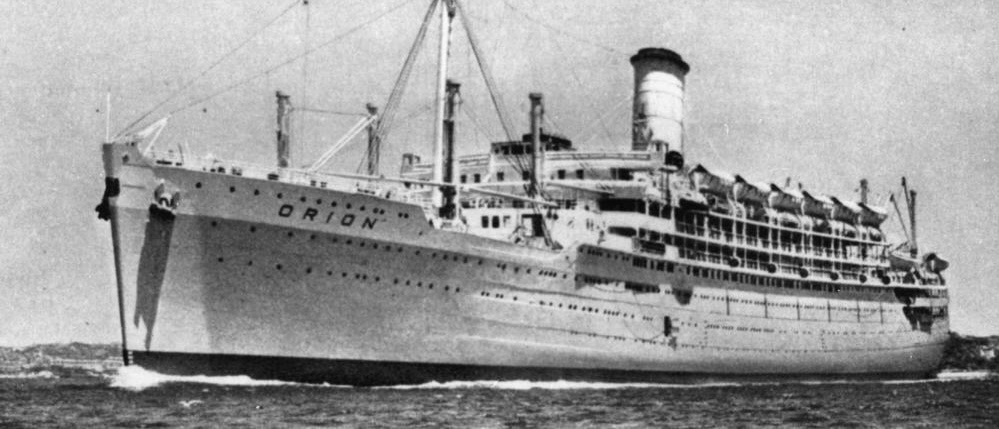
SS Orion
Orient Line · 1934 · Ship Guide
Overview
SS Orion was one of the most important interwar Orient Line liners and a defining ship of the Britain–Australia route in the late 1930s and postwar years. Built for the Orient Steam Navigation Company, she combined substantial size, a modern single-funnel profile, and a design language that marked a clear break from older multi-funnel liner traditions. Her career later expanded beyond peacetime passenger service into wartime troop transport and then postwar migrant and tourist service, giving the ship a long and varied interpretive life.
In collecting and interpretation, Orion is best divided into four phases: prewar two-class liner service, wartime troopship service, postwar refitted liner service, and later one-class migrant/tourist service. Material from those phases can look related, but it does not necessarily belong to the same historical context.
Key Facts
Passenger figures vary by service phase. For cataloging purposes, it is usually best to preserve the exact capacity wording and date context used by the source or artifact being cited.
Design & Construction Context
Orion is especially significant as a modernizing ship. Her profile differed strikingly from many earlier liners, with a single funnel and single mast that gave her a cleaner, more contemporary silhouette. She was also notable for interior design that has often been described as unusually modern for its time, reflecting an effort to adapt passenger spaces to long-distance travel in warmer climates rather than simply reproducing heavy Edwardian land-based interiors at sea.
In route terms, Orion belonged to the Britain–Australia service world rather than the North Atlantic prestige race. That matters interpretively: her fame rests less on record-breaking speed and more on her importance as a long-distance mail and passenger liner linking Britain with Australia through the imperial route system.
Service History (Summary)
1934–1935: Built by Vickers-Armstrong at Barrow-in-Furness, launched in December 1934, and completed in August 1935 for the Orient Line. She entered service that year as one of the company’s most modern ships.
1935 prewar service: Orion began her route career in the Britain–Australia trade and quickly established herself as one of the line’s most recognizable ships. She also attracted attention as a modern liner, and her construction was documented in Paul Rotha’s 1935 film Shipyard.
Late 1930s: In addition to regular route work, she also operated cruise voyages, showing the flexibility that many interwar liners needed in order to balance scheduled liner service with leisure cruising.
Second World War: During the war, Orion served as a troopship. Like many major British liners, her peacetime passenger identity gave way to military transport work, making wartime material a distinct interpretive category from earlier passenger ephemera.
1946–1947: She returned to Vickers-Armstrong’s Barrow yard on 1 May 1946 for refit, which took about a year. After completion, she became the first Orient Line ship to resume postwar voyages to Australia, sailing from Tilbury on 27 February 1947.
Postwar service: In the late 1940s and 1950s, Orion resumed the Europe–Australia service pattern and also undertook cruises, including voyages to the west coast of the United States. This phase represents her mature postwar liner identity.
1958–1961: She was successively altered for changing passenger demand, first with revised class arrangements and later as a one-class ship. These refits reflect the wider shift from traditional liner-class structures toward migrant and mass-passenger service.
1963: Retired from service as sea travel to Australia declined under air competition. She departed on her final voyage in February 1963 and was then broken up.
Design as a Break with the Older Liner Profile
Orion's single funnel, single mast, and cleaner superstructure made her one of the most visibly modern British liners of the mid-1930s. Her appearance broke decisively with the multi-funnel silhouette that had dominated earlier imperial-route passenger ships.
The change was not merely cosmetic. Her arrangement reflected newer machinery, altered ventilation requirements, and a growing preference for streamlined exterior design paired with modern interiors suited to both scheduled liner service and cruising.
Wartime Repatriation
During and immediately after the Second World War, Orion served as a troop transport. Australian War Memorial records document her departure from Liverpool on 8 August 1945 carrying 706 Royal Australian Air Force personnel, including 600 former prisoners of war, who reached Sydney on 15 September via the Panama Canal and New Zealand.
That voyage gives the ship's wartime role unusually concrete human context: the same passenger liner that had carried peacetime travelers to Australia became part of the machinery that brought servicemen and former prisoners home.
Interpretive Notes
A Britain–Australia liner first: Orion should be read primarily in the context of the long imperial route between Britain and Australia, not the Atlantic speed-race framework.
Her modern design identity matters: the single funnel, single mast, and modern interiors are not incidental details but central to what made Orion distinctive within the Orient Line fleet.
Wartime and peacetime material belong to different worlds: troopship references, military transport narratives, and government movement records should not be collapsed into the same interpretive category as passenger lists, brochures, and tourist-class ephemera.
Late-career one-class material reflects a different passenger economy: by the late 1950s and early 1960s, Orion was operating in a changed world shaped by migration flows and the decline of traditional multi-class ocean liner travel.
Evidence-first ship guideSources (Selected)
- Ocean Liner Curator — Sources (master bibliography)
- RMS Orion — overview chronology, specifications, wartime and postwar service
- Lloyd’s Register Foundation Heritage & Education Centre — RMS Orion
- SS Maritime — Orient Line RMS Orion
- Australian War Memorial — 1945 RAAF repatriation voyage aboard Orion