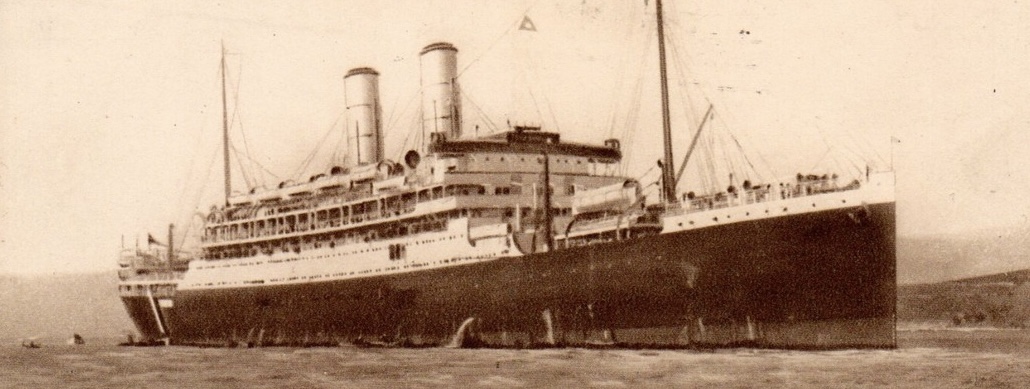
SS Oronsay (1925)
Orient Line · entered service 1925 · Ship Guide
Overview
SS Oronsay was an Orient Line ocean liner built by John Brown & Company at Clydebank and launched in 1924. She belonged to the important interwar generation of Britain–Australia liners that combined long-distance imperial passenger service with the visual presence and scale expected of a major prestige route.
In collecting and interpretation, Oronsay is especially useful because she bridges two very different contexts: the polished interwar Orient Line passenger trade and the dangerous wartime career that ended with her loss off Liberia in 1942. Material from those phases should not be blended casually.
Key Facts
As with many liner summaries, some quick-reference sources disagree slightly on tonnage presentation. For museum-level cataloging, preserve the form actually used by the source or printed artifact rather than silently standardizing it.
Design & Construction Context
Oronsay belongs to the interwar Orient Line fleet that sustained the long Britain–Australia route in the era between the First World War and the rise of larger 1930s liners such as Orion. She was not simply a transport vessel in the narrow sense, but a prestige imperial-route liner whose public identity depended on distance, reliability, and onboard standards suitable for a long passage through the Mediterranean, Suez, the Indian Ocean, and onward to Australia.
Interpreting ships like Oronsay is helpful because they broaden the idea of what an “ocean liner” was. In North Atlantic collecting, the term is often shaped by speed contests and express service. In the Britain–Australia trade, the emphasis was instead on endurance, route prestige, imperial connection, and the social world of a long-distance voyage.
Service History (Summary)
1925–1939: Served the Orient Line’s Britain–Australia route after beginning her maiden voyage on February 7, 1925. This is the principal collecting era for menus, passenger lists, route brochures, deck plans, luggage labels, and tourist ephemera associated with Oronsay.
1937: Carried the Australian military contingent traveling to Britain for the coronation of King George VI and Queen Elizabeth, giving her a clear ceremonial and imperial association in period documentation.
1938: The route was extended to New Zealand on at least one voyage, a useful reminder that not every surviving item should be interpreted as strictly “Australia only” without checking the itinerary.
1940: Taken up as a troopship and involved in major evacuation operations, including service connected with Norway and western France. During an air raid in June 1940, she was damaged while embarking troops near St Nazaire and also took aboard survivors from Lancastria.
1940: She also carried evacuated children under the Children’s Overseas Reception Board scheme and later suffered bomb-related damage while in convoy service.
Final voyage, 1942: While sailing from Cape Town to the United Kingdom via Freetown, she was torpedoed off Liberia on October 9, 1942. Most aboard survived, but lives were lost in the sinking and subsequent abandonment.
Interpretive Notes
Route identity matters: Oronsay belongs first to the Britain–Australia passenger world, not to a North Atlantic framework. That distinction affects how menus, passenger ephemera, schedules, and advertising should be contextualized.
Interwar and wartime material should be separated carefully: an Orient Line passenger brochure from the late 1920s or 1930s reflects a very different historical setting from troopship or evacuation-related material from 1940–1942. Same ship, sharply different documentary cultures.
Tonnage shorthand can mislead: postcard captions and enthusiast fleet lists sometimes round figures or present simplified specifications. Curator practice is to preserve what the artifact says while noting better-documented particulars in the record.
Loss narratives can become overcompressed: many short summaries jump from “Orient liner” straight to “torpedoed in 1942.” For interpretation, it is worth preserving the long interwar passenger career rather than letting the dramatic end eclipse the ship’s main service life.
Evidence-first ship guideSources (Selected)
- Ocean Liner Curator — Sources (master bibliography)
- SS Oronsay (1924) — overview and chronology
- Simplon Postcards — Orient Line fleet summaries and postcard record
- Australian National Maritime Museum — Orient Line collection context
- Powerhouse Museum — Orient Line SS Oronsay postcard record
- List of ships named Oronsay — name-disambiguation aid