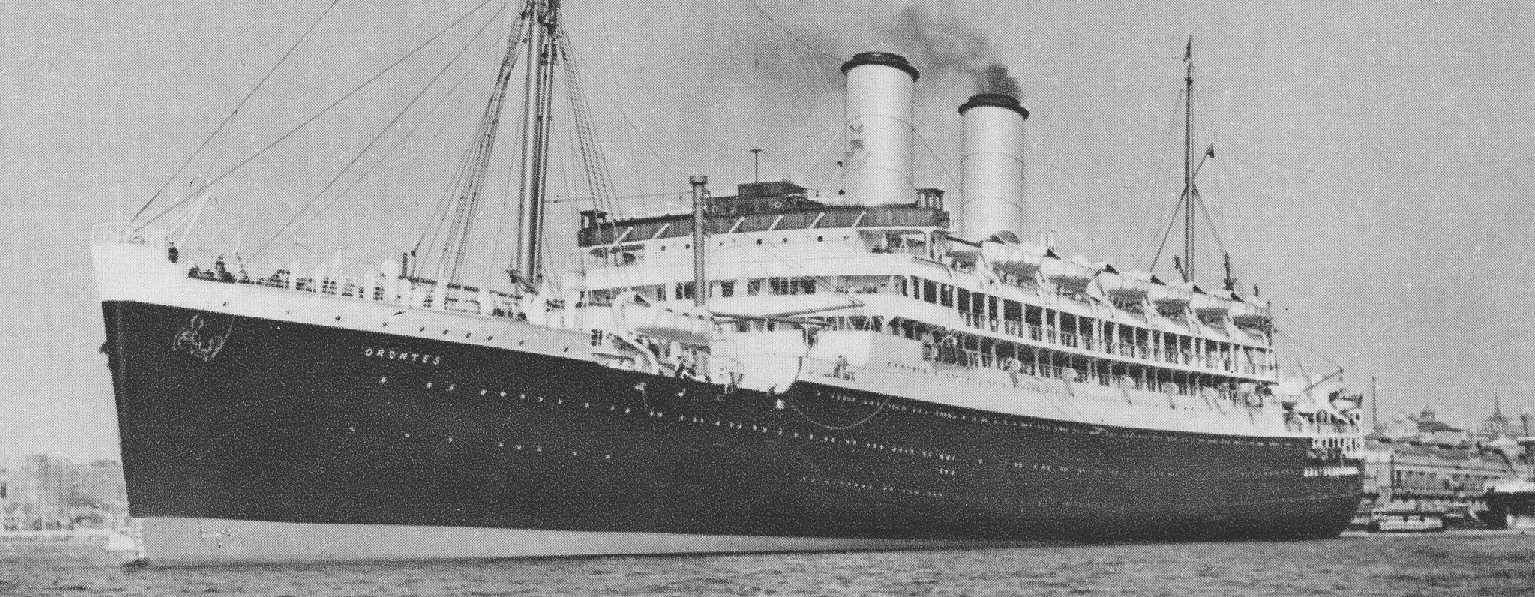
SS Orontes (1929)
Orient Line · entered service 1929 · Ship Guide
Overview
SS Orontes was a substantial interwar Orient Line passenger liner built for the long England–Australia route by way of the Mediterranean and Suez. She was the fifth and last of Orient Line’s broadly similar 20,000-ton liners of the 1920s. She belonged to the later generation of large imperial-route liners that emphasized sustained long-distance service, passenger comfort, and mail-and-passenger regularity rather than North Atlantic record-chasing. Her career bridged the late interwar world, wartime troopship duty, and a postwar return to civilian liner service before the final contraction of the traditional Britain–Australia liner era.
In collecting and interpretation, Orontes is best divided into three main phases: interwar Orient Line passenger service, wartime troopship service, and postwar refitted liner service. Material from those phases should be cataloged with care, since class structure, interiors, route presentation, and onboard identity changed over time.
Key Facts
Published tonnage and accommodation figures are not always presented identically across references and promotional literature. For cataloging purposes, it is best to preserve the exact wording used by the artifact or source being cited, especially when distinguishing as-built, refitted, and postwar service phases.
Design & Construction Context
Orontes belonged to the mature interwar world of Britain–Australia liner travel rather than the Atlantic express-liner race. Her operating world was one of long passages, imperial communications, and route continuity via the Mediterranean and Suez Canal. That context matters: she should be interpreted primarily as an imperial-route liner, not as an Atlantic-type prestige ship judged by Blue Riband standards.
She was the last of the so-called Orama-class group and represented the refined culmination of that family of Orient Line ships. Contemporary descriptions emphasize the effort made to improve her public rooms and overall passenger appeal within the established England–Australia liner framework.
Service History (Summary)
1929: Built at Barrow-in-Furness by Vickers-Armstrong, Orontes was launched in February 1929, completed in July, and entered service later that year. Her maiden voyage was a Mediterranean cruise, after which she began regular Orient Line service to Australia in October 1929.
1929–1940 interwar service: In peacetime she worked the England–Australia route through the Mediterranean and Suez. This is the primary interpretive setting for passenger lists, brochures, menus, luggage labels, deck plans, and commercial photographs tied to her civilian liner identity.
1932: She is remembered in a wider cultural context for carrying the England cricket team outward on the Bodyline tour, an episode that gives the ship a small but notable place in sporting as well as maritime history.
1940–1947 wartime troopship phase: During the Second World War, Orontes served as a troopship. This phase shifted the ship firmly out of the passenger-liner world and into military transport service, and artifacts from it should be interpreted accordingly.
1947: After the war she carried repatriated German prisoners of war from Melbourne to Cuxhaven before re-entering the civilian sphere. This transitional moment belongs neither wholly to peacetime passenger glamour nor to ordinary commercial liner routine, and it is best treated as a postwar logistical phase of its own.
1947–1948 refit and return: After refitting, Orontes returned in 1948 to the England–Australia passenger route. Her postwar identity belongs to the late survival period of the traditional liner connection between Britain and Australia.
1953 modernization: She was refitted as a one-class ship, reflecting the broader mid-century simplification of passenger accommodations and the changing economics of long-distance liner travel.
1958 incident and end of career: In August 1958 she was involved in a collision with Empire Baltic on the Thames, but she remained in service afterward. Her career ended in 1962, when she was scrapped at Valencia.
Interpretive Notes
This is an Australia-route liner first: Orontes belongs to the Orient Line’s Britain–Australia service world, and her meaning is best understood through imperial-route geography rather than Atlantic comparison.
Interwar and postwar material should not be collapsed together: even though the ship retained the same name and broad route identity, postwar refits and changing class arrangements mean that prewar and postwar artifacts often belong to distinct commercial presentations.
Wartime material sits in a different interpretive frame: troopship photographs, military transport records, and personnel references should be separated from passenger-service ephemera and onboard commercial imagery.
The 1953 one-class conversion matters: class language on brochures, passenger lists, and deck plans can help date material more precisely within the ship’s long career.
The ship reflects the persistence of the imperial liner system: rather than being memorable for one catastrophic end, Orontes is notable for durability—surviving interwar service, war service, and postwar commercial adaptation before final retirement in the jet-age transition period.
Evidence-first ship guide