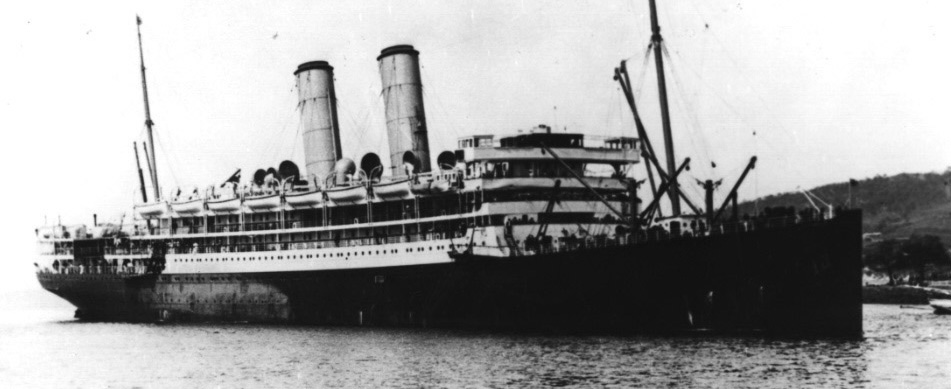
SS Otranto
Orient Line · 1909 · Ship Guide
Overview
SS Otranto was a large Orient Line liner built for the long England–Australia route in the years just before the First World War. She belonged to the imperial-route world of Mediterranean, Suez, Indian Ocean, and Australian service rather than the North Atlantic express-liner tradition, and her significance lies in that long-haul route context. Her peacetime passenger career was later eclipsed by a substantial wartime life as an armed merchant cruiser and troopship, ending catastrophically in 1918 after collision and wreck off the Scottish coast.
In collecting and interpretation, Otranto is best divided into three phases: prewar Orient Line passenger service, wartime armed merchant cruiser service, and wartime troop transport service. Material from those phases should be distinguished carefully rather than treated as a single undifferentiated ship identity.
Key Facts
Published passenger-capacity figures vary because sources describe the ship’s accommodations in different class breakdowns and because wartime troop numbers belong to a separate operational phase. For cataloging purposes, preserve the exact wording and service phase used by the source or artifact being cited.
Design & Construction Context
Otranto belonged to the long-distance imperial route system between Britain and Australia, a service world distinct from both the Atlantic speed race and shorter Mediterranean passenger trades. Her importance lies in sustained route service over vast distances through the Mediterranean and Suez Canal toward Australia. That context should shape interpretation more than Atlantic comparisons.
She was also part of an era in which major British and dominion passenger lines depended on large, steady, long-range ships with substantial passenger and mail responsibilities rather than pure record-breaking speed. In that sense, Otranto represents the practical grandeur of the prewar imperial liner network.
Service History (Summary)
1909: Built at Belfast by Workman, Clark & Co., Otranto was launched in March 1909, completed in July, and entered Orient Line service that October. She began work on the England–Australia route through the Mediterranean and Suez.
1909–1914 prewar service: In peacetime she served the long Australia run as a passenger liner in the Orient Line system. This is the correct context for passenger lists, brochures, menus, and route ephemera tied to her original commercial identity.
1914 requisition: Soon after the outbreak of the First World War, Otranto was requisitioned and converted into the armed merchant cruiser HMS Otranto. From this point onward, references to the ship increasingly belong to a naval and military framework rather than a civilian passenger one.
1914–1915 armed merchant cruiser phase: In her early wartime role she served in patrol and auxiliary naval duties. This phase should be treated separately from both her prewar passenger service and her later troopship role.
Later wartime troopship service: As the war continued, Otranto was used as a troop transport, carrying large numbers of servicemen across dangerous wartime sea lanes. In this period she became associated above all with the movement of troops rather than with passenger commerce.
6 October 1918: While carrying American troops in convoy off the west coast of Scotland, she collided with HMS Kashmir in heavy seas. Driven onto the rocky coast of Islay, she became a total wreck.
Loss and aftermath: The disaster caused heavy loss of life and became one of the more tragic troopship incidents of the later war period. Because the wreck followed both collision and grounding in severe conditions, the event should be interpreted as a compound disaster rather than a simple sinking narrative.
Launch, Wireless, and Prewar Identity
Otranto’s first launch attempt on 23 March 1909 failed after the lubricating tallow on the slipway froze; she moved only a short distance before stopping. After the ways were rebuilt she was successfully launched four days later, on 27 March. By 1913 she carried wireless telegraphy with call sign MOD, another useful dating clue for technical and communications material.
Commissioning as an Armed Merchant Cruiser
The Admiralty requisitioned Otranto on 4 August 1914 and commissioned her ten days later. That exact transition matters because civilian Orient Line documents and naval records can overlap closely around the opening weeks of the war. Once commissioned, her command, armament, pennant identity, and documentary trail belong to HMS Otranto.
Coronel, 1914
As an armed merchant cruiser, HMS Otranto was present with Rear Admiral Christopher Cradock’s force during the 1 November 1914 Battle of Coronel. She escaped the destruction that overtook Good Hope and Monmouth, giving the former liner a direct connection to one of the Royal Navy’s major early-war defeats.
The Mounsey Rescue
After the 1918 collision with Kashmir, destroyer HMS Mounsey came alongside in enormous seas despite the danger of being crushed against the much larger transport. U.S. Navy documentary history credits the rescue with removing roughly 300 American troops, 266 officers and crew of Otranto, 30 French sailors, and a YMCA worker before Mounsey withdrew for safety.
The rescue deserves to be treated as a distinct event within the disaster. It was not simply “lifeboat evacuation”: the weather prevented normal boat handling, and the destroyer repeatedly risked collision to take people directly from the liner.
The 6 October 1918 Disaster
In severe weather off Islay, Otranto collided with HMS Kashmir while both ships were carrying American troops. The destroyer HMS Mounsey came alongside in dangerous seas and removed hundreds before Otranto drifted onto the rocks and broke up.
Published casualty totals vary depending on whether they count American soldiers, British crew, French sailors, and later deaths separately. Contemporary U.S. naval reporting placed the American military death toll in the mid-360s, while modern memorial sources generally describe more than 400 total deaths. For exhibit labels, the chosen total should therefore be tied to its source rather than presented as universally fixed.
Why Otranto Matters
Otranto is important because her remembered end can easily erase the ship she had been built to be: a long-haul Australia-route liner. Her strongest interpretation keeps the prewar Orient Line, armed-merchant-cruiser, and troopship phases distinct while acknowledging the 1918 loss as one of the major U.S. overseas-transport disasters of the First World War.
Interpretive Notes
This is an Australia-route liner first: Otranto should be understood within the Orient Line’s England–Australia service system, not through North Atlantic assumptions.
Peacetime and wartime material belong to very different worlds: passenger brochures, class references, route ephemera, and commercial imagery belong to one interpretive frame, while armed merchant cruiser records, troopship documentation, and loss narratives belong to another.
The Islay disaster dominates memory, but not the whole career: because the 1918 wreck was so tragic, it can overshadow the ship’s earlier significance as a substantial prewar Orient liner. Both identities matter and should be kept in balance.
Route geography matters: references to London, Tilbury, Naples, Suez, and Australian ports help place artifacts and documents in the ship’s original operating world, which differed markedly from Atlantic passenger culture.
Evidence-first ship guideSources (Selected)
- Ocean Liner Curator — Sources (master bibliography)
- HMS Otranto — construction, service chronology, specifications, and loss bibliography
- U.S. Naval Institute Proceedings, November 1918 — contemporary Otranto casualty reporting
- Historic Environment Scotland — American Monument / Tuscania and Otranto commemoration
- Norway Heritage — SS Otranto passenger ship summary
- Wrecksite — Otranto wreck summary
- Clydeships / Belfast shipbuilding reference context for Otranto
- Naval History and Heritage Command — contemporary account of the HMS Mounsey rescue
- U.S. Naval Institute — Otranto, Coronel and 1918 loss context