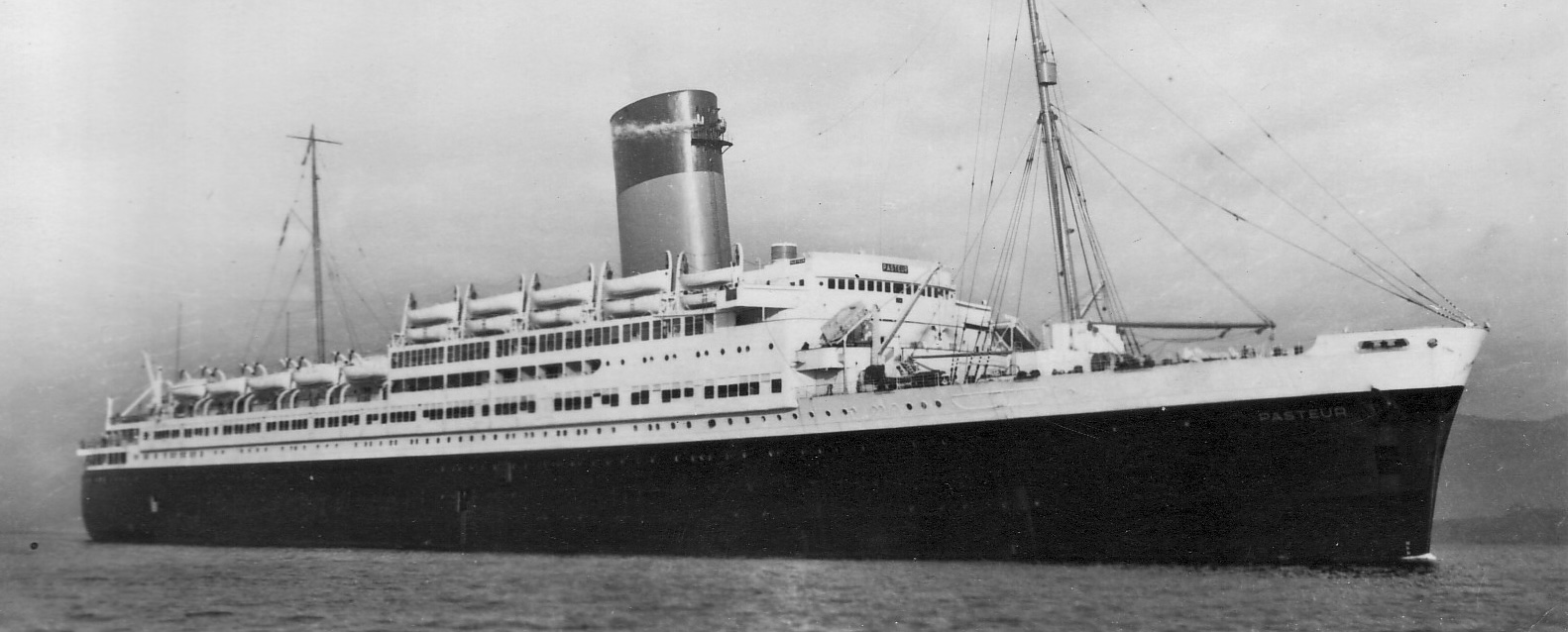
SS Pasteur
Compagnie de Navigation Sud-Atlantique · 1939 · Ship Guide
Overview
SS Pasteur was a large French liner built at Saint-Nazaire for the Compagnie de Navigation Sud-Atlantique and intended for the South America route. Launched in 1938 and completed in 1939, she entered history at exactly the wrong moment for a peacetime prestige career: war intervened before her planned civilian service could properly develop, and the ship spent much of her early life not as a luxury liner but as a troopship and hospital ship.
In collecting and interpretation, Pasteur is especially interesting because her identity fractures into several distinct phases: intended French South America liner, wartime British-controlled troop transport, postwar French troopship, German-owned Bremen, and later Regina Magna. Cataloging should follow the exact printed name and date on the artifact, not assume a single uninterrupted liner identity.
Key Facts
Pasteur is a ship for which tonnage, deck counts, speed claims, and even “type” vary by career stage. For museum-level precision, separate the original 1939 Pasteur from the extensively rebuilt Bremen of 1959 onward rather than silently blending their specifications.
Design & Construction Context
Pasteur was ordered as a modern French South America liner after the loss of L'Atlantique. She was conceived as a smaller but fast and prestigious replacement for that route, intended to compete with important interwar South Atlantic ships from other lines.
That matters interpretively because she is often remembered more for what happened after 1939 than for what she was built to do. In her original conception, Pasteur was a French prestige liner for the South Atlantic passenger market, not primarily a military transport. War interrupted that identity before it could fully establish itself in routine service, which gives the ship a slightly “counterfactual” place in liner history.
Service History (Summary)
1938–1939: Built at Saint-Nazaire and completed just before the outbreak of the Second World War. Although prepared for civilian liner use, her peacetime career was effectively overtaken by wartime demands almost immediately.
1940–1945: Entered British-controlled wartime service as a major troopship and, in some phases, hospital ship. She transported very large numbers of troops across multiple theaters and became one of the more significant Allied transport liners of the war.
Wartime significance: secondary summaries emphasize her exceptional mileage and troop totals during the war, underlining how completely her early identity shifted from luxury South America liner to high-capacity military transport.
1945–1956: Returned to French ownership but continued in major transport work, including the movement of troops connected with French postwar commitments. This phase is historically important but should not be mistaken for a straightforward return to prewar passenger-liner normality.
1957–1959: Sold to Norddeutscher Lloyd and renamed Bremen. She was then heavily rebuilt, enlarged, and modernized before re-entering passenger service in German ownership.
Later life: Continued under further names including Regina Magna, eventually passing into cruise, accommodation, and hotel-ship roles before her final loss under tow in 1980.
Interpretive Notes
Original intention versus actual service must be distinguished: a ship guide for Pasteur should preserve the fact that she was built as a French South America liner even though much of her fame rests on wartime and postwar transport service.
Name discipline is essential: artifacts marked Pasteur, Bremen, or Regina Magna belong to very different cultural and commercial settings. Same hull, very different historical context.
Specifications changed materially after rebuilding: seller language sometimes treats all technical figures as if they applied equally across the ship’s entire life. Curator practice should separate the original French ship from the rebuilt German vessel.
Wartime service can eclipse the liner identity: because the civilian career was interrupted so early, there is a tendency to remember Pasteur chiefly as a transport. That is understandable, but it should not erase the ship’s intended place within the interwar French liner world.
Evidence-first ship guideSources (Selected)
- Ocean Liner Curator — Sources (master bibliography)
- SS Pasteur — overview and broad chronology
- French-language Pasteur summary — launch, technical characteristics, and French context
- Simplon Postcards — Bremen / ex-Pasteur research lead
- Fakta om Fartyg — Pasteur / Bremen chronology and specifications (research aid)