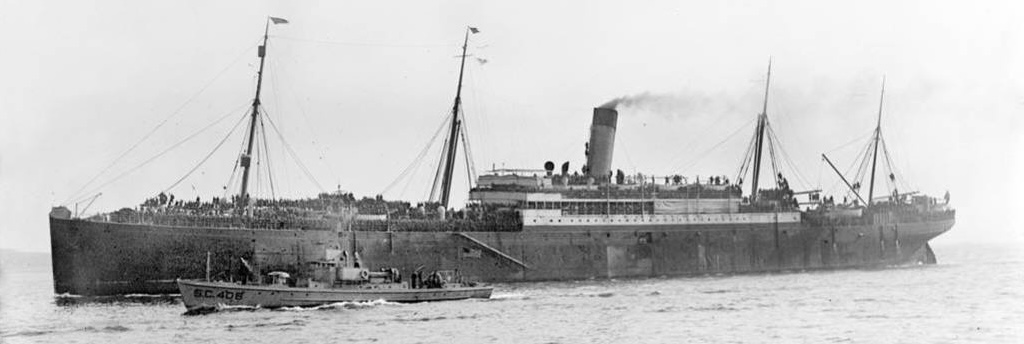
SS Patricia
Hamburg-Amerika Line · 1899 · Ship Guide
Overview
SS Patricia was a large German passenger and cargo liner built by AG Vulcan at Stettin for the Hamburg-Amerika Line. Launched in February 1899 and entering service that May, she was the fourth and final member of the company’s Pennsylvania class: a group of high-capacity steamships designed to carry freight, cabin travelers, and very large numbers of emigrants between Hamburg and New York.
Her significance lies less in speed or luxury than in the scale of her migration work. During the years before the First World War, Patricia became part of the routine machinery that carried thousands of Europeans toward North America. Rebuilt in 1910 with accommodation increasingly concentrated in second class and steerage, she remained active until wartime conditions ended her ordinary German service. In 1919 she was surrendered to the United States, used briefly as a naval troop transport, and then passed to British control.
This page treats Patricia as the Hamburg-Amerika Line liner launched in 1899. Other vessels have carried the name, so builder, date, dimensions, route, and operator should always be checked before attributing an image, document, or artifact.
Key Facts
Note on measurements: surviving summaries give several nearby tonnage figures. The ship was altered and remeasured during her career, so any figure should be retained with its date and documentary context.
Design & Construction Context
Patricia was the last completed member of HAPAG’s large P-class emigrant liners. Her single funnel, four masts, broad hull, and moderate speed reflected a design centered on carrying capacity and operating economy rather than express performance.
The ship was built to carry a mixed commercial load. A comparatively small number of cabin passengers occupied the more formal accommodation, while thousands of steerage travelers and substantial freight capacity supplied much of the vessel’s practical value.
Hamburg–New York Service
Patricia entered Hamburg–New York service in 1899. Her sailings generally included one or more Channel ports, with Boulogne, Plymouth, Southampton, or Cherbourg appearing in schedules at different times.
The route connected Hamburg’s emigrant infrastructure with New York’s immigration system. Rail travel, shipping agents, medical inspection, temporary lodging, baggage processing, and government documentation all surrounded the ocean passage itself.
Passenger & Migration Evidence
Passenger lists are among the most important sources for Patricia. They can preserve travelers’ names, ages, occupations, places of origin, relatives, intended destinations, and class of passage. Such records show the ship as an active carrier of individuals and families rather than merely a technical entry in a fleet register.
The documentary record should be read carefully. Names and place-names may appear in German, English, or phonetic forms, and later indexes can introduce transcription errors. Where identity matters, the original manifest image should take priority over a derivative database entry.
Life Aboard
Daily life differed sharply according to class. First- and second-class travelers received more private cabins and formal dining arrangements, while steerage passengers lived in denser communal accommodation shaped by cost, inspection rules, and the practical requirements of mass transport.
Surviving passenger information provides useful evidence of the shipboard routine. Meal times, baggage rules, medical requirements, deck access, and conduct regulations can reveal the structured nature of the crossing more directly than broad promotional descriptions.
Rebuilding in 1910
In 1910 Patricia was rebuilt and remeasured, with her gross tonnage rising to roughly 14,466 tons in compiled accounts. Her accommodation was altered to emphasize second class and steerage, commonly listed as about 408 second-class and 2,143 steerage berths.
The rebuilding marks an important divide in the ship’s documentary history. Capacity, tonnage, deck arrangement, and possibly visual details may differ between early and later records even though the ship’s name remained unchanged.
First World War
The outbreak of war in 1914 ended Patricia’s ordinary Hamburg–New York career. She remained under German control but did not resume normal passenger service to the United States.
After Germany’s defeat, the ship was surrendered to the United States as part of the redistribution of German merchant tonnage. This transfer changed her flag, administration, personnel, purpose, and documentary record.
USS Patricia
The United States Navy commissioned the former German liner as USS Patricia in March 1919. Assigned to troop-repatriation work, she made four voyages from France to the United States and returned a total of 8,865 servicemen.
Her naval career was brief but historically distinct. Official photographs and Navy records should be cataloged within this phase rather than treated as ordinary Hamburg-Amerika Line material simply because the ship retained her original name.
Fire Aboard, April 1919
During an April 1919 repatriation voyage, a HAPAG agent aboard the transport locked himself in a stateroom and started a fire by creating an electrical short circuit. Crew members forced entry, extinguished the fire, and detained him. The incident did not prevent Patricia from reaching Boston on 17 April with returning troops.
Assisting Graf Waldersee
On 11–12 June 1919, Patricia received the distress call from her damaged sister Graf Waldersee after that ship was rammed by Redondo. Patricia removed all passengers and about half the crew, then took the damaged transport in tow while salvage efforts developed.
This episode links the two P-class sisters in a way their ordinary HAPAG histories do not: both were former German emigrant liners temporarily serving the United States, and one became the rescue ship for the other.
Why Patricia Matters
Patricia matters because the majority experience aboard her was migration rather than luxury, yet her final months added a remarkably well documented troop-return phase. Her surviving archive can therefore be read from both ends of mass Atlantic movement: Europeans leaving for America before 1914 and American servicemen returning from Europe in 1919.
British Control & Disposal
USS Patricia was struck from the Naval Register in September 1919 and delivered for British use. She was operated under the British Shipping Controller, with Ellerman’s Wilson Line associated with her management during the postwar period.
The aging ship did not secure a lasting second commercial career. She was scrapped at Blyth in 1921, ending a working life of just over two decades.
Collecting Profile
Material associated with Patricia may include passenger lists, HAPAG schedules, postcards, photographs, menus, passenger-information booklets, immigration papers, and U.S. Navy records. Images of emigrants gathered on her decks are especially important because they preserve evidence of the ship’s majority passenger population.
Attribution should not rest on the name alone. The ship’s single-funnel, four-masted P-class profile closely resembled her sisters, and unrelated vessels also carried the name Patricia. A reliable identification should use a caption, date, route, operator, or comparison with securely identified photographs.
Interpretive Notes
Patricia is a useful corrective to ocean-liner histories dominated by speed records and elite interiors. Her principal importance was the movement of people on a very large scale. Thousands experienced her as a temporary living environment during one of the most consequential transitions of their lives.
Her final career also shows how the First World War reordered the Atlantic fleet. A liner built to transport European emigrants under the German flag ended as an American troop-repatriation ship and a British-controlled asset before being dismantled.
Evidence-first ship guideSources (Selected)
This list is intentionally conservative.
- Ocean Liner Curator — Sources (master bibliography)
- Norway Heritage — S/S Patricia, Hamburg America Line
- Naval History and Heritage Command — USS Patricia
- Shipscribe — USS Patricia, 1919
- GG Archives — SS Patricia archival collection
- GG Archives — SS Patricia immigrant-ship collection
- FamilySearch — Hamburg Passenger Lists research guide