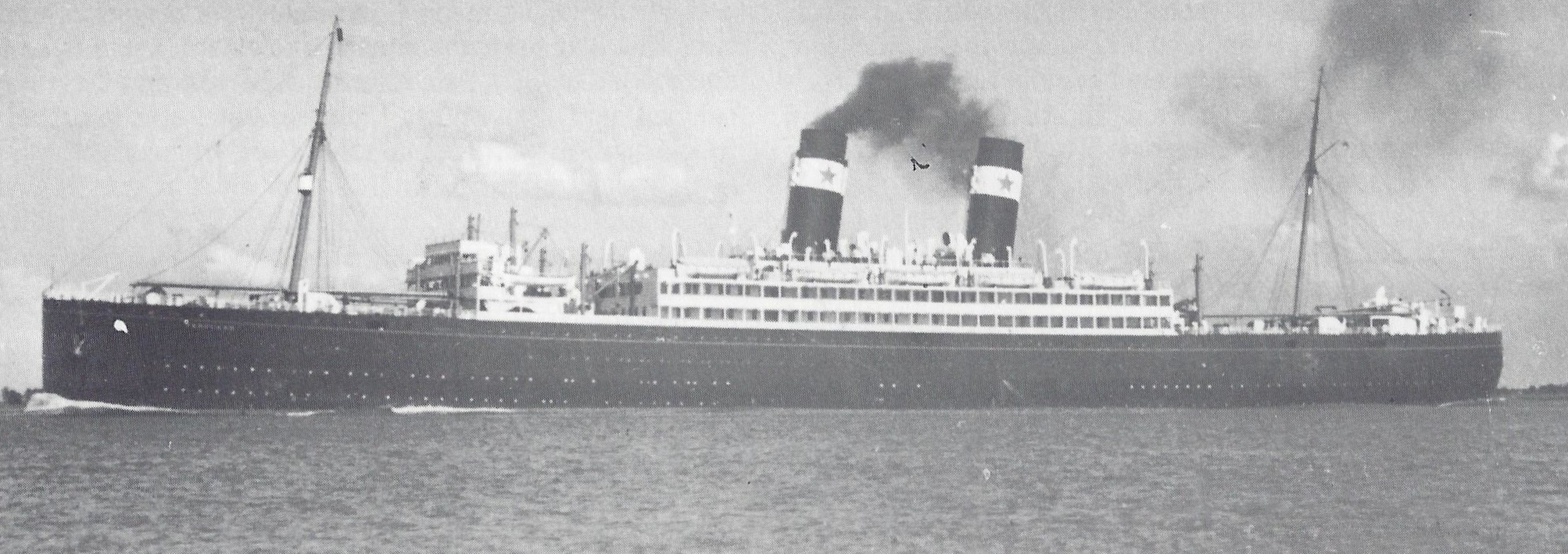
SS Pennland
Launched as Pittsburgh · 1920 · Pennland from 1926 · Ship Guide
Overview
SS Pennland began life as Pittsburgh, a passenger liner laid down by Harland & Wolff at Belfast in November 1913 for International Navigation Company interests. The First World War halted construction before launch; work resumed after the conflict and the ship was finally launched on 11 November 1920 as yard no. 457. She entered service in 1922.
Her career crossed several corporate identities. White Star Line was her first operator, Red Star Line gave her the name Pennland in 1926, and ownership later passed through Leyland, Arnold Bernstein's Red Star interests, and Holland America Line. In 1940 she became a troopship. German air attack crippled her off Greece on 25 April 1941, after which HMS Griffin sank the abandoned vessel by gunfire.
Key Facts
An Interrupted Prewar Design
Pittsburgh is a good example of a ship whose design generation and service generation do not neatly match. Conceived before the First World War, she entered commercial service nearly a decade later into a changed passenger market. Her machinery combined proven reciprocating engines with an exhaust-steam turbine driving a center propeller, an arrangement related to the combination system used on several prominent prewar liners.
As built, the ship also carried refrigerated cargo space and large third-class accommodation. She was therefore not simply a cabin-passenger vessel: migration traffic and freight remained central to the economics of the ship.
Pittsburgh in White Star Service
White Star Line operated Pittsburgh when she entered service on 6 June 1922, initially from Liverpool to Boston and Philadelphia. Later that year her route shifted to Bremen–Southampton–Halifax–New York, with Hamburg replacing Bremen as the German terminus in 1923.
Her early career included dramatic incidents. In November 1922 she rescued the crew of the Italian steamer Monte Grappa. In March 1923 a huge Atlantic wave wrecked portions of her bridge and wheelhouse, damaged navigation equipment, and injured Captain Thomas Jones and a crew member before the ship safely reached Europe.
Pennland and Red Star Line
The ship was renamed Pennland in 1926 to match Red Star Line's “-land” naming convention. By 1928 she was serving the Antwerp–Southampton–Cherbourg–New York route. Her near-sister SS Westernland, formerly Regina, later joined the same service.
Corporate ownership changed repeatedly during the Depression. Arnold Bernstein acquired Red Star operations in the mid-1930s and had Pennland refitted at Kiel in 1935 as a one-class tourist ship. After Bernstein's businesses were dismantled under Nazi persecution, Holland America Line acquired the Red Star fleet in 1939 and registered Pennland in Rotterdam.
Troopship Service
After the German invasion of the Low Countries in 1940, normal liner service ended. The British Ministry of War Transport chartered Pennland and converted her into a troopship. Her wartime voyages carried forces across the Atlantic, to West Africa, the Mediterranean, and ultimately toward Greece.
On 25 April 1941, during the Allied evacuation from Greece, German dive-bombers attacked Pennland in the Saronic Gulf. Bomb damage wrecked the engine room, punctured the hull, smashed navigation equipment, wounded the master, and killed four crew members. After abandonment, escorting destroyer HMS Griffin sank the disabled liner by gunfire.
Interpretive Notes
Operator and owner are not interchangeable: the ship could be White Star-operated, Red Star-branded, German- or Dutch-registered, and owned by another company at different points. Date the artifact before assigning corporate identity.
The 1935 refit matters: passenger capacity and accommodation descriptions differ because the ship's layout changed substantially.
Use the correct sister relationship: Westernland shared the interrupted-build lineage and similar machinery; Doric belonged to the same broad group but differed technically.
Evidence-first ship guide