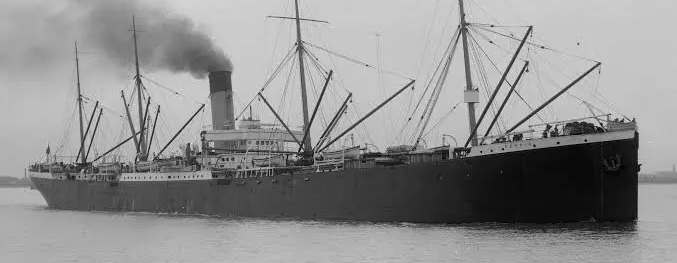
SS Persic
White Star Line · entered service 1899 · Ship Guide
Overview
SS Persic was a Jubilee-class White Star cargo-passenger liner built by Harland & Wolff for the Australia trade. Launched on 7 September 1899 and entering service late that year, she combined substantial cargo capacity with passenger accommodation on the Liverpool–Cape Town–Australia route.
Her career shows why White Star cannot be understood only through its Atlantic express ships. Persic was a practical long-haul liner whose history joined migration, refrigerated trade, military transport and ordinary scheduled service in one vessel.
Key Facts
A Working White Star Liner
The Jubilee ships were designed around commercial utility. Refrigerated cargo, wool, general freight and passengers all mattered to the economics of the route. Their moderate speed was therefore not a shortcoming but part of a different operating logic from the prestige North Atlantic run.
Surviving documents also require care with passenger terminology. White Star's 1907 promotional literature described the Australia service as carrying one class, while other surviving documents can use different labels. The safest curatorial practice is to preserve the terminology of the particular source and date rather than normalize everything into one later classification scheme.
Service History
1899–1900: Persic entered service during the South African War period. Her early career included troop-carrying context and a serious rudder-stock problem that caused delay at Cape Town, illustrating how quickly a commercial voyage could intersect with both military and mechanical demands.
1900s–1914: She settled into the Australia service, carrying passengers and freight across the long route. This steady work, rather than any single headline event, formed the core of her peacetime identity.
First World War: Persic served in transport roles under Australian and British wartime arrangements. In 1918 she was torpedoed while carrying troops but remained afloat and was brought to safety. The survival is especially important because it allowed the ship to return to civilian work rather than ending her story in wartime loss.
Postwar: After repair and refit, Persic resumed commercial service to Australia. By the mid-1920s machinery wear made continued operation uneconomic; she was withdrawn in 1926 and scrapped the following year.
Interpretive Notes
Persic is best read as part of a transport system rather than as an isolated ship. Her route linked Britain, southern Africa and Australia; her cargo spaces connected agricultural production to British markets; and her passenger work formed part of migration and imperial mobility.
Wartime survival is also central to her identity. Unlike ships whose military service culminated in destruction, Persic crossed back into peacetime service, so wartime and civilian records should remain distinct but connected phases of the same career.
Collecting & Attribution Context
For Persic, the most useful attribution clues are date, route and service phase. Peacetime passenger contracts and promotional pieces belong to the Australia trade; military references belong to wartime transport use; postwar material again reflects civilian operation. Those contexts can overlap in a long career, but they should not be collapsed into a single generic description.
The surviving 1910 passage-contract evidence is particularly instructive because it demonstrates how documentary terminology can differ from broad company advertising. Rather than treating one source as automatically correcting another, the better approach is to identify what each document was doing, for whom, and at what date.
Why Persic Matters
Persic offers a compact history of the working liner as infrastructure. She moved people, food, raw materials and, in wartime, troops. None of those functions was incidental. Together they show how a liner could be both a passenger environment and a piece of a much larger logistical network.
Her 1918 survival also gives the career an unusual continuity. The torpedoing did not become the vessel's endpoint; it became one episode within a longer service life. That distinction matters when interpreting photographs or documents produced after the war, because they belong to a ship that had passed through a major wartime event and then resumed commercial work.
That ordinary continuity also helps explain why Persic deserves space in a reference archive. Her story is not dependent on fame: it is the accumulation of scheduled voyages, cargo work, passenger movement, wartime service, damage, repair and return. Taken together, those stages preserve the operating history of a route that was economically important even when it attracted far less publicity than White Star's Atlantic service.
Evidence-first ship guide