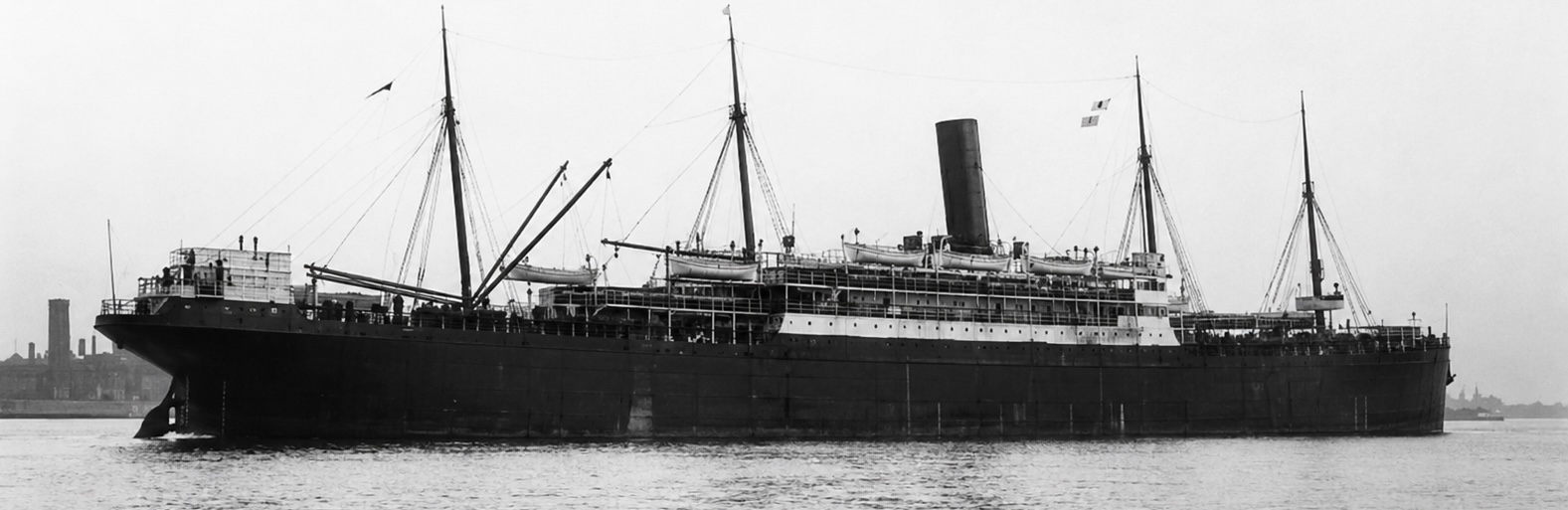
SS Poland
Dominion Line · 1902 · Ship Guide
Overview
SS Poland was a British-built passenger and cargo steamship whose long career unfolded under several names and operating arrangements. Constructed in 1897 at West Hartlepool by Furness, Withy & Co., she was launched as Victoria for the Wilson’s & Furness-Leyland Line. She became Manitou in 1898 and entered service for the Atlantic Transport Line before later employment by the Red Star Line.
The name Poland was adopted in 1920. During the final phase of her career she was associated first with Red Star Line and then, from 1922, with White Star Line management. Her history is therefore best understood not as the story of a purpose-built flagship, but as an example of how useful passenger-cargo ships circulated among related companies, routes, and fleet identities.
This page treats Poland as the 1897 Furness, Withy-built vessel formerly named Victoria and Manitou. Other vessels and records may use the name “Poland,” so builder, dimensions, former names, operator, and date should be checked before attribution.
Key Facts
Tonnage figures can vary with date, alteration, and measurement system. A variant figure should be read alongside the name and year under which it was recorded.
Design & Construction Context
Built at the end of the nineteenth century, the vessel that became Poland belonged to the large intermediate type of Atlantic passenger-cargo steamship. She was substantial enough for regular ocean service but was not designed as an elite express liner competing for speed records or prestige. Her commercial value lay in flexible capacity, cargo carriage, and dependable operation.
Her proportions and mixed-use career reflect an Atlantic system populated by many ships that occupied the space between freighter and luxury liner. Such vessels carried migrants, ordinary travelers, goods, and mail while supporting the broader route networks maintained by the major shipping groups.
As Victoria and Manitou
The ship was launched as Victoria in 1897 for the Wilson’s & Furness-Leyland Line. In 1898 she was renamed Manitou for Atlantic Transport Line service. Because that change occurred very early in her life, photographs, manifests, advertisements, and technical references from most of her career are more likely to identify her as Manitou than as Poland.
From 1902 through 1914 she served under Red Star Line operation, notably on the Antwerp–Philadelphia route. This was an important migration and commercial corridor, and passenger records connected with Manitou preserve much of the ship’s documented human history.
War and Postwar Transition
The First World War disrupted the normal commercial patterns of nearly every Atlantic company. Ships were requisitioned, reassigned, adapted, or held away from their prewar routes. The vessel’s postwar return to civilian use culminated in her renaming as Poland in 1920.
The new name placed her within Red Star Line’s familiar “-land” naming tradition. By then she was already more than two decades old, and her continued employment illustrates both the shortage of usable passenger tonnage after the war and the value of serviceable older ships during the reconstruction of transatlantic schedules.
Service as Poland
Under the name Poland, the ship occupied a relatively brief final chapter. She remained associated with Red Star Line before transfer to White Star Line in 1922. The corporate relationships among Red Star, White Star, Atlantic Transport, and other International Mercantile Marine interests allowed ships to move across nominal fleet boundaries as commercial requirements changed.
Her White Star connection should therefore be described accurately but not overstated. She was not conceived as a White Star flagship and did not belong to the company’s celebrated purpose-built liner classes. Her transfer instead demonstrates the practical management of available tonnage within a larger shipping combine.
Migration and Passenger-List Evidence
Passenger manifests are especially important for studying this ship because her successive names divide the documentary record. A traveler who sailed aboard her in 1905 would appear under Manitou, while an early-1920s traveler could appear under Poland. Searching only one name risks missing most of the vessel’s career.
Researchers should preserve the departure port, arrival port, sailing date, master, and line designation recorded in each source. These details help distinguish genuine records from unrelated ships and can reveal whether the vessel was being operated directly by one company or deployed through a related corporate arrangement.
Collecting Profile
Material associated with Poland may include passenger lists, immigration records, sailing notices, postcards, photographs, company timetables, and documents carrying Red Star or White Star branding. Items bearing the earlier name Manitou may be more common because the ship carried that name for most of her active life.
A photograph labeled only “SS Poland” should be compared with known views of Manitou and the ship’s documented profile. Likewise, a generic Red Star or White Star item cannot be tied to this vessel merely because it dates from the correct period. Strong attribution requires the ship’s name, a specific voyage, a passenger or crew connection, or a traceable documentary history.
Manitou and the Red Star Years
The ship spent most of her working life not as Poland but as Manitou. After her 1898 acquisition by the Atlantic Transport Line, she became part of that company's mixed passenger-and-cargo fleet. From 1902 she was deployed for Red Star Line service, particularly on the Antwerp–Philadelphia route, connecting continental European migration traffic with a major American port outside New York.
This phase is central to identifying surviving material. A large proportion of manifests, photographs, and advertisements belonging to the hull will be filed under Manitou, while the later name Poland represents only the final few years of a career already more than two decades old.
First World War Transport Service
Wartime use further disrupted the ship's commercial identity. Manitou carried Canadian troops early in the conflict and was formally requisitioned for transport work from 1915. Her military employment included Mediterranean operations associated with the Dardanelles campaign, and surviving summaries record several encounters in which the ship avoided enemy attack.
The return to civilian service therefore required more than simply restarting an old schedule. The vessel was refitted after the war and renamed Poland in 1920, entering a postwar Atlantic market in which older but serviceable tonnage remained valuable while fleets were being rebuilt.
White Star Service and Final Disposal
After transfer to White Star management in 1922, Poland served routes including Bremen–Southampton–Quebec–Montreal. Her White Star period was short and operational rather than prestigious; she was an elderly intermediate liner used where available tonnage was commercially useful.
The ship was sold in 1925, briefly receiving the name Natale, and was broken up in Italy. The sequence Victoria → Manitou → Poland → Natale is a reminder that corporate and national labels can obscure the continuity of a single hull across almost three decades.
Interpretive Notes
Poland is historically useful because her identity crossed several company boundaries. Her career complicates the tendency to treat each shipping line as a fixed and self-contained fleet. In practice, ownership, chartering, management, and corporate affiliation could place one hull within several different line histories.
She also shows why former names are essential evidence. The name Poland represents only the closing years of a vessel whose longer story was written as Victoria and especially Manitou. A complete interpretation must follow the ship herself rather than stopping at the name painted on her hull during one phase.
Evidence-first ship guideSources (Selected)
This list is intentionally conservative.
- Ocean Liner Curator — Sources (master bibliography)
- Norway Heritage — S/S Poland, Red Star Line
- Norway Heritage — S/S Poland, White Star Line
- Heritage Ships — SS Poland identity summary
- The National Archives — Passenger lists research guide
- Norway Heritage — SS Poland / Manitou chronology
- GG Archives — Atlantic Transport Line fleet list