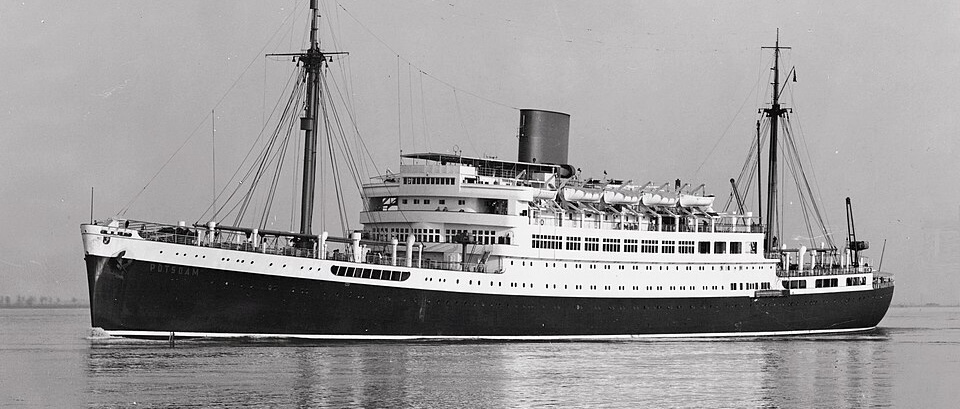
SS Potsdam (1935)
Norddeutscher Lloyd · Bremen–East Asia · Ship Guide
Overview
SS Potsdam was a fast passenger-and-cargo liner completed by Blohm & Voss in 1935 for Norddeutscher Lloyd's modernized East Asia service. Originally ordered by Hamburg-Amerika Linie, she passed to NDL before entering service as German shipping interests reorganized their route responsibilities.
Her importance extends beyond route history. Potsdam combined Benson once-through high-pressure boilers with turbo-electric propulsion, making her one of the most technically ambitious merchant ships of her generation. After the Second World War she became the British troopship Empire Fowey, and later the Pakistani pilgrim carrier Safina-E-Hujjaj, remaining in service until the 1970s.
Key Facts
Built for a Reorganized German East Asia Service
Potsdam began as a HAPAG project, but a reorganization of German overseas routes transferred her to Norddeutscher Lloyd before completion. She joined Scharnhorst and Gneisenau in the accelerated East Asia service, reducing journey times between Germany and the Far East.
The three ships are frequently discussed together, but Potsdam was not simply another unit of one standardized class. They were deliberately different in hull form and machinery, allowing German designers and operators to compare competing technical solutions in actual long-distance service.
Benson Boilers and Turbo-Electric Propulsion
Potsdam's machinery was her most distinctive feature. Four very high-pressure Benson once-through boilers supplied steam to turbines driving electrical generators; electric motors then turned the two propeller shafts. Contemporary technical literature emphasized the installation as a major experiment in merchant propulsion.
The arrangement offered engineering advantages but also introduced complexity. The ship therefore belongs to a wider interwar search for more efficient propulsion systems rather than to a simple evolutionary line from reciprocating engines to conventional geared turbines.
The East Asia Route
Her maiden voyage began on 5 July 1935. The route connected northern Europe with Mediterranean ports and then continued through the Suez Canal toward Colombo, East Asia, Shanghai, and Japan. Contemporary schedules and reports show Potsdam operating as part of NDL's attempt to make the Far East service substantially faster than earlier German passenger-cargo ships.
Her 17,500-ton scale and relatively modest passenger complement reflect that role. She was not conceived as a North Atlantic floating hotel; she combined passenger accommodations with significant cargo capacity for a long commercial route.
Not a Sister of Scharnhorst and Gneisenau
Potsdam, Scharnhorst, and Gneisenau are sometimes grouped as if they were sisters because they entered the same service at roughly the same time. Contemporary technical discussion makes the opposite point: their differing hull forms and machinery were part of the comparison.
This distinction is especially useful for photographs and technical ephemera. Similar route, operator, and general silhouette do not establish identical design. Builder, machinery arrangement, bow form, and plans are stronger evidence.
Second World War
When war began in September 1939, Potsdam was away from Germany and returned by a route around northern Scotland. During the war she was used primarily as an accommodation ship at German-controlled ports rather than resuming regular passenger service.
Plans were considered in 1942 to convert her for aircraft-carrier use, but no completed carrier conversion followed. In the final phase of the war she participated in the evacuation of people from Germany's eastern territories as the Soviet advance transformed the Baltic into a major evacuation route.
British War Prize and Empire Fowey
British authorities took possession of Potsdam in June 1945. The ship was initially named Empire Jewel and then Empire Fowey. Her original high-pressure machinery proved troublesome in postwar British service, and she underwent major reconstruction with replacement boilers and turbines before returning as a troopship.
That rebuild substantially changed the engineering character that had made the 1935 ship notable. Researchers should therefore avoid assuming that machinery data from the NDL period apply unchanged to photographs, manuals, or records from the later British troopship.
Safina-E-Hujjaj and the Pilgrim Trade
In 1960 the former German liner was sold to Pakistani interests and renamed Safina-E-Hujjaj. She entered the pilgrim trade, carrying travelers connected with the Hajj and giving the hull a third major commercial identity after German liner service and British military transport.
The ship's survival into the 1970s is striking for a vessel whose original machinery had been considered unusually advanced in 1935. She was finally withdrawn and scrapped at Gadani in 1976.
Why Potsdam Matters
Potsdam is a useful counterpoint to better-known German prestige liners. Her significance lies not in North Atlantic size records but in the technically ambitious modernization of long-distance East Asia service and in the attempt to test new propulsion systems under demanding commercial conditions.
Her later lives also make her valuable for tracing the reuse of passenger ships after political rupture. A vessel designed under the German shipping reorganization of the 1930s later served British troop movements and Pakistani religious travel, with major engineering changes along the way.
Interpretive Notes
Do not confuse her with Holland America's Potsdam: the 1900 Rotterdam–New York liner was a different ship. This guide concerns the 1935 vessel built by Blohm & Voss as yard no. 497.
The East Asia trio were not true sisters: Scharnhorst, Gneisenau, and Potsdam shared a service concept but differed materially in design and machinery.
Postwar specifications changed: the extensive British rebuild means later Empire Fowey technical data should not automatically be projected backward onto the original NDL configuration.
Evidence-first ship guideSources (Selected)
- Ocean Liner Curator — Sources (master bibliography)
- GG Archives — North German Lloyd fleet list
- Simplon Postcards — Norddeutscher Lloyd, Potsdam and later Empire Fowey
- Wilhelm Plöger, “Deutsche Schnelldampfer im Ostasiendienst” (1935)
- Niedersächsisches Landesarchiv — Norddeutscher Lloyd archival holdings, including Potsdam