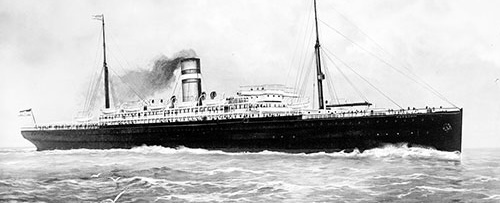
SS Potsdam (1900)
Holland America Line · Rotterdam–New York · Ship Guide
Overview
SS Potsdam was one of Holland America Line's most important turn-of-the-century passenger liners. Built by Blohm & Voss at Hamburg, she was launched in December 1899 and entered Rotterdam–New York service in May 1900.
At more than 12,500 gross tons, Potsdam represented a major increase in scale for the Dutch line. She combined substantial first- and second-class accommodation with very large third-class capacity, reflecting the dual importance of cabin travel and mass emigration on the North Atlantic.
Key Facts
A New Scale for Holland America Line
Potsdam was among the largest ships yet built for Holland America when she entered service. Contemporary Dutch reporting emphasized her scale, machinery, passenger accommodations, cargo capacity, and safety equipment, presenting her as a major step forward for the national merchant fleet.
Her importance was not based on extreme speed. A service speed of about 15 knots was adequate for reliable scheduled crossings, while her size allowed Holland America to carry large numbers of emigrants as well as cabin passengers and freight.
Rotterdam–New York Service
From May 1900, Potsdam worked the Rotterdam–New York route, commonly calling at Boulogne-sur-Mer. Surviving passenger lists document her continued use on this service through the years before the First World War.
The ship's accommodation figures vary by source and date, but the pattern is consistent: several hundred first- and second-class berths were paired with a much larger third-class capacity. This made her representative of the migration-centered economics that underpinned much of Holland America's North Atlantic business.
Modernization and Fleet Context
Potsdam remained an important Holland America vessel as newer ships joined the fleet. By 1915 she appeared alongside Rotterdam, Nieuw Amsterdam, Noordam, and Rijndam in company fleet material.
Her relationship with Rijndam and Noordam is especially useful for the archive. All three belonged to the same broad early-twentieth-century Holland America expansion and shared similar dimensions, machinery, route purpose, and passenger-market strategy.
Sale to Sweden and Stockholm
Holland America sold Potsdam in 1915 to Swedish interests. Renamed Stockholm, she entered Gothenburg–New York service in December that year and became part of the developing Swedish American Line story.
Her long useful life continued well beyond her original Dutch career. The ship was later converted to oil firing and remained in Swedish passenger service until the late 1920s.
Conversion to Solglimt
In 1928 the former liner was sold to Norwegian whaling interests and converted into a whale factory ship. Renamed Solglimt in 1929, she entered a radically different industrial role far removed from her earlier passenger service.
This transformation is an important reminder that older liners were often adapted rather than immediately scrapped. Their hull volume and machinery made some suitable for industrial conversion even after passenger service was no longer economical.
War, Capture, and Final Loss
German auxiliary cruiser Pinguin captured Solglimt in Antarctic waters in January 1941. The vessel was taken to occupied France and entered German service under the name Sonderburg.
After wartime damage and salvage, the ship was ultimately scuttled as a blockship near Cherbourg in 1944. The wreck was raised after the war and broken up, ending a career that had stretched from Dutch passenger service to Swedish emigration traffic, Norwegian whaling, and wartime auxiliary use.
Why Potsdam Matters
Potsdam illustrates Holland America Line's transition into the era of large modern passenger steamers before the First World War. She combined national prestige with the practical economics of emigration, freight, and reliable scheduled service.
Her later career is equally revealing. Few ships moved through so many distinct identities: Dutch liner, Swedish immigrant ship, Norwegian whale factory ship, captured wartime vessel, and finally blockship. That continuity makes her unusually valuable for tracing how large passenger ships were reused across changing commercial and political worlds.
Interpretive Notes
Launch and service years differ: Potsdam was launched in 1899 but completed and entered passenger service in 1900. This guide uses 1900 in the title because it marks her active Holland America service identity.
Passenger-capacity figures vary: contemporary descriptions and later fleet summaries give different third-class totals, likely reflecting differing configurations and whether temporary accommodation was counted.
Later names should not be treated as separate ships: Stockholm, Solglimt, and Sonderburg were successive identities of the same vessel.
Evidence-first ship guide