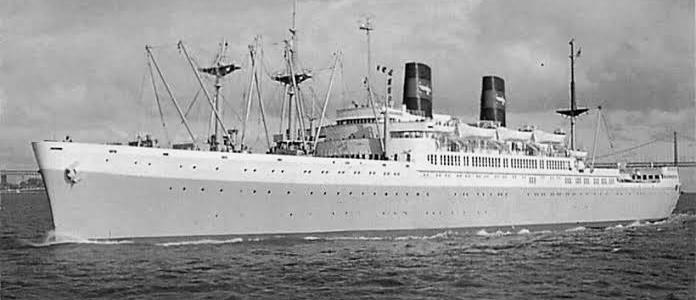
SS President Cleveland (1947)
American President Lines · completed 1947 · Ship Guide
Overview
SS President Cleveland was one of two postwar American President Lines passenger flagships converted from uncompleted U.S. wartime transport projects. Built in Alameda, California, she was launched in 1946 and entered commercial service in 1947 on routes connecting the U.S. West Coast with Pacific and Asian ports.
Together with sister President Wilson, she illustrates the government's role in the U.S. merchant marine, the persistence of ship-based international travel after the Second World War, and the distinct geography of the transpacific liner trade.
Key Facts
From Military Design to Civilian Liner
The vessel was laid down in August 1944 as a planned Admiral-class naval transport, originally designated Admiral D. W. Taylor (AP-128). The naval construction project was cancelled and the hull was completed instead as a commercial passenger ship. Planned naval identity does not constitute a commissioned U.S. Navy career.
Contemporary trade reporting described final work at Bethlehem-Alameda in May 1947. The ship's eventual passenger role blended substantial cargo capacity with accommodations for long-distance Pacific travel.
The Transpacific Route
American President Lines advertised a route from San Francisco and Los Angeles across the Pacific via Honolulu to Yokohama, Kobe, Shanghai, Hong Kong, and Manila. Such schedules brought together leisure travelers, returning residents, international business, and trade across a network of multiple ports rather than a single point-to-point Atlantic crossing.
The Online Archive of California's description of the American President Lines records identifies President Cleveland and President Wilson as its two principal postwar passenger flagships, with each able to carry approximately 550 passengers and substantial cargo.
Passenger Classes and Documentary Context
A 1949 U.S. General Accounting Office decision discussing passage aboard the sisters describes complicated first-class, tourist-class, and third-class categories. The episode makes it important not to reduce all historical accommodation labels to a single unchanging passenger figure.
Collector material—fare tables, tickets, deck plans, advertisements, and passenger lists—should be dated to the particular voyage or administrative arrangement. The ship's public image as a modern postwar liner coexisted with government charter and fare-class regulation.
Charter, Sale, and Retirement
APL initially operated the liner under charter from the U.S. government. A 1958 federal court record specifies a December 1947 delivery, charter arrangements, and the eventual redelivery and sale framework in 1954. This differs from implying that the company owned the ship outright for her entire career.
The APL archival finding aid records that President Cleveland reached her statutory retirement age late in 1972, while sister President Wilson made a final round-the-world voyage in April 1973. Together their retirement marked the end of a long APL transpacific passenger-service tradition.
Oriental President and the End of Her Career
Sold in February 1973, President Cleveland was subsequently renamed Oriental President and registered under Panama. She was scrapped at Kaohsiung, Taiwan, in 1974.
Photographs and memorabilia from this final ownership period should not automatically be attributed to the American President Lines era: the original ship and its subsequent commercial identity are related but distinct documentary contexts.
Interpretive Notes
Multiple historical identities: the wartime transport name was proposed, whereas President Cleveland and later Oriental President were actual merchant-ship names.
Do not conflate launching, completion, and passenger service: the ship was launched in 1946, completed in 1947, and operated during the postwar commercial era.
Passenger totals are configuration-dependent: period APL descriptions cite approximately 550 passengers; other published figures should be compared against dated deck plans.
Shipping policy matters: understanding the vessel's U.S. government construction and subsequent charter helps explain why these two related ships became flagship postwar liners.
Evidence-first ship guideRelated Guides
See companion SS President Wilson (1948) for the other APL flagship completed from the wartime transport program.
Sources (Selected)
- Ocean Liner Curator — Sources (master bibliography)
- Online Archive of California — American President Lines Records, 1871–1995
- U.S. GAO — 1949 passenger classification decision concerning both sister ships
- American President Lines v. United States (1958) — charter and delivery chronology
- U.S. Naval Institute Proceedings (August 1947) — contemporary trade report
- SS President Cleveland (1947) — secondary chronology and post-APL service