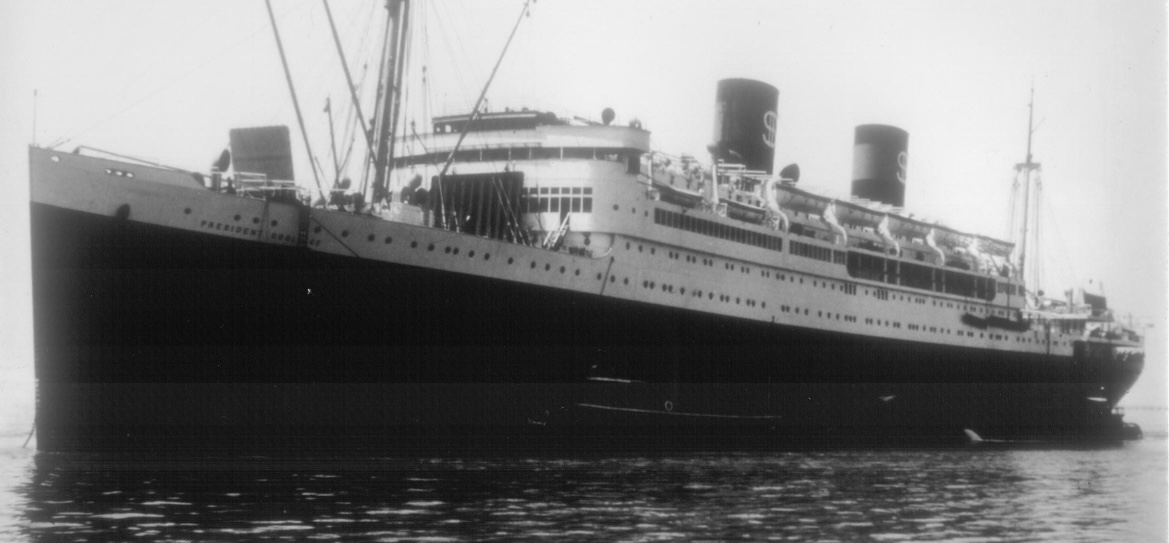
SS President Coolidge
Dollar Steamship Line · 1931 · Ship Guide
Overview
SS President Coolidge was a large American trans-Pacific liner built for the Dollar Steamship Line and later operated by American President Lines. Together with her near-sister President Hoover, she represented the high-water mark of the company’s interwar Pacific passenger service, combining modern machinery, substantial scale, and a route system linking the U.S. West Coast with Hawaii, East Asia, and the Philippines. Her career later shifted dramatically from luxury liner to wartime troopship, and it is in that latter role that she became one of the most famous wrecks in the Pacific.
In collecting and interpretation, President Coolidge is a ship of two very different identities: a refined interwar Pacific liner in peacetime, and a major U.S. troop transport in wartime. Objects from those two phases should be distinguished carefully rather than treated as a single undifferentiated service life.
Key Facts
Some sources present passenger totals differently because the ship’s peacetime accommodations were altered over time, and wartime troop totals belong to a completely different operational phase. For cataloging purposes, preserve the exact figures and wording used by the specific source or artifact being cited.
Design & Construction Context
President Coolidge was built at the height of Dollar Steamship Line ambition, when the company sought to maintain a prestigious and modern American presence on Pacific passenger routes. Her scale, propulsion system, and route role made her one of the most important American-built liners of her day outside the Atlantic sphere. In design terms, she belongs to the world of long-distance Pacific travel rather than Atlantic speed competition.
This distinction matters interpretively. The ship’s significance lies in the geography of American Pacific commerce and passenger travel: San Francisco, Honolulu, East Asia, and Manila. Even in peacetime, her cultural setting was quite different from that of the more commonly remembered North Atlantic liners.
Service History (Summary)
1929–1931: Ordered in late 1929, laid down in 1930, launched in February 1931, and delivered in October 1931 for Dollar Steamship Line service. She entered the Pacific passenger trade as one of the largest and most technically advanced American merchant ships then afloat.
1930s peacetime service: Operated on the company’s trans-Pacific routes from San Francisco, serving ports such as Kobe, Shanghai, and Manila. During this period she represented the premium end of interwar American Pacific passenger travel.
Corporate transition: As the Dollar organization weakened financially, the broader system passed into American President Lines control. President Coolidge continued in service through that transition, making her a useful vessel for tracking continuity between the two operating identities.
1940–1941: Assisted in evacuation work as the East Asian political situation deteriorated. With war approaching, she increasingly served military and strategic transport needs even before full wartime conversion.
1941–1942 wartime service: Converted into a troopship and used in Pacific military transport after the outbreak of war. In this phase she carried very large troop contingents and matériel, becoming one of the more important American troop transports in the theater.
26 October 1942: On approaching Espiritu Santo, she entered mined waters after safe-entry information had been omitted from her sailing orders. After striking mines, she was deliberately beached; most aboard got ashore safely, but the ship became a total loss.
Interpretive Notes
This is a Pacific liner first: President Coolidge should be understood within the American trans-Pacific route system, not through the categories usually applied to Atlantic liners.
Peacetime and wartime material are fundamentally different: passenger ephemera, route brochures, and cabin-class references belong to one interpretive world, while troopship records, military cargo references, and loss narratives belong to another.
The wreck dominates memory, but not the whole career: because the ship’s loss was so dramatic and because the wreck later became famous in its own right, it is easy to let the 1942 disaster eclipse her earlier significance as one of the leading American Pacific liners of the interwar period.
Evidence-first ship guideSources (Selected)
- Ocean Liner Curator — Sources (master bibliography)
- SS President Coolidge — overview chronology, specifications, and wartime loss
- U.S. National Archives — The sinking of SS President Coolidge
- Herbert Hoover Presidential Library — contextual article on SS President Hoover and SS President Coolidge
- American President Lines — corporate context