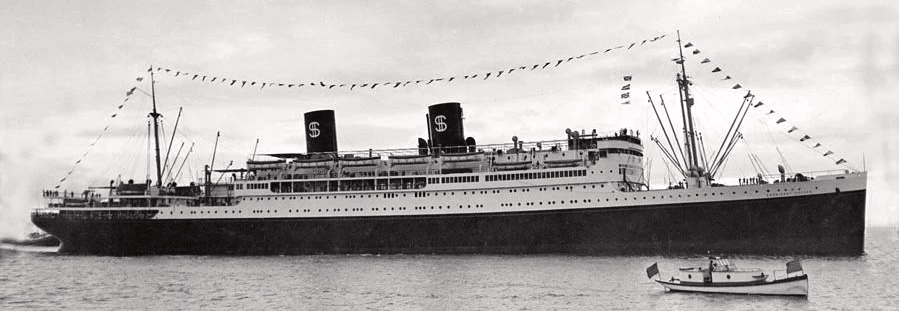
SS President Hoover
Dollar Steamship Line · 1931 · Ship Guide
Overview
SS President Hoover was a large American trans-Pacific liner built for the Dollar Steamship Line at the start of the 1930s. Together with her near-sister President Coolidge, she represented the most ambitious expression of the line’s Pacific passenger service in the interwar years, combining modern passenger accommodations with the scale and technical confidence expected of a major American route flagship. Her career was comparatively short, but the ship remains notable for both her intended prestige role and her dramatic 1937 loss off the coast of Taiwan.
In collecting and interpretation, President Hoover belongs to the late interwar Pacific service world rather than the North Atlantic liner tradition. Material tied to the ship often reflects American trans-Pacific route branding, Asian port networks, and the final years of the Dollar Steamship Line before broader corporate transition.
Key Facts
Capacity figures and some technical summaries are presented differently across quick-reference works. For cataloging purposes, preserve the wording and figures used by the specific source or artifact being cited.
Design & Construction Context
President Hoover was conceived as a major trans-Pacific passenger liner at a time when American operators were still investing in long-distance scheduled sea travel to Asia. Her scale, modern machinery, and paired construction with President Coolidge show the Dollar Line’s intent to project confidence and continuity across Pacific routes that linked the U.S. West Coast with Honolulu, the Philippines, China, and Japan.
She belongs to a different interpretive world from the better-known North Atlantic superliners. The ship’s significance lies in American Pacific route culture, interwar Asian port networks, and the commercial geography of westbound and eastbound liner travel rather than in Blue Riband competition or Atlantic prestige rivalry.
Service History (Summary)
1929–1931: Ordered in late 1929, built at Newport News, launched in December 1930, and delivered in July 1931 for Dollar Steamship Line service.
1931–1937: Operated on the company’s trans-Pacific routes from San Francisco, with service patterns that included Honolulu, Manila, Kobe, and Shanghai. In this period she formed part of the line’s premier Pacific passenger offering and was one of the most recognizable American liners in the trade.
Corporate context: Her operating years coincided with the increasingly difficult financial position of the Dollar Steamship Line during the Depression decade. That broader instability forms part of the historical backdrop to her career, even though the ship herself remained a prominent working unit of the fleet.
December 1937: During a typhoon, President Hoover ran aground on Kashōtō / Green Island off Taiwan. Although passengers and crew were rescued, the liner could not be refloated and was declared a total loss.
After the wreck: The stranded ship was dismantled and scrapped where she lay, ending a career of only a few years but leaving a disproportionately memorable place in Pacific liner history because of the dramatic nature of the loss.
The August 1937 Shanghai Bombing
On 30 August 1937, at approximately 5:40 p.m., SS President Hoover was attacked by Chinese bomber aircraft while anchored in the Yangtze estuary during fighting around Shanghai. The U.S. Naval History and Heritage Command’s photograph catalogue (NH 77702) records one bomb hit and three near misses. According to that catalogue, seven crew members were injured, one of whom later died, and three passengers were stunned. The liner subsequently returned to service.
This episode is important because it places the liner directly inside the rapidly worsening security environment of East Asia before her loss. It also means that late-1937 photographs and newspaper reports may relate either to the Shanghai bombing or to the Taiwan wreck and should not be conflated.
The Green Island Wreck
At about 01:00 on 11 December 1937, President Hoover struck a reef off Green Island, Taiwan, in heavy weather. Attempts to lighten and refloat the vessel failed as wind and seas drove her farther onto the reef. Passengers and crew were evacuated safely.
The wreck was declared a total loss and sold to the Kitagawa Ship Salvage Company for $500,000. U.S. archival reporting notes that salvage continued over roughly three years, so the wreck’s physical disappearance was a process rather than a single immediate scrapping event.
Why President Hoover Matters
President Hoover represents the high-water mark of Dollar Line’s interwar Pacific ambition just before war and financial collapse transformed the system. Her six-year career compressed technical modernity, trans-Pacific route culture, geopolitical danger, and corporate decline into a remarkably short span.
Interpretive Notes
This is a Pacific flagship, not an Atlantic liner: President Hoover should be interpreted through San Francisco–Asia route culture, not through the vocabulary usually applied to Atlantic express liners.
The Dollar Line context matters: objects connected to the ship often also illuminate the final major phase of the Dollar Steamship Line before the broader transition toward American President Lines. That corporate background can shape how later references describe the ship.
The wreck defines memory, but not the whole meaning of the ship: while the 1937 grounding is central to the vessel’s historical profile, the ship’s significance also lies in what she represented before that loss: an ambitious American interwar Pacific liner at the height of her route identity.
Evidence-first ship guideSources (Selected)
- Ocean Liner Curator — Sources (master bibliography)
- SS President Hoover — overview chronology, specifications, and wreck summary
- U.S. National Archives — SS President Hoover article and corporate context
- U.S. Naval History and Heritage Command — photograph NH 77702; 30 August 1937 bombing, reported time and casualties (institutional catalogue)
- The Mariners’ Museum — President Hoover porthole-glass fragment, accession 1940.0464.000001, with passenger L. S. Clark’s letter of 9 February 1940; firsthand recollection with differing casualty figures
- Takao Club — detailed narrative of the SS President Hoover wreck
- American President Lines — later corporate context for the former Dollar system