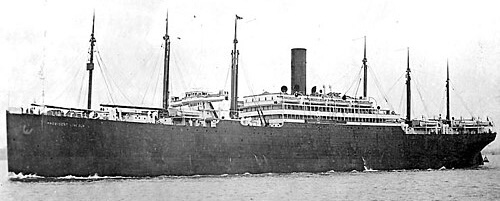
SS President Lincoln
Hamburg-America Line · entered service 1907 · Ship Guide
Overview
SS President Lincoln was a large Hamburg America Line transatlantic liner built in Belfast in the early 1900s. She belonged to the busy German–American passenger world rather than the absolute fastest Atlantic express-liner tier, and her significance lies in that immigrant and regular-service context between Hamburg and New York. Her career later shifted dramatically when the United States seized her during the First World War and converted her into a troop transport, a role in which she was lost in 1918.
In collecting and interpretation, President Lincoln is best divided into three main phases: prewar Hamburg America Line passenger service, U.S. Army transport service, and U.S. Navy troop transport service. Material from those phases should be distinguished carefully rather than treated as a single undifferentiated ship identity.
Key Facts
Published passenger totals vary by source and by date, especially when comparing prewar commercial service with later wartime troop capacity. For cataloging purposes, it is best to preserve the exact wording used by the source or artifact being cited.
Design & Construction Context
President Lincoln belonged to the generation of large German transatlantic liners that carried emigrants, regular passengers, and mail across the North Atlantic in the years before the First World War. She should be understood chiefly within the Hamburg–New York service framework rather than through prestige comparisons with the very fastest Atlantic record-breakers.
Launched by Harland & Wolff as the unfinished Scotian for Furness, Withy interests and acquired by HAPAG before completion, she also reflects the international and commercially intertwined nature of prewar liner construction: a German line operating a Belfast-built ship in one of the world’s busiest migrant and passenger corridors.
Service History (Summary)
1903 construction and early identity: Built at Belfast by Harland & Wolff, President Lincoln entered the Hamburg America Line fleet in 1903. In her peacetime identity she belonged to the German transatlantic passenger world centered on service between Hamburg and New York.
1907 onward: Sources commonly associate the ship’s North Atlantic passenger service with the Hamburg–New York route from 1907 onward. This is the correct interpretive frame for passenger lists, route brochures, luggage labels, deck plans, and commercial photography tied to her civilian identity.
Prewar service: Her significance in this phase lies in regular large-scale transatlantic traffic rather than in speed records. She formed part of the steady infrastructure of German-American liner travel in the high era of migration.
1917 seizure by the United States: When the United States entered the First World War, the ship was seized and taken into American service. At that point, her identity changed fundamentally from German passenger liner to American wartime transport asset.
Army and Navy transport service: First used as an Army transport and later commissioned in the U.S. Navy as USS President Lincoln, she carried troops to France as part of the American Expeditionary transport system. This phase should be interpreted separately from her civilian liner life.
31 May 1918: While returning from Brest to the United States, she was torpedoed by the German submarine U-90 about 300 miles west of Brest. The loss became one of the notable sinkings of a large American troop transport during the war. NHHC records 26 deaths and the capture of one officer.
Aftermath: Twenty-six men were lost in the sinking. The ship’s destruction and the capture of Lieutenant Edouard V. M. Isaacs, who later escaped from German captivity, helped secure her place in wartime memory.
Interpretive Notes
This is a German transatlantic liner first: President Lincoln should be understood initially through Hamburg America Line’s passenger service, not only through her later American naval identity.
Her American wartime phase is important but distinct: once seized in 1917, the ship entered an entirely different interpretive world of troop transport, naval administration, and wartime loss.
Civilian and wartime material belong to different collecting contexts: passenger ephemera reflects one historical frame, while Army and Navy transport records belong to another.
The ship illustrates wartime reversal: a German liner became an American troop transport and was then sunk by a German submarine, a sequence that captures the upheaval of wartime shipping history.
Harland & Wolff context matters: the ship also reflects the cross-national shipbuilding world of the prewar liner era, with Belfast construction serving German commercial ambitions.
Evidence-first ship guide