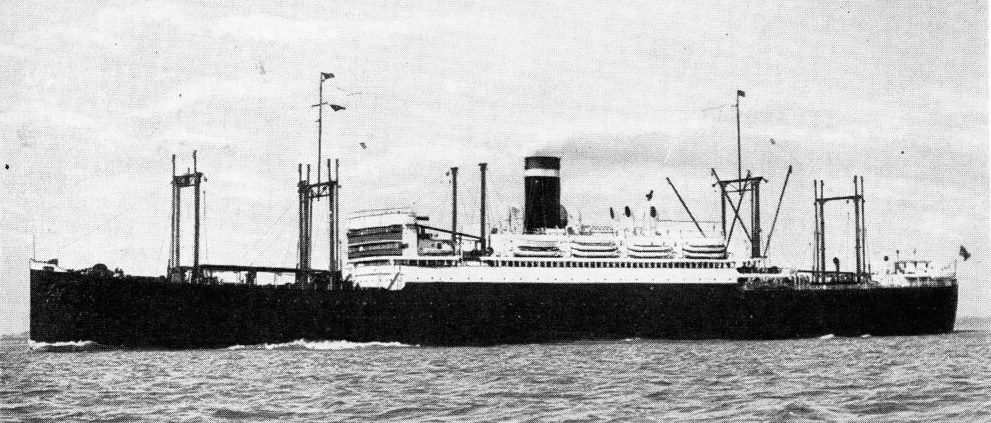
SS President Roosevelt (1922)
United States Lines · entered service under this name 1922 · Ship Guide
Overview
SS President Roosevelt was one of the United States Shipping Board's large Design 1029 passenger-and-cargo liners, popularly known as the “535-foot” type. Built by New York Shipbuilding Corporation at Camden, New Jersey, she was completed in early 1922 as Peninsula State, briefly became President Pierce, and in August 1922 received the name by which she became best known: President Roosevelt.
For nearly two decades she served United States Lines on the North Atlantic, commonly paired in company literature with near-sister President Harding. Her second career was even more consequential. Taken over by the War Department in 1940 and renamed Joseph T. Dickman, she became a major troop transport and later a Navy attack transport, participating in amphibious operations in North Africa, Sicily, Italy, and southern France before returning troops home after the war.
Key Facts
From Peninsula State to President Roosevelt
The ship emerged from the same ambitious Shipping Board program that produced President Harding and numerous related “535” liners. The class was conceived during the First World War but entered commercial service afterward, when the United States was trying to sustain a large, American-built merchant fleet in peacetime.
Her names changed quickly. Completed as Peninsula State, she was redesignated President Pierce in 1922 and then renamed President Roosevelt in August. That short sequence is important for attribution: surviving documents from early 1922 can refer to the same hull under three different names within a matter of months.
United States Lines Atlantic Service
As President Roosevelt, the ship became a regular United States Lines vessel on the New York–Europe route. Contemporary schedules and passenger material place her on the Bremen service via ports such as Southampton and Cherbourg. United States Lines advertising frequently paired her with President Harding, emphasizing their American construction and comparatively modern accommodations.
The pair occupied a useful middle position in the fleet. They lacked the enormous prestige scale of Leviathan, yet were substantial enough to form a dependable core of scheduled transatlantic service. Period literature from the 1920s therefore often presents them together rather than as isolated ships.
The 535-Foot Type
President Roosevelt belonged to Design 1029, one of the most recognizable large passenger types created for the Shipping Board. Ships of the family later served a wide range of operators and routes, including United States Lines, Pacific Mail, Dollar Line, American President Lines, and the armed services.
The familiar “535-foot” label is a class shorthand based on overall length. Register dimensions can appear shorter in individual sources, so apparently conflicting figures do not necessarily indicate different ships or measurement errors.
Joseph T. Dickman: Conversion to Troopship
The War Department took over President Roosevelt in October 1940, renamed her Joseph T. Dickman, and converted her to troop transport duty. The Navy assumed the ship on 27 May 1941, completed further conversion at New York Navy Yard, and commissioned her as AP-26 on 10 June.
In February 1943 she was reclassified APA-13, reflecting her role as an attack transport equipped to put troops ashore during amphibious operations. This was not merely a change of name or paint: the wartime vessel belonged to a fundamentally different operational world from the passenger liner that had sailed for United States Lines.
Amphibious War Service
Joseph T. Dickman supported major Allied landings in the Mediterranean. In July 1943 she took part in the invasion of Sicily as part of the Gela landing force and fought off German air attack while unloading troops. She followed with service during the Salerno landings in September.
Her later wartime work included additional amphibious operations and transport assignments, including the southern France campaign. By war's end she had earned six battle stars, a remarkable second career for a ship designed two decades earlier as a commercial passenger liner.
Repatriation and Final Years
After Japan's surrender, Joseph T. Dickman carried former prisoners of war and returning service personnel back to the United States. She also participated in Operation Magic Carpet, the immense postwar movement of American forces home.
She decommissioned on 7 March 1946 and returned to the Maritime Commission. No attempt was made to restore her to United States Lines passenger service. The ship was ultimately scrapped in 1948.
Interpretive Notes
Separate civilian and naval phases: photographs of USS Joseph T. Dickman should not be treated as straightforward visual documentation of the 1920s passenger liner. Wartime alterations changed both appearance and function.
Watch the early-1922 names: Peninsula State, President Pierce, and President Roosevelt all identify the same hull, but they correspond to distinct documentary moments.
Pair with President Harding: company brochures and fleet lists repeatedly present the two ships together. That commercial pairing is often more useful for identification than generic “United States Lines” branding alone.
Evidence-first ship guide