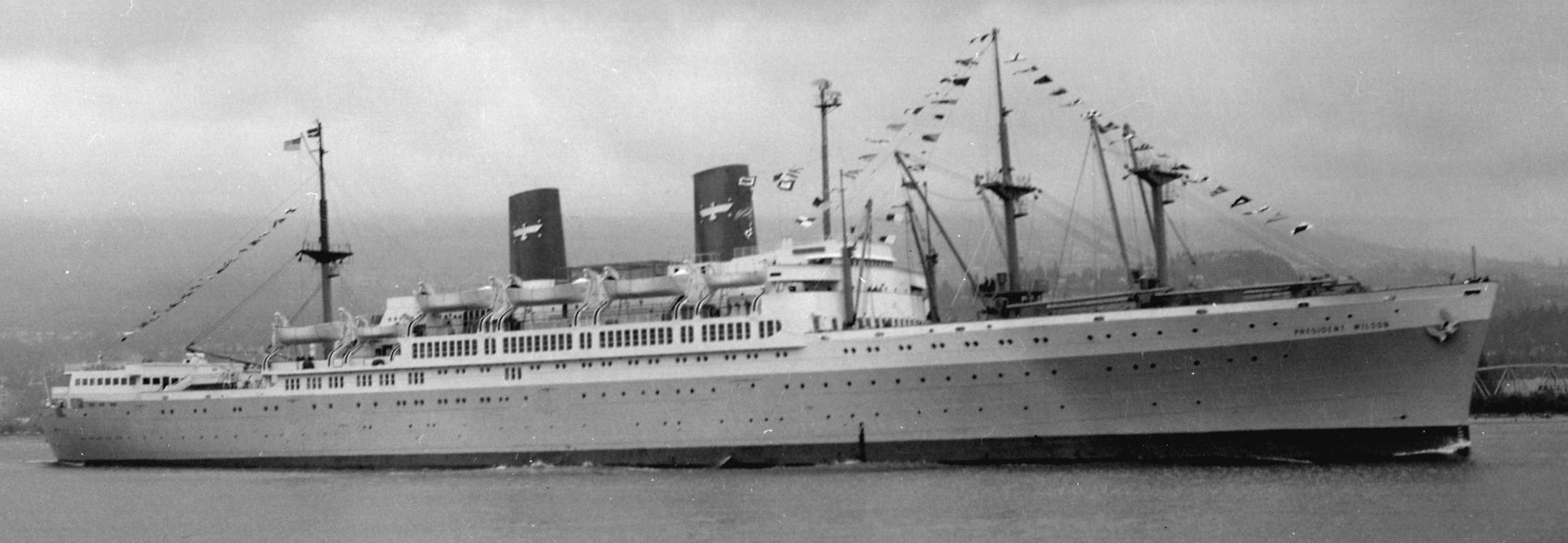
SS President Wilson (1948)
American President Lines · completed 1948 · Ship Guide
Overview
SS President Wilson was an American transpacific passenger liner whose origins lay in the United States' wartime transport program. Intended for military use under the name Admiral F. B. Upham, the incomplete ship was finished as a commercial passenger vessel and entered American President Lines service in 1948.
With sister President Cleveland, she represented a postwar attempt to provide modern American-flag accommodation on Pacific routes linking the West Coast, Hawaii, and Asian ports. Her career also illustrates the changing relationship between government-built tonnage and privately operated liner services.
Key Facts
From Transport Project to Passenger Liner
The Maritime Commission ship was constructed at the Bethlehem yard in Alameda, California, and delivered in April 1948. The planned Navy role was cancelled before completion; her eventual identity as President Wilson should therefore not be confused with commissioned military service under the intended name.
The Maritime Administration identifies her commercial configuration as type P2-SE2-R3, adapted from an Admiral-class troop transport design. Unlike a purpose-designed express liner, her structure and propulsion reflected the military transport program from which she emerged.
Across the Pacific
American President Lines operated President Wilson on long-distance routes from San Francisco through California and Hawaii to destinations including the Philippines, China, and Japan. Its ships connected ports and travelers across a very different geography from that of the North Atlantic express liners.
The vessel was initially chartered from the United States Maritime Commission. American President Lines acquired her outright in August 1954, underscoring the relationship between postwar public shipbuilding and commercial passenger routes.
Life On Board
An extensive passenger voyage encompassed days at sea, port calls, and crossings of the Pacific. Period APL promotional literature described deck recreation, onboard meals, and international destinations as central elements of the journey.
The ship's passenger configuration and published accommodation totals varied over time and between sources. An individual deck plan or fare brochure should therefore be dated to its specific season or refit rather than assumed to describe the entire service career.
A Rescue at Sea in 1964
In 1964, while in commercial service, President Wilson participated in the rescue of sailors from a sinking Greek cargo ship. The U.S. Maritime Administration awarded the vessel the Gallant Ship Award for the crew's actions.
This incident is a notable episode in her history independent of her passenger-service role: a liner could also provide urgent assistance in the vast expanse of the Pacific.
Later Career and Historical Attribution
President Wilson remained associated with American President Lines until 1973, when she was sold and later sailed under the name Oriental Empress. Records of her final disposal are not wholly consistent, so the date should be attributed to its source rather than repeated uncritically.
Two earlier vessels carried the name President Wilson in shipping records. The 1948-built ship must be distinguished by date, dimensions, route, and operator from the earlier namesake.
Interpretive Notes
Identify the hull, not only the name. Historical fleet lists contain more than one President Wilson; references lacking a year should not be attached automatically to the 1948 vessel.
Do not confuse planned and actual naval service. The intended designation Admiral F. B. Upham records a cancelled construction purpose, not a completed Navy career.
Different tonnage figures may reflect different definitions. Historical fleet lists and later ship summaries do not always agree; a guide should identify the measurement used.
Pacific history belongs in the wider liner narrative. The vessel's multi-port itinerary, U.S. maritime policy context, and relationship to Asian ports are essential, not peripheral, to her significance.
Evidence-first ship guideRelated Guides
See her sister SS President Cleveland (1947) for the other APL transpacific flagship. For an earlier namesake in the American passenger-ship tradition, see SS President Roosevelt.
Sources (Selected)
- Ocean Liner Curator — Sources (master bibliography)
- U.S. Maritime Administration — SS President Wilson and the Gallant Ship Award
- U.S. Maritime Administration — President Wilson vessel model and historical context
- GG Archives — American President Lines historical fleet list
- Whitworth University — American President Lines passenger travel brochure (circa 1948)