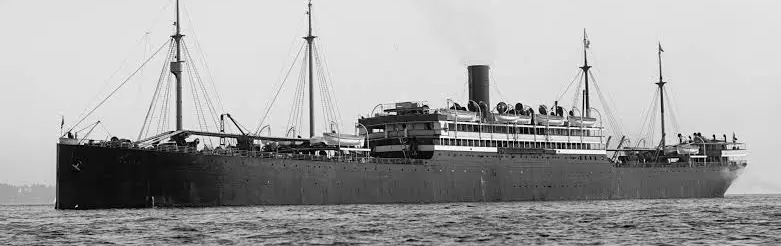
SS Pretoria
Hamburg-Amerika Line · 1897 · Ship Guide
Overview
SS Pretoria was a large German passenger and cargo liner built by Blohm & Voss at Hamburg for the Hamburg-Amerika Line. Launched in 1897 and entering service in February 1898, she belonged to the company’s Pennsylvania class, a group of exceptionally capacious emigrant steamships designed to carry large numbers of third-class passengers together with freight and a smaller cabin complement.
Her regular work centered on the Hamburg–New York trade, usually by way of English and French Channel ports. Rebuilt in 1910 with enlarged passenger accommodation, she remained an important migration ship until the First World War ended her German commercial career. After the war, she briefly served the United States Navy as USS Pretoria, passed to British control, and was scrapped in 1921.
This page treats Pretoria as the Hamburg-Amerika Line liner launched in 1897. She should not be confused with the much later Deutsche Ost-Afrika Linie turbine liner Pretoria launched in 1936.
Key Facts
Note on capacity: surviving summaries give different first-, second-, and third-class totals for different phases of the ship’s life. The 1910 rebuilding materially changed her accommodation, so capacity figures should always be tied to a date.
Design & Construction Context
Pretoria was conceived as a high-capacity working liner rather than a prestige express steamer. Her four masts, single funnel, broad hull, and comparatively moderate speed reflected a design optimized for freight and mass passenger traffic. The class was among the largest emigrant types operated by Hamburg-Amerika Line before the era of the giant luxury liners.
The ship’s commercial strength was volume. She could move large numbers of steerage passengers while carrying substantial cargo, making her useful on routes where migration and freight produced steadier returns than speed competition.
Hamburg–New York Service
Pretoria entered the Hamburg–New York service in February 1898. Her sailings commonly included calls at Channel ports such as Boulogne, Cherbourg, Plymouth, or Southampton, though the exact itinerary varied by year and schedule.
The vessel’s long westbound passenger lists document the scale of European migration in the years before the First World War. For many travelers, Pretoria was not a luxury destination but the physical means of leaving one social and political world for another.
Rebuilding in 1910
In 1910 Pretoria was rebuilt and remeasured at approximately 13,234 gross tons. Compiled sources describe a configuration emphasizing roughly 400 second-class and 2,200 third-class berths, demonstrating how strongly the ship had become oriented toward the intermediate and emigrant trades.
This rebuilding is an important dating clue. Interior descriptions, capacities, deck arrangements, and tonnage figures created before 1910 may not match later records, even though they concern the same vessel.
Passenger & Migration Evidence
Surviving manifests for Pretoria can record names, ages, occupations, places of origin, nearest relatives, destinations, physical descriptions, and immigration-status information. Such documents make the ship especially important to family history and migration research.
Passenger lists should be interpreted as administrative records rather than neutral portraits. They preserve valuable detail, but spelling, transcription, language, and inspection practices can introduce inconsistency. The original image should be consulted whenever a precise identity or relationship depends on a single entry.
Class & Passenger Experience
The experience aboard Pretoria differed substantially by class. Cabin passengers had more privacy and access to formal public rooms, while steerage travelers lived within high-density accommodations structured around economy and control. The ship’s large emigrant capacity makes it especially important not to let the relatively small body of surviving promotional imagery define the experience of everyone aboard.
Photographs showing emigrants on deck, inspection routines, or crowded communal spaces may provide a more representative view of the ship’s social history than idealized company advertising.
First World War
The outbreak of war in August 1914 disrupted Pretoria’s scheduled commercial service. Unlike several German liners trapped in American ports, she remained within the German sphere and was later surrendered under the postwar settlement.
Her German commercial career was therefore ended not by ordinary retirement but by the broader destruction and redistribution of the merchant fleet that followed the war.
USS Pretoria
The United States Navy took over the ship in March 1919 and commissioned her as USS Pretoria. She was employed in the post-armistice transport effort, helping return American military personnel from Europe rather than carrying troops into combat.
Naval records belong to a distinct phase of the vessel’s history. Although the name was retained, her flag, command structure, purpose, crew organization, and documentary trail were no longer those of Hamburg-Amerika Line.
Four Repatriation Crossings
Between 11 May and 25 August 1919, USS Pretoria made four crossings from Brest to New York and returned 10,380 First World War veterans to the United States. Naval History and Heritage Command identifies units including the 8th, 149th, and 150th Machine Gun Battalions, the 149th Field Artillery Battalion, and the 144th Infantry Battalion among those carried.
Three Fires in January 1920
After transfer out of U.S. Navy service, Pretoria suffered three fires in New York Harbor in the first days of January 1920. The third, on 4 January while she lay at Staten Island Pier, broke out in a forward hold and caused damage estimated at about $100,000 in contemporary reporting.
These fires belong to the unstable postwar ownership phase and should not be projected backward onto her HAPAG migration career.
Why Pretoria Matters
Pretoria is historically strongest when read in two scales at once: as one of HAPAG’s great capacity-driven migration ships and, briefly, as a U.S. troop-repatriation transport. The shift from thousands of emigrants westbound before 1914 to thousands of veterans returning home in 1919 gives the same hull two very different mass-movement contexts.
British Control & Disposal
After her U.S. Navy service, Pretoria came under the British Shipping Controller and was operated for a period by Ellerman Lines. Like many older former German liners transferred after the war, she faced an uncertain commercial future in a market crowded with surplus, repaired, and replacement tonnage.
She was sold to British shipbreakers in November 1921. Her disposal ended a career of roughly twenty-four years, most of it spent carrying migrants and cargo across the North Atlantic.
Collecting Profile
Surviving material may include passenger lists, postcards, photographs, sailing schedules, advertisements, immigration documents, information booklets, and U.S. naval records. Because the later 1936 liner carried the same name, dates and visual details are essential.
The 1897 vessel is identifiable by her single funnel and four-masted profile in German service. A photograph or postcard bearing only the name Pretoria should be checked against the depicted era, funnel arrangement, hull form, operator, and any printed route information.
Interpretive Notes
Pretoria represents a form of ocean-liner history that can be obscured by attention to speed and luxury. Her principal historical role was capacity: she moved people and goods in very large numbers and became part of the routine machinery of transatlantic migration.
Her career also demonstrates how war could detach a ship from the company and national identity for which she had been built. The passage from HAPAG liner to American naval transport and British-controlled merchant vessel is one continuous hull history, but each phase must be interpreted within its own institutional context.
Evidence-first ship guideSources (Selected)
This list is intentionally conservative.
- Ocean Liner Curator — Sources (master bibliography)
- Norway Heritage — S/S Pretoria, Hamburg America Line
- GG Archives — SS Pretoria archival collection
- GG Archives — SS Pretoria immigrant-ship records
- Naval History and Heritage Command — USS Pretoria
- DocsTeach / U.S. National Archives — manifest of alien passengers aboard SS Pretoria