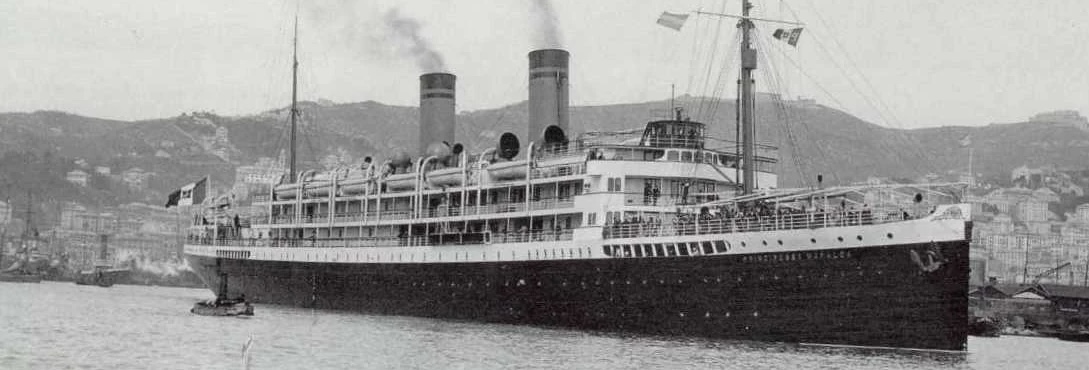
SS Principessa Mafalda
Navigazione Generale Italiana · 1909 · Ship Guide
Overview
SS Principessa Mafalda was an Italian transatlantic liner built for Navigazione Generale Italiana and completed in 1909 for the South America route. Named for Princess Mafalda of Savoy, she spent most of her career connecting Italy with Buenos Aires and the wider emigrant and commercial traffic of the South Atlantic.
In collecting and interpretation, Principessa Mafalda is especially significant because she combines two different historical identities: a long-serving Italian emigrant and passenger liner, and the dramatically remembered vessel lost off Brazil in 1927. It is useful to preserve both contexts rather than allowing the final disaster to eclipse the ship’s long working life.
Key Facts
Casualty totals, exact survivor counts, and some technical particulars vary among summaries of the sinking. For museum-level precision, it is best to cite the exact figure used by the source in hand rather than implying a single perfectly stable consensus.
Design & Construction Context
Principessa Mafalda belonged to the generation of Italian South American liners that served both prestige and mass-migration functions. She was not a North Atlantic speed champion in the Anglo-German competitive mold, but a substantial Mediterranean-based emigrant and passenger ship designed for a route of enormous demographic and commercial importance.
That context matters interpretively. Ships on the Italy–River Plate route carried not only wealthier travelers but also very large numbers of migrants, families, and workers moving between Europe and South America. As a result, the surviving documentation for Principessa Mafalda can sit at the intersection of migration history, Italian national maritime identity, and transatlantic passenger culture.
Service History (Summary)
1909–1927: Served NGI on the South American route, principally linking Italy with Buenos Aires and other Atlantic South American ports. This is the main collecting era for passenger lists, route ephemera, line advertising, emigrant references, and multilingual travel material associated with the ship.
Long-service context: by the time of her final voyage, Principessa Mafalda was no longer a modern ship. Multiple accounts emphasize her age, accumulated mechanical difficulties, and deteriorating condition, which are crucial to interpreting the 1927 disaster responsibly.
Final voyage, 1927: She left Genoa on October 11, 1927, for Buenos Aires. Mechanical difficulties reportedly affected the voyage from an early stage, including delays, stoppages, and failures in shipboard systems.
October 25, 1927: Off the Brazilian coast, the starboard propeller shaft fractured. Contemporary and later accounts describe the broken shaft as causing severe hull damage, while compromised watertight integrity and the ship’s condition worsened the emergency.
Sinking: although rescue ships arrived and weather was comparatively favorable, the evacuation became increasingly chaotic. Principessa Mafalda finally sank stern first after several hours, and the loss of life became one of the best-known disasters in Italian merchant-shipping history.
The Final Emergency in Detail
On the afternoon of 25 October 1927, the starboard propeller shaft failed off the Brazilian coast. The rotating machinery damaged the hull near the stern and water entered rapidly. Rescue ships converged on the scene, but evacuation unfolded over several hours and became increasingly chaotic as the stern settled lower.
The standard published chronology records 1,252 passengers and crew aboard and 314 fatalities. Other later retellings give different figures, so any alternate total should be sourced explicitly rather than blended into the guide.
Inquiry and Mechanical Lessons
The Italian naval investigation focused on the propeller-shaft casing and ordered changes to shaft arrangements on Italian-registered ships after the disaster. The inquiry also criticized the placement of several lifeboats that could not be used effectively once the ship took a severe stern-down attitude.
Why Principessa Mafalda Matters
The ship matters beyond the catastrophe because the disaster exposed the vulnerability of an aging migration liner still operating a demanding intercontinental route. Her long working career and her final mechanical failure belong to the same historical story, not two unrelated narratives.
Interpretive Notes
Do not let the phrase “Italian Titanic” do all the work: that label is common in popular retellings, but curator practice should keep the ship anchored to her actual route, company, age, and technical circumstances rather than relying on analogy alone.
Migration context matters: this was an Italy–South America liner with a major third-class role. Passenger material should therefore often be read through emigration history, not just through elite-liner culture.
Late-career deterioration is part of the story: many summaries note poor maintenance, aging equipment, or long-running mechanical trouble. Those themes are interpretively important, but claims should be phrased carefully and tied to documented reporting rather than exaggerated hindsight.
Casualty narratives need restraint: the sinking generated numerous dramatic stories, including later claims about panic, gunfire, sharks, suicides, and failures of rescue. Some of these are repeated inconsistently across sources. Curator practice is to distinguish well-attested basics from more sensational and less secure embellishments.
Evidence-first ship guideSources (Selected)