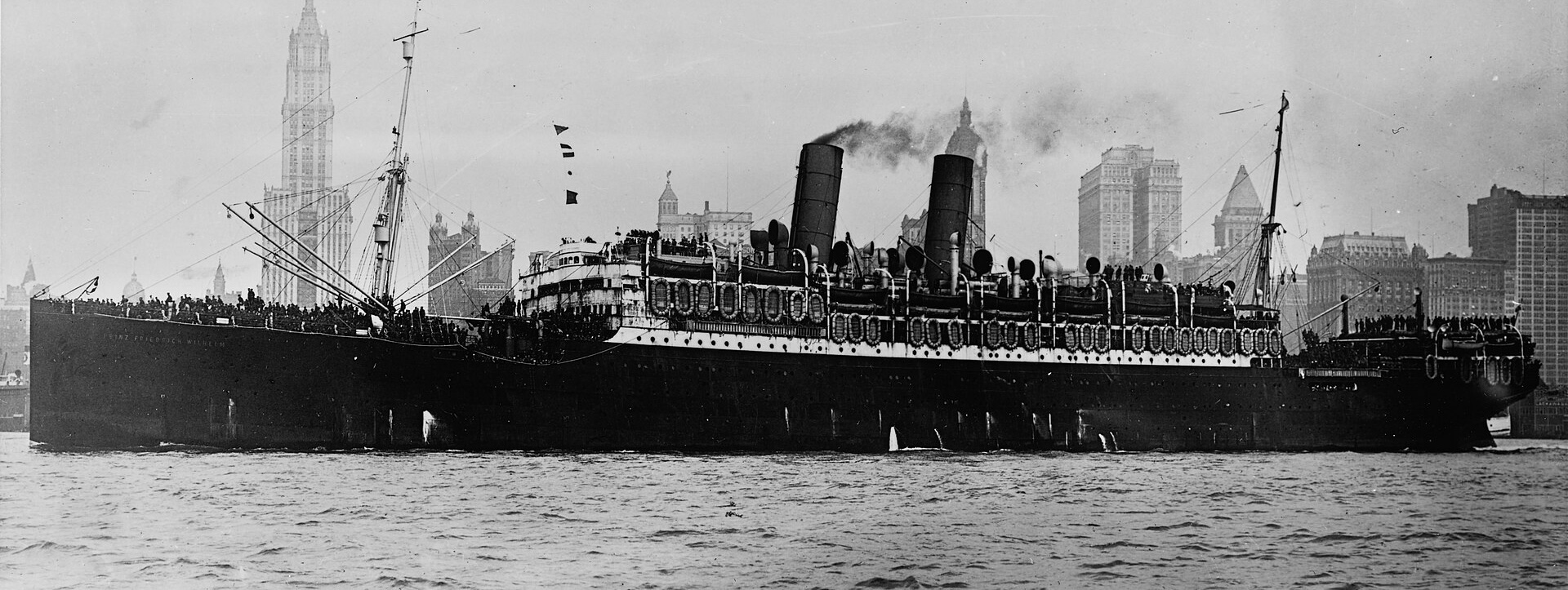
SS Prinz Friedrich Wilhelm
Norddeutscher Lloyd · entered service 1908 · Ship Guide
Overview
SS Prinz Friedrich Wilhelm was a Norddeutscher Lloyd transatlantic liner of the mature pre-First World War German Atlantic fleet. She was not one of the record-breaking Kaiser-class express greyhounds, but she was a substantial and important Bremen–New York liner built for steady passenger service in the era when German shipping remained a major force on the North Atlantic.
In collecting and interpretation, Prinz Friedrich Wilhelm is especially important because the ship had a notably layered post-1919 afterlife. The same hull later appeared as Empress of China, Empress of India, Montlaurier, Monteith, and Montnairn. Artifacts should therefore be cataloged under the printed name and date actually shown on the piece, rather than under a single simplified ship identity.
Key Facts
Design & Construction Context
Prinz Friedrich Wilhelm was built during the years when Norddeutscher Lloyd maintained a broad and stratified North Atlantic fleet. She did not occupy the supreme prestige tier of the company’s express liners, but she was still a large and commercially significant passenger ship, intended for regular transatlantic service with meaningful accommodation for both cabin passengers and emigrants.
This makes her historically useful. Ships like Prinz Friedrich Wilhelm show how Atlantic liner systems actually functioned beyond the handful of famous record-breakers. Much of the business of transatlantic movement depended on capable mid-tier liners whose service was routine, substantial, and document-rich.
Service History (Summary)
1907–1908: Built by Joh. C. Tecklenborg at Geestemünde, launched in October 1907, and completed for Norddeutscher Lloyd’s North Atlantic passenger trade. She entered service with her maiden voyage from Bremen to New York via Southampton and Cherbourg on June 6, 1908.
1908–1914: Operated in Norddeutscher Lloyd’s transatlantic service during the final great prewar phase of German competition on the Atlantic. This is the principal prewar commercial chapter and the phase to which most original NDL passenger ephemera belongs.
1912 context: She is sometimes noted in Titanic-related summaries as one of the ships in the wider signal environment during the disaster, though she was not one of the principal rescue ships. That association should not overshadow her own main service history.
1914–1919: With the outbreak of the First World War, her normal commercial career was interrupted. She sought refuge in Norway and remained out of ordinary German Atlantic service.
1919: After the war she was surrendered and briefly entered U.S. Navy service as USS Prinz Friedrich Wilhelm, making troop-return voyages from France. This is a distinct documentary phase and should be treated separately from her prewar NDL identity.
1921–1929: Passed into Canadian Pacific service and underwent a sequence of renamed identities: Empress of China, Empress of India, Montlaurier, Monteith, and Montnairn. Her long afterlife under new names makes her especially important for collectors attentive to hull continuity across multiple companies.
Interpretive Notes
Name discipline is essential: this hull’s history cannot be responsibly reduced to one permanent name. An artifact marked Prinz Friedrich Wilhelm belongs to a different interpretive moment than one marked Empress of India or Montnairn, even though the hull is the same.
Norddeutscher Lloyd material should be kept distinct from Canadian Pacific material: company style, route context, and passenger audience changed substantially across the ship’s career. House style and printed route evidence are important catalog clues.
This was a working Atlantic liner, not merely a footnote to larger ships: vessels of this class often receive less attention than the giant express liners, but they are central to understanding ordinary prewar Atlantic travel and migration.
Postwar renaming can mislead sellers and catalogers: because the ship later had several Canadian Pacific names, unattributed photographs and postcards may circulate under the wrong identity. Good curator practice follows the evidence on the piece, not the most famous name in the hull’s biography.
Passenger liner and repatriation transport: Prinz Friedrich Wilhelm belonged to Norddeutscher Lloyd’s broad passenger network before wartime circumstances transformed her role. Her 1919 U.S. Navy service, in which official records credit the ship with returning 15,213 veterans on five westbound crossings, belongs to the enormous logistical effort of bringing American forces home after the Armistice.
That transport work should remain distinct from the ship’s earlier commercial identity. Military passenger totals, Navy markings, and troopship records describe a temporary institutional use of the hull, while prewar brochures, menus, and passenger lists document a different route system and audience.
The repatriation record also gives the ship significance beyond prestige or design. For thousands of returning servicemen, she functioned as part of a vast demobilization system rather than as a luxury liner. That human context deserves to remain visible alongside the technical and corporate history.
Evidence-first ship guide