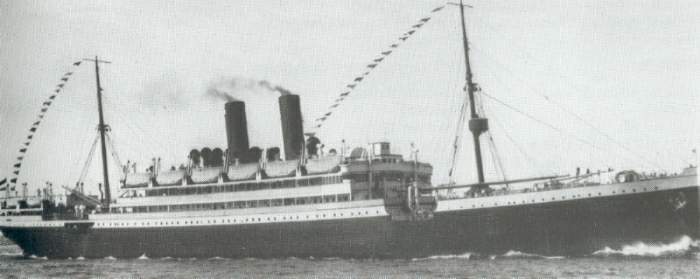
SS Prinzess Irene
Norddeutscher Lloyd · 1900 · Ship Guide
Overview
SS Prinzess Irene was a large German passenger and cargo liner built for Norddeutscher Lloyd by AG Vulcan at Stettin. Launched in 1900, she belonged to the broad Barbarossa-class family of combination liners: ships designed to carry substantial freight while also accommodating cabin passengers and large numbers of emigrants.
Her prewar career included the Bremen–New York route, Mediterranean sailings from Genoa and Naples to New York, and early voyages on Norddeutscher Lloyd’s imperial mail service to East Asia. Interned at New York after the outbreak of the First World War, she was seized by the United States in 1917 and entered naval service as USS Pocahontas. After the war she returned to German ownership and sailed successively as Bremen and Karlsruhe before being broken up in 1932.
This page treats Prinzess Irene as the Norddeutscher Lloyd liner launched in 1900. Sources may omit the final “s,” substitute “Princess Irene,” or use the later names Pocahontas, Bremen, and Karlsruhe. Date, builder, route, and dimensions should be checked before attribution.
Key Facts
Note on measurements: published length and passenger-capacity figures vary with the measurement convention and the ship’s configuration. Figures should be cited in the context of the source and date in which they appear.
Design & Construction Context
Prinzess Irene was built as a combination passenger-and-cargo liner rather than as a record-breaking express ship. Her two funnels, twin screws, and long central superstructure reflected Norddeutscher Lloyd’s need for ships capable of earning revenue from freight, cabin traffic, mail, and mass migration on several routes.
Although smaller and slower than the company’s four-funnel prestige liners, she offered the range and capacity required for dependable scheduled service. Her practical design made possible a career that continued for more than three decades under four names and two national flags.
Early Service & East Asian Mail Route
After completion in September 1900, Prinzess Irene entered service from Bremen to New York. Later that year she began the first of several voyages on the German imperial mail route to East Asia, sailing through the Mediterranean and Suez Canal toward ports in Asia and Japan.
These early voyages demonstrate that the ship was not conceived solely as a North Atlantic migrant carrier. She formed part of a wider German communications network linking Europe with overseas commercial and imperial destinations.
Mediterranean–New York Service
From 1903, Prinzess Irene became closely associated with Norddeutscher Lloyd’s Genoa–Naples–New York service. This route carried tourists, returning residents, and large numbers of emigrants from southern and southeastern Europe to the United States.
Passenger lists from these sailings are among the strongest sources for reconstructing the ship’s working life. They identify the vessel by date, master, ports, and passenger community, and they preserve evidence that broad company histories often omit.
1911 Fire Island Grounding
In April 1911, while approaching New York, Prinzess Irene grounded on a sandbar off Fire Island. The liner remained stranded for roughly eighty-three hours while tugs and salvage efforts worked to free her. She was eventually refloated with comparatively limited damage.
The incident received extensive newspaper attention because a large passenger liner had become immobilized close to one of the world’s busiest ports. It is best interpreted as a navigation and salvage episode rather than as a major shipwreck, since the vessel returned to service.
Internment at New York
Prinzess Irene reached New York in July 1914 shortly before the outbreak of the First World War. With British naval power making a return voyage unsafe, she remained in port and was interned during the period of American neutrality.
When the United States entered the war in April 1917, the government seized the ship. Damage to her machinery and systems required repair before she could be placed in active American service, a pattern shared by several interned German liners.
USS Pocahontas
The vessel was commissioned in July 1917, initially under an anglicized form of her German name, and was renamed USS Pocahontas in September. Assigned to the Cruiser and Transport Force, she carried American military personnel to Europe and continued transport work after the Armistice.
U.S. Navy summaries credit Pocahontas with carrying more than 24,000 servicemen to Europe and returning more than 23,000 to the United States. In May 1918 she was engaged by a surfaced German submarine, whose shellfire failed to stop the transport. Her American career therefore represents a major operational phase rather than a brief change of registry.
Return as Bremen
After decommissioning in November 1919, the ship passed back into civilian control. Norddeutscher Lloyd repurchased her in 1922 and renamed her Bremen. After refitting, she resumed Bremen–New York service in 1923, helping the company rebuild its passenger operations after the war.
This name should not be confused with Norddeutscher Lloyd’s celebrated turbine liner Bremen of 1928. The older ship carried the name only until that new express liner required it.
Final Career as Karlsruhe
In 1928 the former Prinzess Irene was renamed Karlsruhe. She continued in more modest passenger service, including voyages linking Bremen with ports in the United States, until 1932.
Her final years illustrate the long commercial usefulness of well-built prewar combination liners. By the time she was withdrawn, however, newer motor ships and turbine liners had made her reciprocating machinery and older accommodations increasingly uneconomic.
Passenger Lists & Migration Evidence
Migration records are central to the ship’s history. A large portion of her passengers traveled in steerage or third class, particularly on the Mediterranean route. Manifests may preserve birthplace, occupation, last residence, destination, relatives, and contacts in both Europe and America.
Searches should include all major names and spelling variants: Prinzess Irene, “Princess Irene,” Pocahontas, Bremen, and Karlsruhe. A search restricted to the original German name will omit much of the ship’s wartime and postwar documentary record.
Collecting Profile
Surviving material may include Norddeutscher Lloyd postcards, menus, passenger lists, sailing schedules, advertisements, immigration documents, and photographs of the 1911 grounding. American-period material includes troop transport photographs, embarkation papers, unit histories, and postcards identifying USS Pocahontas.
Objects from the later German career may carry the names Bremen or Karlsruhe. Because both names were used by other prominent liners, strong attribution requires a date, route, dimensions, photograph, or provenance trail that points specifically to the former Prinzess Irene.
USS Pocahontas
The United States seized Prinzess Irene in 1917. She entered U.S. Navy service under her German name before being renamed USS Pocahontas on 1 September 1917. The change also avoided confusion with a Navy tug then carrying the name Pocahontas.
Assigned to the Cruiser and Transport Force, the former liner became part of the American trooplift to France. U.S. Navy engineering records credit Pocahontas with nine wartime transport voyages carrying 22,579 troops to Europe. Her large prewar passenger spaces made the conversion from migration carrier to troop transport particularly effective.
Return to Germany: Bremen and Karlsruhe
Unlike many German liners permanently retained by Allied powers, the ship ultimately returned to German ownership. She resumed service under the name Bremen in 1922 and was renamed Karlsruhe in 1928, remaining active until withdrawal and demolition at Bremerhaven in 1932.
Those later identities make chronology essential in image and document attribution. A 1920s item labeled Bremen may refer to this former Prinzess Irene, not the famous turbine liner Bremen launched in 1928.
Interpretive Notes
Prinzess Irene is valuable as a history of continuity through disruption. The same hull served German migration and mail routes, became an American wartime transport, and then returned to German commercial service in the changed world of the 1920s.
Her repeated renaming also demonstrates why ship history must follow physical identity rather than a single name. Each name marks a distinct phase, but no one name contains the complete story.
Evidence-first ship guideSources (Selected)
This list is intentionally conservative.
- Ocean Liner Curator — Sources (master bibliography)
- Norway Heritage — S/S Prinzess Irene, Norddeutscher Lloyd
- GG Archives — SS Prinzess Irene archival collection
- NavSource Naval History — USS Pocahontas (ID-3044)
- Naval History and Heritage Command — USS Prinzess Irene photograph
- The National Archives — Passenger lists research guide
- U.S. Naval History and Heritage Command — USS Pocahontas (ID-3044)