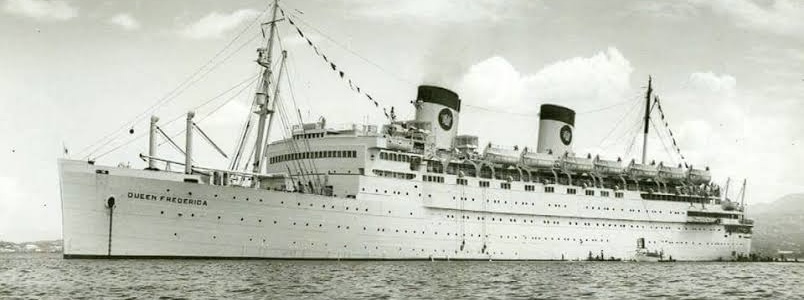
SS Queen Frederica (1955)
National Hellenic American Line · Greek-flag service from 1955 · Ship Guide
Overview
SS Queen Frederica was the final major identity of one of the most remarkable American-built passenger ships of the interwar era. Completed in 1927 as Matson Line's Malolo, she later became Matsonia, served as a wartime troop transport, crossed the Atlantic for Home Lines as Atlantic, and in 1955 entered Greek-flag service as Queen Frederica.
Her Greek career first belonged to National Hellenic American Line, a Home Lines affiliate, and later to Chandris Lines. She carried migrants and travelers between the Mediterranean and North America, made Australia voyages, and eventually worked increasingly as a cruise ship before being laid up in 1973.
Key Facts
From Malolo to Matsonia
The ship began life far from the Mediterranean. Matson ordered Malolo for its prestige service between California and Hawaii, and she became one of the most important American passenger liners of the 1920s. Her design was associated with William Francis Gibbs and emphasized high standards of passenger comfort and safety.
In 1937 Matson extensively rebuilt the ship and renamed her Matsonia. The refit added enclosed accommodation where open deck space had previously existed and substantially altered her passenger configuration.
Wartime Troop Transport
During the Second World War, Matsonia served as a troop transport under War Shipping Administration control. The U.S. Naval History and Heritage Command preserves photographs of the ship in this wartime role and identifies her as the former Malolo.
She returned briefly to commercial Hawaiian service after the war but made her final Matson voyage in April 1948. By then a new phase of her career was already approaching.
Home Lines and the Atlantic
Home Lines acquired the ship in 1948 and renamed her Atlantic. Rebuilt for transatlantic work, she entered Genoa–New York service in 1949 and later operated on a mixture of Mediterranean, North Atlantic, Canadian, and cruise itineraries.
This was already a major reinvention. A ship built for American luxury tourism to Hawaii had become a high-capacity transatlantic liner serving the very different passenger markets of postwar Europe.
Becoming Queen Frederica
In 1954–55 the ship was transferred to National Hellenic American Line, a Home Lines affiliate created for Greek-flag transatlantic service. Renamed Queen Frederica after the Greek queen, she began regular service linking Piraeus and other Mediterranean ports with New York.
A contemporary 1956 account from the Order of AHEPA described her as the largest Greek-flag transatlantic passenger liner in regular service between Greece and America. That contemporary description is valuable evidence for how the ship was presented within the Greek-American community.
Greek-American Migration and Travel
Queen Frederica became closely associated with postwar travel between Greece and North America. Her service connected Greek migrants, established diaspora communities, tourists, and families across the Atlantic.
Published Home Lines timetables show her operating alongside Homeric and Italia, with calls including New York, Halifax, Mediterranean ports, and Piraeus. She was therefore part of a broader Home Lines system even while marketed under a specifically Greek identity.
1960–61 Refit
The liner was substantially modernized around 1960–61. Later reference material describes a two-class arrangement of approximately 174 First Class and 1,005 Tourist Class passengers, together with expanded public rooms and swimming-pool facilities.
These changes demonstrate how aggressively operators adapted older liners to new markets. By then Queen Frederica was already more than thirty years old, yet investment continued because her hull, speed, and capacity remained commercially useful.
Canada and Seasonal Cruising
For several years the ship operated on services linking northern Europe with Canada and also undertook seasonal cruises. This mixed employment reflected the increasing difficulty of sustaining older liners on a single year-round scheduled route.
Home Lines' timetables and promotional material place Queen Frederica within an operating pattern that blended line voyages with leisure cruising well before cruising became the dominant use of large passenger ships.
Transfer to Chandris
In November 1965 the ship and the National Hellenic American Line operation passed to Chandris Lines. She retained the name Queen Frederica but received Chandris funnel markings and became part of a rapidly expanding Greek-owned passenger fleet.
Under Chandris she continued transatlantic work, cruised from North America, and made voyages to Australia. Museums Victoria preserves a 1968 Chandris accommodation plan, documenting the ship's later passenger arrangement and her place in the Europe–Australia and Pacific cruise market.
Australia and the Late Career
Queen Frederica had already made an Australia migrant voyage in 1958 and returned to Australian waters under Chandris in the later 1960s. Her career thereby linked three major passenger worlds: Hawaii, the North Atlantic and Mediterranean, and the Europe–Australia migration system.
By the end of the 1960s, however, age and changing safety requirements increasingly limited where she could operate. She shifted toward cruising and remained active until being laid up in 1973.
Scrapping and Fire
After several years laid up in Greece, the ship was sold for demolition in 1977. During dismantling at Eleusis in 1978, fire swept through the remaining interiors and gutted the vessel.
The damaged hull lingered at the breakers for an extended period before demolition was completed. Her physical end was untidy, but it followed an unusually long working life of roughly half a century.
Why Queen Frederica Matters
The ship matters because few liners embodied so many distinct passenger-shipping systems. She was an American luxury liner, a wartime troopship, a postwar transatlantic migrant carrier, a Greek-flag diaspora ship, an Australia migrant vessel, and finally a cruise ship.
Her career also cautions against treating a ship's name as its whole identity. Queen Frederica was only one chapter in the life of a hull whose commercial meaning changed repeatedly across five decades.
Collecting Profile
Collectible material is unusually rich because the ship's career spans four major identities: Malolo, Matsonia, Atlantic, and Queen Frederica. Brochures, deck plans, menus, passenger lists, postcards, tickets, photographs, and sailing schedules should be cataloged by identity and operator.
Greek-period material may carry National Hellenic American Line, Home Lines, or Chandris branding. Those distinctions are historically meaningful and can help date otherwise similar ephemera.
Interpretive Notes
Queen Frederica was not a Greek Line vessel: she operated under National Hellenic American Line and later Chandris Lines. The frequent shorthand association with “Greek Line” should not be treated as an operator identification.
Tonnage and passenger figures changed repeatedly: major rebuilds in 1937, 1948–49, and around 1960–61 substantially altered the ship. Figures from the original Malolo configuration should not be applied uncritically to Queen Frederica.
Ownership and management can be described differently by sources: Home Lines controlled the National Hellenic American operation before the 1965 transfer to Chandris. This guide distinguishes the operating brand from the broader corporate relationship.
Evidence-first ship guideSources (Selected)
- Ocean Liner Curator — Sources (master bibliography)
- U.S. Naval History and Heritage Command — S.S. Matsonia
- Gjenvick-Gjønvik Archives — SS Atlantic archival collection
- Last Ocean Liners — National Hellenic American Line / Queen Frederica
- Museums Victoria — Chandris Lines Queen Frederica accommodation plan, 1968
- Maritime Timetable Images — Home Lines sailing schedules