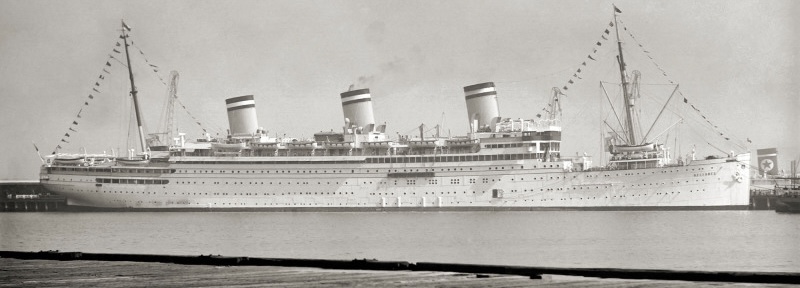
SS Reliance
Hamburg America Line · renamed Reliance 1922 · Ship Guide
Overview
SS Reliance had one of the more complicated ownership histories among interwar liners. Launched at J.C. Tecklenborg's Geestemünde yard on 10 February 1914 as Johann Heinrich Burchard for Hamburg America Line, she was provisionally completed during World War I but did not begin a normal passenger career until after the war.
Transferred into Dutch ownership and renamed Limburgia, the ship finally made her maiden passenger voyage in 1920. United American Lines acquired her in 1922 and renamed her Reliance; HAPAG bought her back in 1926 and developed her increasingly as a cruise ship.
Key Facts
A Career Delayed by War
Although physically completed during World War I, the ship's intended HAPAG passenger career never began under her original name. That distinction matters: 1915 is a completion date, not a peacetime service date. The vessel's first normal passenger employment came only after transfer to the Netherlands.
The exact legal timing of the Dutch transfer is described differently across secondary sources, but the operational sequence is clear: Johann Heinrich Burchard → Limburgia → Reliance.
Design and Interrupted Beginnings
Reliance's engineering reflected an efficiency-minded early-1910s pattern: reciprocating engines drove the wing shafts while exhaust steam fed a low-pressure turbine for the center screw. More important historically, however, is the mismatch between construction date and operating life. Completed during World War I, the ship never entered the peacetime HAPAG career for which she had originally been built.
The postwar transfer to Dutch ownership therefore marks the true beginning of her passenger biography. That distinction prevents a common chronological shortcut in which 1915 is treated as the start of normal service. In practical terms, the ship's first meaningful commercial identity was Limburgia, not Johann Heinrich Burchard.
United American and HAPAG Service
As Reliance, the ship worked the Hamburg–New York trade under United American Lines before HAPAG repurchased her in 1926. Her first voyage for the returned HAPAG ownership departed Hamburg on 24 August 1926 via Southampton and Cherbourg for New York.
During the late 1920s and 1930s, cruising became increasingly important. HAPAG used Reliance and Resolute as highly visible cruise ships, generating a rich surviving body of brochures, menus, route maps, and souvenir books.
The Cruise-Ship Phase
By the late 1920s, Reliance's identity had shifted noticeably from ordinary line service toward cruising. HAPAG marketed long itineraries in which the ship itself became part of the destination experience, helping explain the unusually rich survival of illustrated brochures and souvenir publications. Those materials are not peripheral to her story; they document one of the important ways older liners were repurposed in the interwar market.
Fire and End of Career
A major fire on 7 August 1938 gutted Reliance at Hamburg and ended her operating career. Norway Heritage dates scrapping at Bremerhaven to 1940; other secondary works give 1941. Rather than imply certainty where the record varies, this guide treats 1940–41 as the disposal window while identifying 1940 as the stronger dated reference presently available.
Interpretive Notes
Name and flag are essential. Material under the names Limburgia and Reliance should not be merged casually. The same hull passed through German, Dutch, American-linked, Panamanian, and again German registry contexts.
Cruise material is not secondary history. The ship's late career as a cruise vessel was a major commercial identity in its own right and explains why so much illustrated ephemera survives.
Evidence-first ship guide