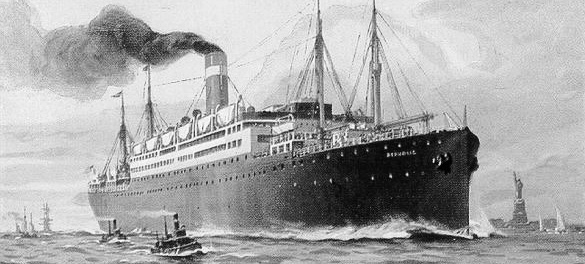
SS Republic
United States Lines · 1924 · Ship Guide
Overview
SS Republic was a United States Lines passenger ship with an unusually layered identity. Built at Harland & Wolff for a service plan that never fully developed, she entered commercial life in 1907 as the Hamburg America liner President Grant, passed through American naval and army service during and after the First World War, and then re-entered civilian transatlantic service for United States Lines in 1924 under the name Republic.
In collecting and interpretation, Republic is especially important because “Republic” is only one phase in a much longer naming history: Servian, President Grant, President Buchanan, and Republic all belong to the same hull. A catalog record should therefore follow the printed name and date on the artifact rather than assuming a single lifelong identity.
Key Facts
Dimensions, speed, and even the most “natural” route description can vary a little across quick-reference summaries because the ship’s long life crossed several owners and service forms. For museum-level work, preserve the exact form used by the source or artifact being cited.
Design & Construction Context
Republic was not a purpose-built United States Lines ship in the same way that a later flagship might be. Instead, she was one of the many complicated inheritances of early-20th-century Atlantic shipping: a Belfast-built hull intended for one ownership pattern, activated under another, interned and seized in wartime, then recycled into an American interwar passenger role.
That makes her especially useful interpretively. She shows how interwar United States Lines service was built partly from repurposed former German tonnage rather than from an entirely new national fleet. In that sense, Republic is less a clean “American-built national symbol” than an example of postwar maritime redistribution, adaptation, and rebranding.
Service History (Summary)
1903–1907: Built at Harland & Wolff, launched in 1903, but not completed until 1907. The gap between launch and active commercial service is part of her unusual early story and reflects the instability of the service arrangements for which she had first been intended.
1907–1914: Entered service as Hamburg America’s President Grant on the Hamburg–New York route via intermediate ports. This is the pre-American commercial phase and should not be conflated with later United States Lines material.
1914–1917: Laid up in the United States after the outbreak of the First World War made operations under the German flag unsafe.
1917–1921: Seized by the United States after entry into the war against Germany, then served as USS President Grant, later Army transport Republic, and then President Buchanan. Her First World War and immediate postwar military identity is an essential part of the ship’s documentary trail.
1924–1931: Re-entered civilian transatlantic service under United States Lines as Republic. Her first United States Lines voyage departed New York for Plymouth, Cherbourg, and Bremen on April 29, 1924. Surviving passenger lists also show later westbound sailings from Bremen to New York via Southampton, Cherbourg, and Cobh.
1931 onward: Returned to government control and moved back into Army and later Navy service. This ended her relatively brief but historically interesting United States Lines passenger career.
From President Grant to Republic
The ship's United States Lines career was only one phase in a much longer sequence. After German service as President Grant and American wartime use, she returned to passenger work in 1924 under the name Republic.
U.S. Naval History and Heritage Command records that the vessel had been delivered back to the U.S. Shipping Board in 1921, remained laid up at Norfolk, and then entered North Atlantic passenger service with United States Lines in 1924.
Army and Navy Service After the Liner Years
In 1931 the ship returned to Army control, beginning a new transport phase that included Pacific service. The Navy commissioned her as USS Republic (AP-33) in July 1941, and she subsequently carried troops and supplies across the Pacific during the Second World War.
Her longevity makes the name history essential: President Grant, USAT Republic, SS Republic, and USS Republic are not separate ships but successive operating identities of the same hull.
Not the 1903 White Star Republic
This vessel should not be confused with White Star's RMS Republic, the former Columbus lost after collision with Florida in 1909. The shared name is coincidental; the ships have different builders, owners, and service histories.
Interpretive Notes
Name discipline is essential: many ships called Republic exist in liner history, and this particular vessel also lived under multiple other names. A menu, brochure, or passenger list should be cataloged under the name actually printed on it, not under the name most familiar to the modern researcher.
United States Lines material belongs to a narrow window: if an artifact is truly from the United States Lines period, it generally belongs to the 1924–1931 civilian service phase. A “Republic” image or postcard is not automatically United States Lines unless the date, markings, or house style support that attribution.
Route context matters: Republic in United States Lines service was a cabin-class, practical Atlantic carrier rather than a flagship in the Leviathan mold. Seller descriptions sometimes flatten that distinction by presenting all USL ships as equivalent prestige liners.
Military afterlives can distort civilian memory: because the ship had a long later Army and Navy career, secondary summaries often give more attention to her government service than to her interwar passenger years. Curator practice should preserve both, while clearly distinguishing the brief United States Lines chapter from the much longer governmental one.
Evidence-first ship guideSources (Selected)
- Ocean Liner Curator — Sources (master bibliography)
- USS / USAT / SS Republic — overview of naming history and chronology
- GG Archives — SS Republic passenger-list and specification summary
- Great Ships — Republic / United States Lines service summary
- GG Archives — United States Lines archival collection and fleet context
- Titanic Inquiry Project — President Grant background and pre-USL identity
- U.S. Naval History and Heritage Command — President Grant / USS Republic chronology