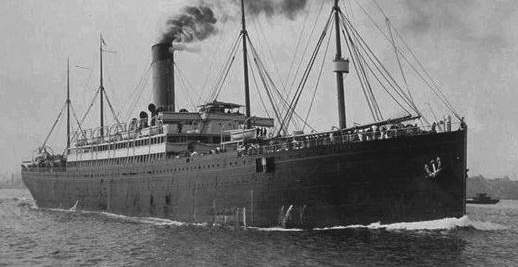
RMS Republic (1903)
Dominion Line / White Star Line · entered service 1903 · Ship Guide
Overview
RMS Republic began life as Columbus, built by Harland & Wolff at Belfast as yard no. 345 for Dominion Line interests. She entered Liverpool–Boston service in October 1903 and was transferred almost immediately into White Star Line's expanding network, receiving the name Republic.
Her six-year career is remembered above all for the January 1909 collision with the Italian liner Florida. That disaster became a landmark in maritime communications because wireless operator Jack Binns was able to send CQD distress calls after the collision, helping bring rescuers—including White Star's Baltic—to the drifting ships.
Key Facts
From Columbus to Republic
Harland & Wolff launched yard 345 as Columbus on 26 February 1903 for the Dominion Line's Boston trade. She sailed from Liverpool for Boston on 1 October. Corporate reorganization inside J. P. Morgan's International Mercantile Marine group soon transferred Dominion's Boston service and the ship to White Star. Renamed Republic, she made her first White Star voyage in December 1903.
Her subsequent pattern mixed Liverpool–Boston work with winter Mediterranean service from Boston and later New York. This route history matters because Republic was not simply a White Star flagship misplaced from the main New York story; she belonged to the company's broader attempt to capture regional and seasonal passenger markets.
The Collision, 23 January 1909
In dense fog off Nantucket early on 23 January 1909, the Italian liner Florida struck Republic in the port side near the machinery spaces. The impact killed people aboard both ships and left Republic flooding and without normal electrical power.
Marconi operator Jack Binns continued working from the damaged wireless cabin using battery power and sent the CQD distress signal. The Siasconset station on Nantucket received and relayed the call. Several vessels responded, while the drifting ships were difficult to locate in the fog.
Wireless and Rescue
Republic's surviving passengers were first transferred by boat to Florida. When Baltic finally reached the scene, the people aboard the damaged Italian ship were transferred again. U.S. government telecommunications history describes the episode as one of the first major demonstrations of maritime radio distress communication; six people died as a direct result of the collision, while more than 1,500 people across the two ships were brought to safety.
The event is sometimes simplified into a claim that it was the “first” wireless rescue at sea. The stronger formulation is narrower: the Republic disaster was an early, highly publicized and consequential demonstration of wireless distress signaling on a large passenger ship. That distinction avoids turning technological history into a slogan.
Loss and Legacy
Efforts were made to tow Republic, but progressive flooding overcame the ship and she sank on 24 January. The wreck later became surrounded by persistent stories of a valuable gold cargo. Those claims are part of the ship's later cultural history, but their existence should not be confused with proof of a treasure cargo.
The well-documented legacy is more important: the collision showed a mass public audience how wireless could connect a disabled ship with shore stations and other vessels. Republic's loss therefore belongs not only to White Star history but to the development of modern maritime safety communications.
Evidence-first ship guideThe Wireless Rescue in Contemporary Context
The 1909 collision is remembered because wireless communication materially changed the rescue. Jack Binns continued transmitting CQD distress calls after the collision, allowing nearby stations and ships to coordinate assistance while Republic remained afloat.
Contemporary newspaper coverage preserved Binns's own account of being thrown from his berth by the impact and then using the still-functioning Marconi apparatus to summon help. That evidence makes the incident an unusually well-documented early demonstration of shipboard wireless as a safety system.
Identity Boundary: The White Star Republic
This Republic was the former Columbus, completed in 1903 and lost in 1909. It should not be confused with the much longer-lived former President Grant that later served United States Lines under the name Republic.
The two ships overlap in twentieth-century documentation but differ completely in builder number, operators, and service chronology. A date check resolves most ambiguous references immediately.
Sources (Selected)
- Ocean Liner Curator — Sources (master bibliography)
- Titanic Inquiry Project — Republic particulars
- U.S. Institute for Telecommunication Sciences — January 1909 maritime radio rescue
- PBS American Experience — contemporary Jack Binns account
- White Star History — RMS Republic
- Library of Congress — contemporary 27 January 1909 newspaper account by wireless operator Jack Binns