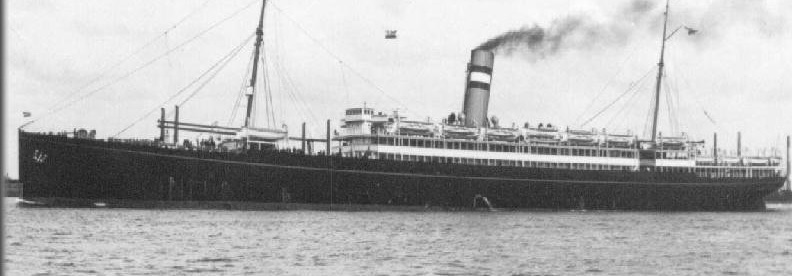
SS Rijndam (1901)
Holland America Line · entered service 1901 · Ship Guide
Overview
SS Rijndam was a large Holland America Line passenger and emigrant steamer built by Harland & Wolff at Belfast and completed in 1901. Designed for the company’s Rotterdam–New York service, she belonged to the same broad generation as Potsdam and her near-sister Noordam: substantial, twin-screw liners intended to carry cabin travelers, mail, cargo, and very large numbers of third-class passengers across the North Atlantic.
Her long career encompassed routine immigrant transport, two serious First World War accidents, United States Navy service as USS Rijndam, a return to commercial operation, and a notable 1926–27 voyage as a floating university. Sold for breaking in late 1928, she reached the Dutch scrapyard in 1929 after more than twenty-seven years of service.
Naming note: Rijndam was the ship’s official Dutch name, derived from the River Rhine. Holland America Line also used the anglicized spelling Ryndam in English-language publicity, and both forms appear in contemporary records and surviving ephemera.
Key Facts
Design & Construction (Context)
Rijndam was built as a steel, one-funnel, two-masted liner with four principal decks and extensive cargo capacity. Her twin screws and duplicated reciprocating machinery offered greater reliability than a single-screw arrangement, while her moderate service speed reflected Holland America Line’s emphasis on dependable schedules and economical transport rather than record-breaking crossings.
The passenger plan embodied the social structure of turn-of-the-century Atlantic travel. A few hundred first- and second-class berths were balanced by accommodation for roughly 1,800 third-class passengers, many of them emigrants traveling from continental Europe to the United States. Cargo, mail, and passenger revenue were therefore equally important to the ship’s commercial purpose.
Service History (Summary)
1901: Entry into service. After completion at Belfast on 3 October, Rijndam departed Rotterdam on 10 October for Boulogne-sur-Mer and New York. She joined Holland America Line’s regular North Atlantic service and soon became a familiar carrier of immigrants, cabin passengers, mail, and freight.
Prewar North Atlantic career. During the years before 1914, the ship operated principally between Rotterdam and New York, commonly calling at Boulogne-sur-Mer and at times other Channel ports. She was later fitted with submarine-signaling equipment and Marconi wireless telegraphy, reflecting the steady modernization of established liners.
25 May 1915: Nantucket collision. In fog south of Nantucket Shoals, Rijndam collided with the Norwegian fruit carrier Joseph J. Cuneo. United States battleships responded to her distress call and removed passengers and crew. Although badly damaged, the Dutch liner survived and was repaired.
18 January 1916: Mine damage. While navigating the Thames Estuary, Rijndam struck a mine laid by a German submarine. Lifeboats were prepared and passengers donned lifejackets, but the ship remained afloat and was again repaired.
1918–1919: United States Navy transport. The United States requisitioned the vessel and commissioned her as USS Rijndam (ID-2505). She carried American troops to Europe and, after the Armistice, helped return servicemen to the United States. She was decommissioned and restored to Holland America Line in October 1919.
Postwar commercial service. Reconditioned for civilian use, Rijndam resumed passenger service during the early 1920s. Surviving passenger lists, menus, schedules, inspection cards, and advertising document her continued role in both cabin travel and migration.
1926–1927: Floating university. On 18 September 1926, the aging liner began a seven-month world cruise under charter for an educational program often described as a floating university. The voyage carried more than 500 students and gave the ship an unusual late-career role far removed from her original Rotterdam–New York routine.
1928–1929: Withdrawal and demolition. After more than a quarter-century of service, Rijndam was sold to Dutch shipbreakers in December 1928. She arrived at Hendrik-Ido-Ambacht in April 1929 for demolition.
Interpretive Notes
Rijndam represents the practical center of North Atlantic liner history. She was neither the fastest nor the most luxurious ship of her era, but her enormous third-class capacity connected her directly to the mass migration that reshaped the United States and Europe during the early twentieth century.
Her survival of both a major collision and a mine strike also illustrates the durability of large steel liners and the value of compartmentation, emergency organization, and nearby assistance. Neither incident should be reduced to a footnote: each reveals the persistent hazards faced by neutral passenger shipping during wartime.
The ship’s final educational charter adds a particularly modern dimension to her story. A vessel designed to transport emigrants and freight was repurposed as a mobile campus, showing how older liners could acquire entirely new cultural meanings late in their careers.
Migration and institutional service: Rijndam is most useful when treated as more than a sequence of accidents and wartime episodes. Her large steerage capacity places her firmly in the migration economy of the early twentieth-century Holland America route, while later troopship and educational use show how the same hull could be repurposed for very different passenger communities.
The 1926 floating-university voyage is especially distinctive because it changed the meaning of the ship without changing her basic identity. Student itineraries, lectures, photographs, and port calls belong to an educational travel experiment rather than ordinary liner service, and surviving material should be cataloged accordingly.
Evidence-first ship guide