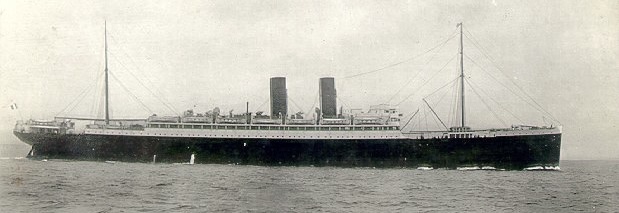
SS Rochambeau
Compagnie Générale Transatlantique · launched 1911 · Ship Guide
Overview
SS Rochambeau was a Compagnie Générale Transatlantique passenger liner built at Saint-Nazaire for the France–New York trade. Launched on 2 March 1911, she entered service later that year and spent more than two decades carrying cabin passengers, emigrants, mail, and cargo across the North Atlantic.
Her technical significance is easy to overlook. Rochambeau used four propellers: the outer pair driven by four-cylinder triple-expansion engines and the inner pair by low-pressure turbines using exhaust steam. That made her part of the same early twentieth-century search for ways to combine mature reciprocating machinery with turbine efficiency, although her four-shaft solution differed from White Star's three-shaft Laurentic arrangement.
The exact maiden-voyage date is not consistently reported. Modern summaries give dates ranging from late August through November 1911. Rather than select one without stronger primary evidence, this guide treats late 1911 as secure and preserves the disagreement explicitly.
Key Facts
Design and Passenger Role
Rochambeau was designed for a market very different from the later prestige image of French Line ships such as Île de France or Normandie. Her large steerage capacity reflects the continued importance of migration traffic before the First World War, while first- and second-class accommodation supported the broader commercial and diplomatic traffic between France and the United States.
The machinery arrangement also makes the ship useful in engineering history. Four shafts allowed CGT to divide power between reciprocating engines and turbines rather than coupling an exhaust turbine to a single center shaft. Contemporary satisfaction with the arrangement suggests that this was a purposeful efficiency experiment, not merely an eccentric specification.
Service History
1911–1914: Rochambeau established herself on French Line's North Atlantic service between Le Havre and New York, carrying a mixed passenger trade that included large numbers of third-class travelers.
First World War: unlike many liners withdrawn entirely into military use, Rochambeau continued to appear in Atlantic passenger traffic under wartime conditions. Surviving passenger lists document Bordeaux–New York sailings in 1918 and Le Havre–New York traffic again in 1919.
Postwar: she returned to regular CGT service and remained useful well into the interwar period despite the arrival of newer tonnage. Her long working career is a useful counterweight to histories focused mainly on French Line's short-lived prestige flagships.
1934: after more than twenty years of service, Rochambeau was sold for demolition at Dunkirk.
Name and Franco-American Context
The name honored Jean-Baptiste Donatien de Vimeur, comte de Rochambeau, commander of the French expeditionary force that fought alongside the Americans during the Revolutionary War. For a liner linking France and New York, the choice carried obvious symbolic value and reinforced the line's public presentation of an enduring Franco-American connection.
Interpretive Notes
Migration history matters: the ship's large steerage capacity makes passenger lists and immigration records especially important evidence. A generic luxury-liner framing would misrepresent her commercial role.
Maiden-voyage uncertainty should stay visible: conflicting late-1911 dates are a case where “unknown with bounds” is stronger than false precision.
French Line branding is not ship attribution: an undated CGT object should not automatically be assigned to Rochambeau. Ship name, voyage date, route, printer marks, or documented provenance materially strengthen identification.
Evidence-first ship guide