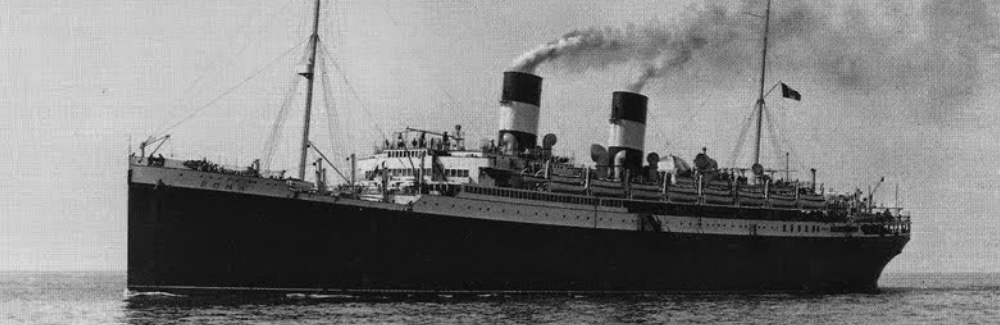
SS Roma
Navigazione Generale Italiana · entered service 1926 · Ship Guide
Overview
SS Roma was a flagship-scale Italian transatlantic liner built for Navigazione Generale Italiana (Genoa) and placed into service in 1926. In contemporary accounts she is often framed as a prestige statement for Italy’s post–World War I return to the North Atlantic passenger trade: a large, modern turbine liner intended for regular service between Italy and New York.
Her later story is a sharp reminder that liners can become “two different ships” in historical memory. In civil service she appears in passenger materials as SS Roma; in wartime narratives she becomes the partially completed aircraft carrier Aquila. When cataloging, tie the ship’s status (liner vs naval conversion) to a dated source rather than letting the later carrier story swallow the liner career.
Key Facts
Design & Construction Context
SS Roma reflects the interwar “big turbine liner” logic: maximize smoothness and passenger comfort on the North Atlantic while projecting national prestige. Sources frequently emphasize her size within the Italian fleet at the time, and the ship’s décor is often described as elaborate (baroque styling is commonly mentioned).
The pairing with MS Augustus is also instructive: the sister-ships are regularly contrasted in summaries because Roma is remembered as the turbine ship, while Augustus is remembered as the diesel sister. That comparison shows up in collecting, too—brochures and postcard sets sometimes present them as a matched “new generation.”
Service History (Summary)
1926–1932: Operated for NGI on the Italy–New York run (Genoa/Naples–New York routing is frequently cited). Passenger-facing material from this era tends to foreground “Italian-made” modernity and an upscale onboard environment.
1932–1940: Transferred to the newly formed Italian Line after the consolidation of major Italian operators (a 1932 transition is commonly cited). Sources also note class/marketing adjustments in the early 1930s as the interwar travel market evolved.
1941–1945: Acquired for naval conversion and renamed Aquila in most accounts. The carrier conversion became a major “what-if” story of Italian naval aviation, but it is crucial to keep the ship’s liner identity separate when describing prewar artifacts.
1945–1952: Damaged and partially sunk in 1945; later raised and scrapped by 1952 in most summaries.
Interpretive Notes
Two collecting lanes: SS Roma (liner) artifacts—brochures, menus, baggage labels, postcards—tend to date to 1926–1940, while Aquila material (plans, naval references, later publications) belongs to the wartime narrative. Keep those lanes distinct in catalog entries.
Route clues: “Genoa–Naples–New York” on a sailing notice is a strong anchor for identifying early liner-period pieces. If a document references Italian Line branding and updated class naming, it likely belongs after the 1932 consolidation.
Collision claims: The 1932 collision is frequently mentioned; if an object is marketed as “after the collision,” treat that as a hypothesis unless the piece is dated or references repairs explicitly. Curator practice: record what the artifact itself states, then add a separate interpretive note.
Passenger liner first, carrier conversion second: Roma had a complete civilian identity before the wartime project to convert her into the aircraft carrier Aquila. The conversion should therefore be treated as a provenance break, not as a routine refit of the passenger ship. Plans, interiors, and passenger ephemera belong to the liner; wartime structural photographs and naval documents belong to the separate Aquila phase.
This distinction is especially useful because the conversion was never followed by a normal commissioned carrier career. The historical record is one of transformation and interruption: a liner removed from commerce, radically rebuilt for war, and left incomplete as the conflict overtook the project.
That incomplete naval afterlife should not be projected backward onto ordinary passenger-era objects or images.
The distinction is essential.
Evidence-first ship guide