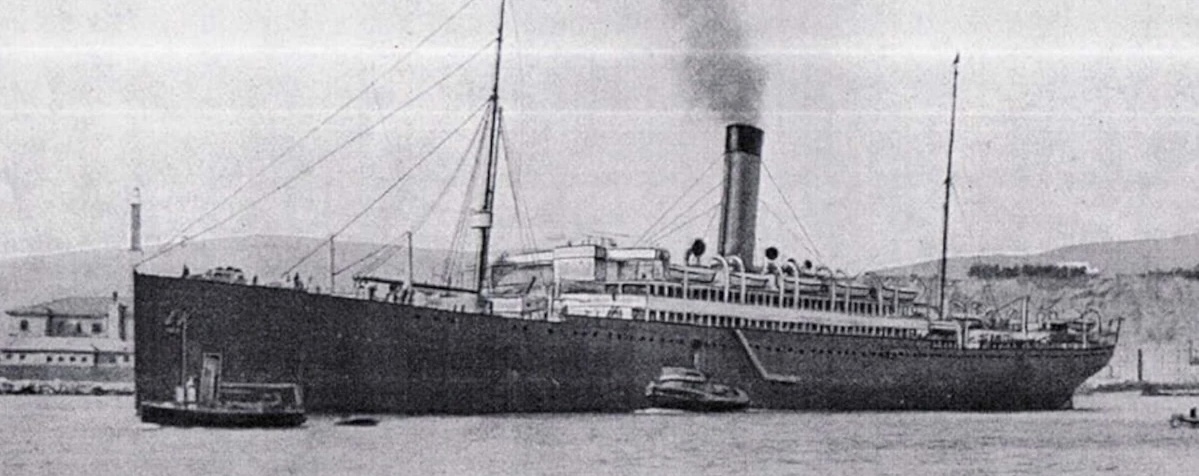
SS Romanic
White Star Line · in White Star service from 1903 · Ship Guide
Overview
SS Romanic was a White Star intermediate liner whose history began outside White Star itself. Harland & Wolff launched her on 7 April 1898 as New England for Dominion Line. After the IMM reorganization, she transferred to White Star in 1903 and became Romanic.
Her service belonged to White Star's commercially vital secondary network: Liverpool–Boston and later Boston–Mediterranean routes linking New England with southern Europe. She later became Scandinavian, extending the same hull into Allan Line and Canadian Pacific contexts.
Key Facts
New England Before Romanic
The ship's Dominion Line origin is central to understanding her. She was not designed specifically as a White Star vessel, and her transfer after the formation of the IMM network demonstrates how ships could be reassigned where capacity was most useful.
Construction and early passenger material may therefore use New England. That name should not be “corrected” to Romanic in cataloging; instead, the later White Star identity should be explained separately.
Liverpool–Boston Service
After transfer to White Star, Romanic served Liverpool–Boston. This placed her within a route system that carried migrants, families, cargo, and ordinary travelers rather than the elite express traffic associated with White Star's best-known New York liners.
Boston service generated its own passenger lists and agency material and deserves to be treated as a primary commercial identity rather than an incidental route.
Boston–Mediterranean Service
White Star later used Romanic on Boston–Mediterranean sailings involving ports such as Naples and Genoa. GG Archives preserves passenger-list evidence for these voyages, which connected New England directly with southern European migration traffic.
This route history is one of the strongest reasons to preserve the ship's fuller narrative. It shows that White Star operated a much broader passenger network than the Liverpool–New York express corridor alone.
Collision of 1907
In 1907 Romanic was involved in a collision with the schooner Natalie B. Nickerson in fog near Nantucket Shoals. The incident belongs to the operational history of the ship but did not define or end her career.
As with other nonterminal accidents, it is best treated proportionately: useful for chronology and maritime operations, but not as the organizing identity of the liner.
Changing Mediterranean Competition
By the early 1910s, changing market conditions and stronger competition affected the economics of White Star's Mediterranean service. Romanic was withdrawn from that work and sold in 1912.
This change reminds us that route history was driven by economics and migration patterns as much as by ship design. A useful liner could become surplus when the market around it changed.
Scandinavian
Sold to Allan Line and renamed Scandinavian, the ship entered a new Canadian-service identity that later continued under Canadian Pacific control. The same hull therefore appears in multiple national and corporate contexts.
For curatorial work, New England, Romanic, and Scandinavian should remain distinct catalog identities even when a summary explains the full life of the hull.
Passenger Markets and Social History
Romanic's original accommodation of roughly 200 first, 200 second, and 800 third-class passengers shows that migration traffic was central to the commercial model. The ship's importance therefore lies not only in corporate transfer history but in the thousands of ordinary journeys made between Britain, New England, and southern Europe.
Passenger lists, immigration records, and family papers can reveal these journeys in ways that prestige-focused liner histories often miss. Boston and Mediterranean traffic deserves to stand alongside the better-known New York express story.
Material Culture and Attribution
Because the same hull served as New England, Romanic, and Scandinavian, surviving menus, postcards, tickets, and photographs should be attributed to the name and company printed at the time. Later collector shorthand can erase real corporate and route differences.
Route wording is particularly useful. A Genoa–Boston passenger list anchors the White Star Mediterranean phase much more precisely than the ship name alone.
That fuller route history also makes Romanic unusually useful for studying how White Star adapted existing tonnage to changing migration markets rather than relying only on new construction.
Interpretive Notes
Romanic is a strong example of White Star expansion through transferred tonnage. The ship's Dominion origin should not be lost simply because the White Star name became better known.
Her Boston and Mediterranean roles also deserve emphasis. They document the less glamorous but commercially essential side of White Star's passenger network and the migration flows connecting southern Europe with New England.
Evidence-first ship guide