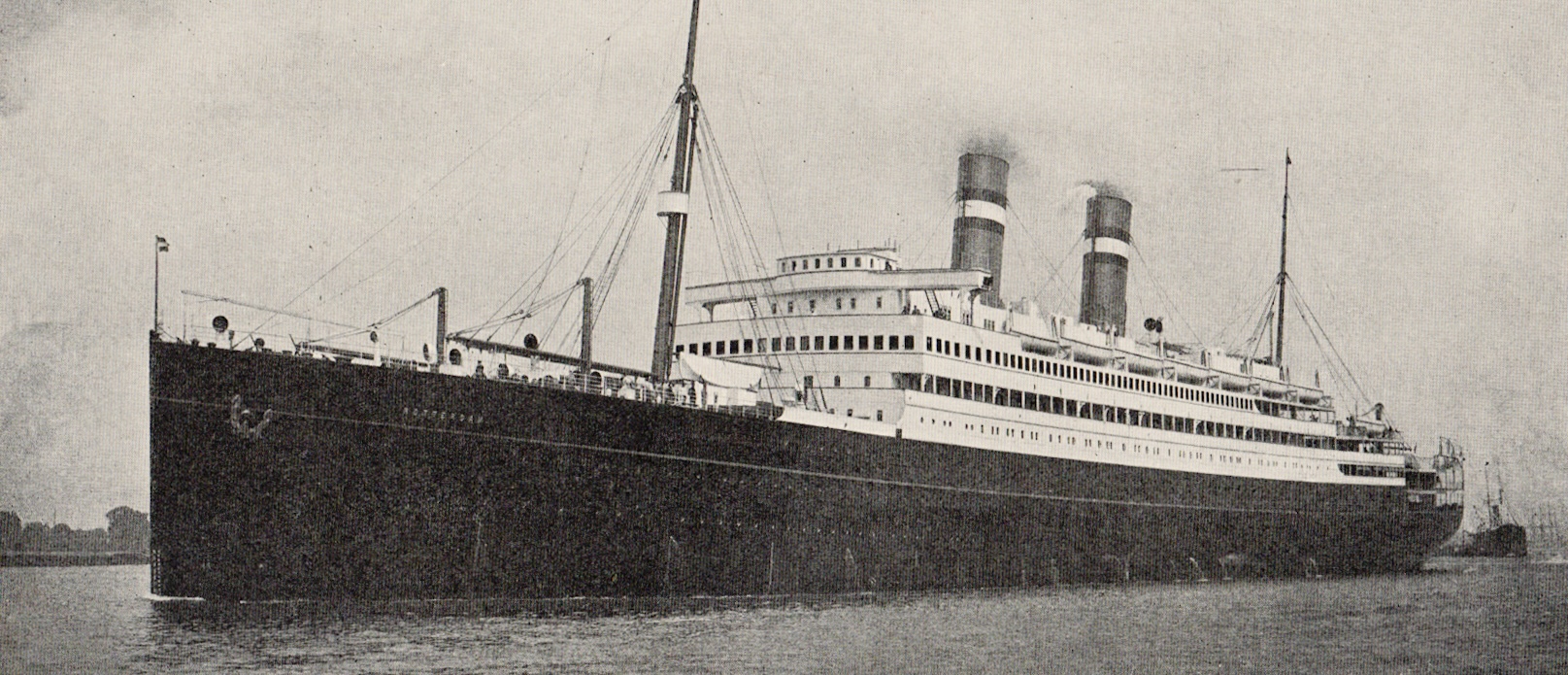
SS Rotterdam (1908)
Holland America Line · entered service 1908 · Ship Guide
Overview
SS Rotterdam (1908) was Holland America Line’s flagship in the years before the First World War and one of the most important Dutch transatlantic liners of her generation. Built by Harland & Wolff in Belfast, she entered service in June 1908 on the Rotterdam–New York route.
Her importance rested less on headline speed than on scale, accommodation, and route identity. Holland America’s own historical timeline identifies Rotterdam as the company flagship and notes a notable design feature: she was the line’s first transatlantic ship with a glass-enclosed promenade.
Key Facts
A Different Model of Prestige
Rotterdam belonged to the same broad era as the fastest British and German express liners, yet Holland America did not build her primarily as a record breaker. Her roughly 16–17-knot service speed supported a different proposition: dependable transportation, substantial passenger capacity, and a distinctly Dutch presence on the North Atlantic.
That difference is historically useful. Liner competition is often narrated as a sequence of Blue Riband contests, but most passengers did not choose solely on speed. Schedule, price, migration networks, reputation, and accommodation mattered enormously. Rotterdam demonstrates how a line could establish prestige without chasing the fastest crossing.
Passenger Experience and the Enclosed Promenade
Holland America’s anniversary history singles out Rotterdam as the company’s first transatlantic vessel with a glass-enclosed promenade. On the North Atlantic, where wind, spray, and cold could make open deck space uncomfortable, enclosure extended the usefulness of the promenade and turned it into a more dependable passenger amenity.
The feature fits the broader direction of Edwardian liner design: public spaces were becoming more numerous, more specialized, and more deliberately insulated from the working realities of the ship. Comfort increasingly meant controlling the passenger’s environment, not merely providing a berth and dining room.
Migration and the Holland America System
The Rotterdam City Archives emphasizes Holland America Line’s major role in European migration to the United States. That context matters for this ship. Rotterdam was not simply a floating hotel for affluent travelers; she operated within a company whose traffic included emigrants, tourists, business travelers, and returning families moving through Rotterdam’s port infrastructure toward New York.
The surviving Holland America headquarters and migration records in Rotterdam reinforce the shore-side half of that story. As with other major liner companies, the vessel was only one component of a larger system of ticketing, rail travel, baggage handling, medical inspection, lodging, and port administration.
War, Adaptation, and Interwar Service
The First World War disrupted normal North Atlantic operations even for neutral Dutch shipping. Rotterdam survived that period and continued into the interwar years, when changing immigration policy and passenger demand encouraged established liners to adapt their accommodation and itineraries. Cruising became increasingly important across the industry as operators sought new uses for large passenger ships outside traditional point-to-point migration traffic.
By the late 1930s the ship belonged to an earlier generation of liner design. The outbreak of the Second World War brought her career to an end, and she was broken up in 1940.
Why Rotterdam Matters
Rotterdam offers a valuable alternative to a speed-centered account of ocean-liner history. She represents a successful route-focused flagship: large, recognizable, commercially useful, and closely tied to the migration history of her home port. Her glass-enclosed promenade and long career show how passenger comfort and operational durability could matter as much as maximum speed.
For attribution, the ship’s name requires special care because “Rotterdam” may refer to the vessel, the city, the departure port, or the company’s headquarters. Strong cataloging should identify which meaning is actually supported by the object or document.
Flagship of a Growing Holland America Line
When Rotterdam entered service in 1908, Holland America Line presented her as its flagship. The company’s own historical timeline identifies her as the first transatlantic ship fitted with a glass-enclosed promenade, an amenity that illustrates how liner design was increasingly shaped around passenger comfort as well as transportation.
She also represented a more visible corporate confidence. Holland America’s historical account describes the fourth Rotterdam as the company’s first two-funnel ship, giving the vessel a stronger express-liner profile even though the line’s identity rested more on dependable service than on competing directly for absolute speed records.
From Crossing to Cruising
Rotterdam remained useful because her career adapted as the passenger business changed. Holland America records that she served as a troop carrier around the end of the First World War and later made regular Mediterranean cruises from New York. That transition is historically significant: it shows an established North Atlantic liner being used not only as point-to-point transportation but increasingly as the destination and experience itself.
Seen in that context, the 1908 Rotterdam belongs to the longer history of the liner-to-cruise transition. Her career connects the mass migration and scheduled-service world of the early twentieth century with the growing leisure-cruise market of the interwar years.
The ship’s long career also makes date-sensitive interpretation essential: flagship-era Atlantic material, cruise-era publicity, and later photographs may all depict Rotterdam accurately while documenting very different passenger products.
Evidence-first ship guide