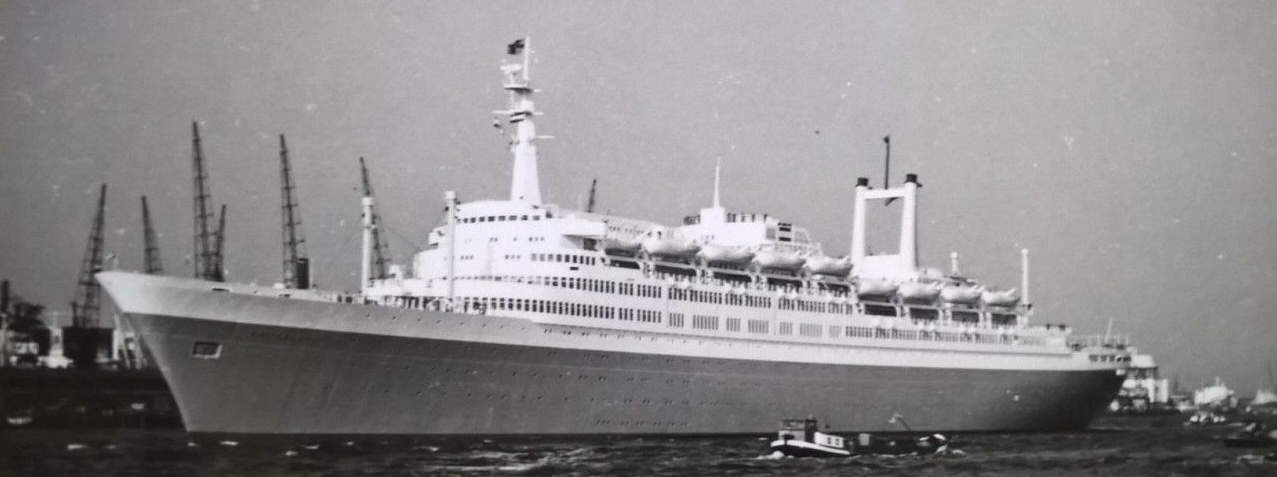
SS Rotterdam (1959)
Holland America Line · 1959 · Ship Guide
Overview
SS Rotterdam of 1959—Holland America Line’s fifth ship of the name—was conceived as both a national flagship and a practical answer to a passenger market already beginning to shift away from scheduled transatlantic travel. Launched by Queen Juliana on 13 September 1958 and placed in service in September 1959, she combined two-class liner operation with design features that could be adapted increasingly toward cruising.
That flexibility explains her extraordinary longevity. She served Holland America Line for 38 years, became the cruise ship Rembrandt under Premier Cruises from 1997 to 2000, survived years of uncertain lay-up, and ultimately returned to Rotterdam as a preserved hotel and visitor attraction.
Key Facts
A Ship of State
Holland America described Rotterdam as a “Ship of State,” and the phrase captures more than marketing. The Dutch government helped finance the project, while the ship’s architecture, interiors, art, and craftsmanship were intended to project a modern national identity. Her unconventional profile—with two narrow uptake structures rather than a traditional central funnel—was visually radical enough to divide contemporary opinion.
The interiors were similarly deliberate. Instead of treating the ship as a floating copy of an older luxury hotel, designers used modern Dutch art and applied design to create a recognizably postwar environment.
Designed for Liner and Cruise Work
The ship entered service while jet aviation was rapidly changing transatlantic travel. Holland America therefore needed a flagship that could still work a two-class North Atlantic schedule but could also be adapted to cruising. Movable partitions and flexible circulation helped make that possible.
In 1969 Rotterdam became a one-class ship. Holland America continued transatlantic passenger service into the early 1970s, but cruising increasingly defined the vessel’s commercial life. This was not simply a retirement from liner service; it was a planned adaptation that allowed a 1950s flagship to remain commercially useful for decades.
Thirty-Eight Years with Holland America
Rotterdam remained with Holland America through world cruises, seasonal itineraries, Alaska service, and repeated refits. The long career means that passenger capacity, room names, decorative schemes, livery, and even the commercial meaning of the ship changed substantially over time.
For collecting and attribution, a dated itinerary is therefore unusually valuable. A 1960 transatlantic menu, a 1970s world-cruise program, and a 1990s Alaska item can all belong to the same ship while documenting very different operational identities.
Rembrandt and the Preservation Struggle
Holland America sold the ship in 1997 to Premier Cruises, which renamed her Rembrandt. After refit work she returned to cruising and even revisited Rotterdam in October 1998. Premier Cruises collapsed in 2000, leaving the ship laid up at Freeport in the Bahamas.
Preservation then became a complicated multi-year project. The ship changed ownership, left Freeport in 2004, underwent work in several European ports, regained the name Rotterdam, and ultimately returned permanently to her namesake city. The present hotel and heritage attraction is therefore a third major interpretive phase after liner/cruise service and the Rembrandt years.
Designing Around Two Markets
The most important design idea aboard Rotterdam was flexibility. Public spaces and circulation were arranged so that class separation could be imposed for line voyages and relaxed for cruises. That was a practical response to uncertainty: Holland America could not know in the mid-1950s how quickly air travel would erode the Atlantic market, but it could build a flagship less dependent on one commercial pattern.
This flexibility also complicates photographs and deck plans. A room shown in a 1960 brochure may have a different access pattern, name, décor, or passenger mix a decade later. Researchers should therefore resist treating “the interior of Rotterdam” as a single frozen design state.
Collecting Across Three Lives
The ship’s evidence naturally separates into three large groups: Holland America service as Rotterdam, Premier Cruises service as Rembrandt, and the preserved hotel/heritage ship after her return to the Netherlands. Modern souvenirs may intentionally reproduce earlier logos or imagery, which makes production date just as important as the historical scene depicted.
Why Rotterdam Matters
Rotterdam is one of the clearest surviving physical records of the transition from ocean liner to cruise ship. She was designed while the North Atlantic passenger trade still mattered, adapted successfully as that market collapsed, and survived long enough to become an artifact of the very age she helped close.
Her preservation also creates a useful warning for researchers: modern hotel-ship branding, restored spaces, and heritage interpretation belong to the ship’s post-service life. They should be distinguished from evidence documenting how the vessel actually looked and operated in a specific sailing year.
Interpretive Notes
Liner and cruise functions were designed to overlap: Rotterdam was conceived for adaptability, so her later cruise emphasis should not be read as an entirely separate afterlife.
Three identities require phase-specific attribution: Holland America service, Rembrandt, and the preserved hotel/museum ship belong to different documentary and physical contexts.
Evidence-first ship guideSources (Selected)
- Ocean Liner Curator — Sources (master bibliography)
- ss Rotterdam — official history and preservation chronology
- Holland America Line — historical timeline, including the 1959 “Ship of State” entry
- Holland America Line — history of the seven Rotterdam ships
- Friends of steamship Rotterdam — service, Rembrandt, and preservation history