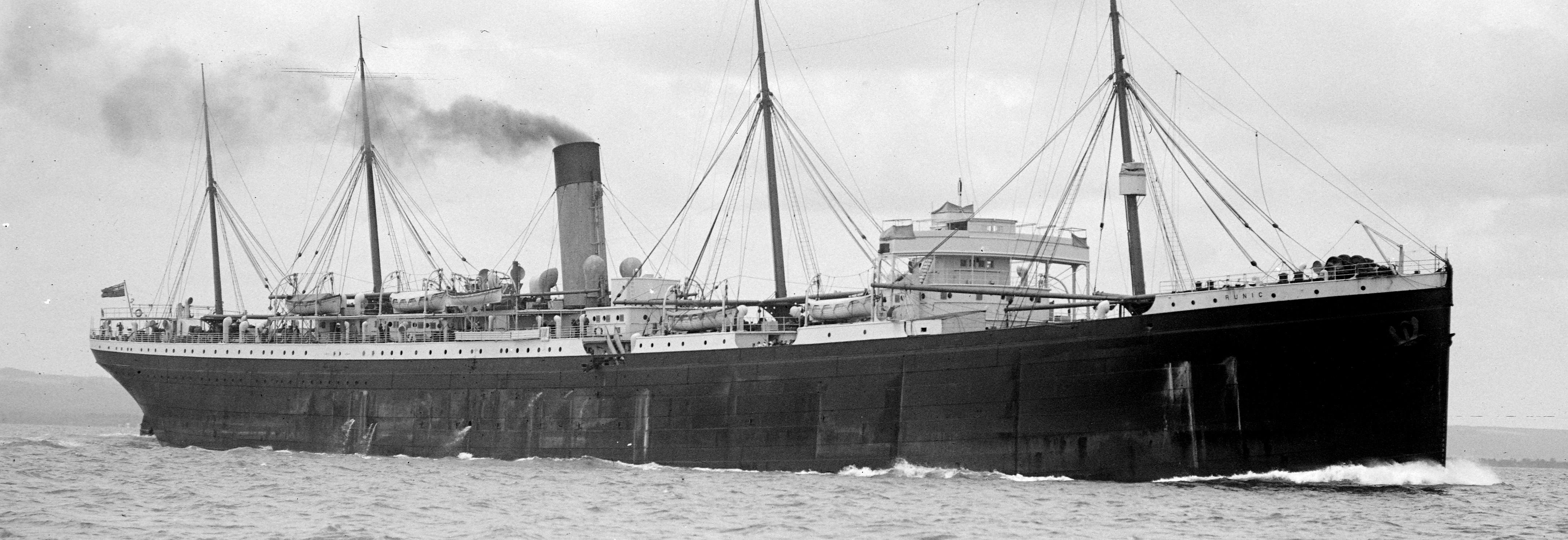
SS Runic (1900)
White Star Line · entered service 1901 · Ship Guide
Overview
SS Runic was the fourth of White Star Line's five Jubilee-class Australia ships. Built by Harland & Wolff, she was launched on 25 October 1900, completed on 22 December, and began her maiden Liverpool–Australia voyage on 19 January 1901.
Like her sisters, Runic belonged to White Star's practical long-haul fleet. Her purpose was to move passengers and large quantities of wool, refrigerated produce and general cargo reliably between Britain, South Africa and Australia, not to compete for Atlantic speed records.
Key Facts
Australia Service
White Star's 1907 literature illustrated Runic as one of the five ships maintaining the Australian service. The route depended on regularity and carrying capacity. Refrigerated cargo and wool were therefore not incidental details but part of the ship's central economic purpose.
This commercial context changes how surviving material should be interpreted. Brochures, passenger papers, freight documents and port photographs belong to a route system with different priorities from White Star's New York express service.
Service History
1901: Soon after entering service, Runic assisted the disabled Union-Castle liner Briton, towing her toward safety. The episode offers a rare glimpse of the everyday operational world surrounding scheduled liners.
1901–1914: She continued the Liverpool–Cape Town–Sydney pattern as a dependable cargo-passenger ship. Her long prewar career is important because it represents the normal working life of the Jubilee class rather than an exceptional event.
First World War: In 1915 Runic entered Australian troop-transport service and became associated with the designation HMAT A54. She continued transport work through the war. A fog collision with the collier Horst Martini in 1915 belonged to this wartime phase and should not be confused with peacetime liner operations.
Postwar: She returned to the Australian route and remained in White Star service into 1930, giving her nearly three decades in the trade for which she had been designed.
New Sevilla: Sale and conversion into the whale-factory ship New Sevilla transformed the vessel's function completely. She remained active in that industrial role until being torpedoed and sunk off the Irish coast in September 1940.
Interpretive Notes
This is the 1900-built Runic, not White Star's earlier 1889 ship of the same name. Construction date is therefore essential in cataloging photographs and documents.
The whaling conversion should also be treated as a hard provenance break. Later industrial records belong to the same hull history, but they do not describe the same functional object as the White Star passenger-cargo liner.
Collecting & Attribution Context
Runic requires two kinds of disambiguation. First, the 1900-built ship must be separated from White Star's earlier vessel of the same name. Second, White Star-era material must be separated from the later New Sevilla factory-ship phase. A bare ship name is therefore not enough for reliable cataloging; construction date, operator and visible configuration all matter.
Australia-service documents can also reveal the commercial priorities that photographs alone may not show. Wool, refrigerated produce and general cargo were fundamental to the route, even when surviving imagery foregrounds passengers or the ship's exterior. Freight references and schedule material are therefore central historical evidence rather than peripheral ephemera.
Why Runic Matters
The ship demonstrates the durability of the Jubilee-class concept. She served the route for which she had been designed, adapted to wartime transport, returned to civilian operation, and only near the end of her White Star career left the passenger-cargo system entirely.
That sequence is valuable because it shows continuity alongside change. The same basic long-haul liner could be repurposed by war without losing its commercial identity, then later undergo a conversion so extensive that a new industrial identity became more appropriate. Treating those stages separately produces a more accurate record than either focusing only on White Star or allowing the later whaling career to dominate.
Seen alongside her sisters, Runic also helps establish the Jubilee ships as a coherent fleet program rather than a set of unrelated biographies. Their common dimensions, machinery, route and cargo purpose make comparison useful, while individual incidents and later careers explain how ships built to the same broad concept could accumulate very different documentary records over time.
That broader fleet context is essential to interpreting her surviving record.
Evidence-first ship guide