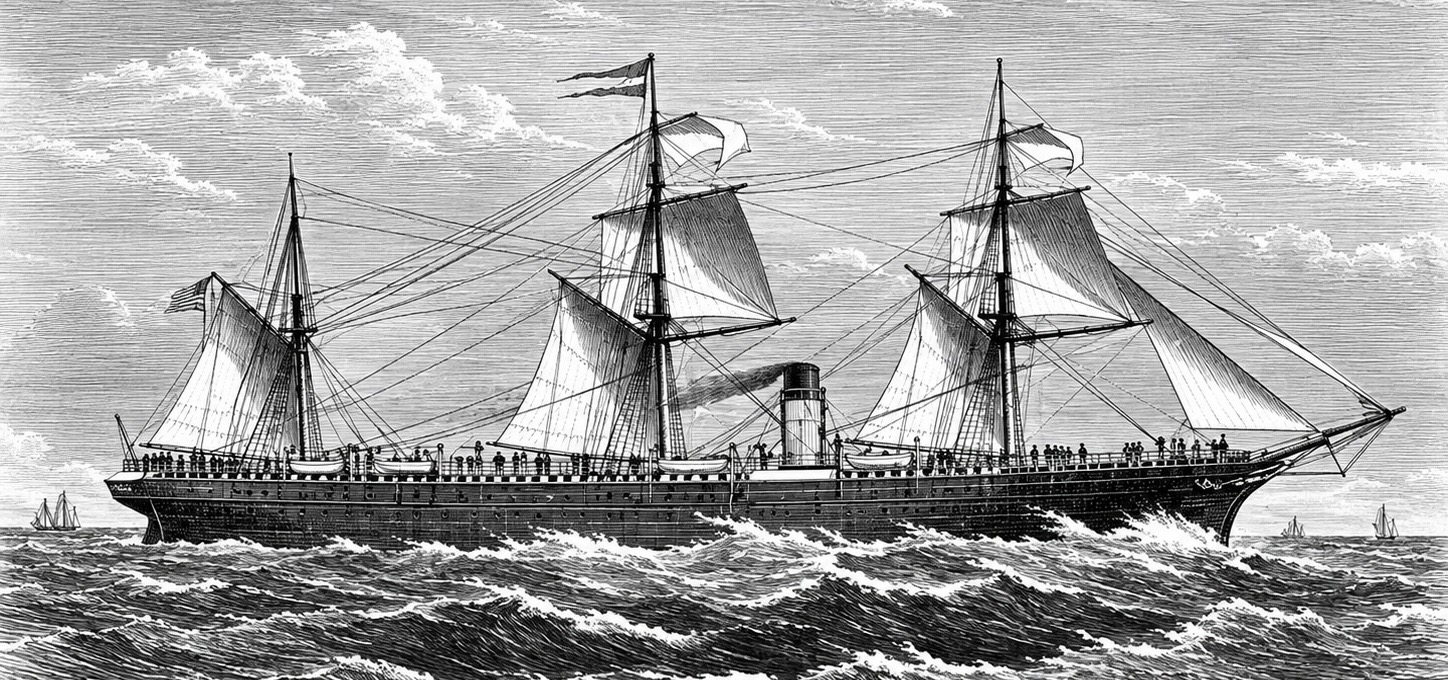
SS Russia (1867)
Cunard Line · Liverpool–New York · Ship Guide
Overview
SS Russia was an iron-hulled, single-screw Cunard express liner built by J. & G. Thomson at Glasgow. Launched on 20 March 1867, she began her maiden voyage from Liverpool to New York on 15 June that year.
She represented a more mature stage of the technological transition begun by ships such as China. Screw propulsion was no longer merely an experiment; in Russia, Cunard combined iron construction, direct-acting machinery, and high service speed in a liner designed to compete seriously for Atlantic prestige.
Key Facts
From Experiment to Express Liner
China had shown Cunard that an iron screw liner could be commercially effective even when paddle ships retained a speed advantage. Five years later, Russia demonstrated how quickly that balance was shifting.
Her direct-acting machinery was itself notable in Cunard service. Rather than preserving the older engineering conventions of the paddle era, the ship belonged to a generation in which screw propulsion increasingly shaped the layout, economy, and performance of the entire vessel.
An Atlantic Speed Contender
Contemporary and later Cunard histories credit Russia with a notably fast west-to-east crossing from New York to Queenstown in 1867, briefly giving her the Atlantic speed record. The distinction was short-lived, with the Inman liner City of Paris soon surpassing her.
The episode is useful not because the record lasted long, but because it demonstrated that screw liners could now challenge the fastest paddle steamers directly. The technological argument for the screw was no longer based on economy alone.
Passengers and Reputation
Russia developed a strong reputation for comfort and speed. Charles Dickens returned to Britain aboard her after his second American reading tour, an association frequently noted in later histories of the ship.
Her initial first-class accommodation is commonly given as roughly 235 passengers, with later capacity increased. As with other nineteenth-century liners, published capacities should be read as configuration-dependent rather than fixed across an entire career.
Sale to Red Star Line
In 1880 Russia was purchased by the Red Star Line and renamed Waesland. Under her new owners she was rebuilt and fitted with compound machinery. Later, in 1889, she received triple-expansion engines.
These repeated machinery upgrades are a reminder of the durability of a good iron hull. A ship launched in 1867 could remain commercially useful for decades if propulsion and accommodations were modernized as technology advanced.
American Line Charter
From 1895 Waesland also sailed under charter to the American Line, including Philadelphia–Liverpool service. By then she was an elderly vessel, but still part of the North Atlantic passenger network she had entered almost three decades earlier.
Loss in 1902
On 5 March 1902 Waesland collided in fog with the steamship Harmonides off the coast of Anglesey. The former Cunarder sank, with two lives lost.
Her loss closed a service life of roughly thirty-five years under two principal identities: first as one of Cunard's important early screw express liners, and later as a long-serving Red Star and American Line vessel.
Why Russia Matters
Russia sits at an important point in Cunard's technical development. Arabia represented the endpoint of the wooden paddle era, China demonstrated the economic promise of iron and screw propulsion, and Russia showed that a screw liner could also compete for speed and prestige.
That makes her a natural bridge toward the larger screw liners of the 1870s, including Bothnia, and toward the increasingly integrated iron-and-screw design language that would define the mature ocean liner.
Interpretive Notes
Speed-record language varies: later sources often use “Blue Riband,” a retrospective term not formally awarded by a governing body. The better-supported point is that Russia made a record Atlantic passage in 1867.
1880 versus 1881: sources differ in whether the sale and renaming to Waesland are dated to 1880 or 1881. Norway Heritage places the purchase and renaming in 1880; some later Cunard references use 1881.
Dimensions may reflect rebuilding: later measurements can describe Waesland after lengthening and should not automatically be treated as her exact as-built dimensions.
Evidence-first ship guide