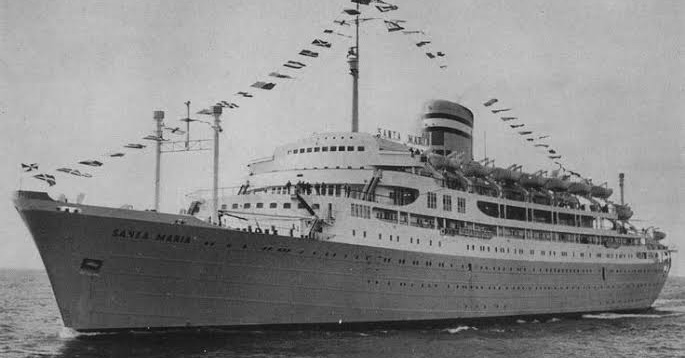
SS Santa Maria (1953)
Companhia Colonial de Navegação · entered service 1953 · Ship Guide
Overview
SS Santa Maria was a major postwar Portuguese passenger liner built for Companhia Colonial de Navegação (CCN). Closely related to the slightly earlier Vera Cruz, she entered service in 1953 and spent two decades linking Portugal with South America, the Caribbean, Venezuela, and the United States.
Her normal passenger career included migrant traffic, long-distance scheduled service, and a changing network of Atlantic ports. Yet her historical reputation is dominated by one extraordinary episode: the January 1961 seizure known as Operação Dulcineia, when Portuguese and Spanish opponents of the Iberian dictatorships took control of the ship and temporarily renamed her Santa Liberdade.
Key Facts
Portugal's Postwar Fleet Renewal
Santa Maria belonged to the large postwar renewal of Portugal's merchant fleet. CCN had already introduced Vera Cruz in 1952, and the newer ship followed the same broad design concept while expanding the company's modern passenger capacity.
Both vessels represented a deliberate break with older prewar tonnage. Their scale, accommodations, machinery, and visual identity were intended to signal a modern Portuguese merchant marine at a time when the country's shipping system still connected metropolitan Portugal with South America, Atlantic islands, and overseas territories.
South Atlantic Service
Santa Maria's maiden voyage began on 12 November 1953 and linked Portugal with Brazil, Uruguay, and Argentina. The South Atlantic remained central to her early career, combining ordinary passenger travel with the movement of emigrants and families between Portugal and South America.
Her role was not limited to a single fixed itinerary throughout her life. CCN adjusted routes as markets changed, and by the later 1950s the ship was also strongly associated with Venezuela, Curaçao, the Caribbean, and Florida.
Migration, Venezuela, and Florida
The liner became part of a wider postwar migration system connecting Iberian and Atlantic ports with Venezuela and other destinations in the Americas. Routes commonly included Lisbon, Vigo, Funchal, Tenerife, La Guaira, Curaçao, and Port Everglades, with variations over time.
This traffic is essential to understanding the ship beyond her famous political episode. For thousands of passengers, Santa Maria was not an abstract national symbol but a practical migration vessel carrying families, workers, tourists, and returning emigrants across the Atlantic.
Operação Dulcineia
During the night of 21–22 January 1961, a group of Portuguese and Spanish political opponents of the Salazar and Franco regimes seized Santa Maria in the Caribbean. The operation was led by Henrique Galvão and Jorge de Soutomayor under the banner of the Directório Revolucionário Ibérico de Libertação (DRIL).
The seizure was known as Operação Dulcineia. The rebels renamed the ship Santa Liberdade and hoped to turn the vessel into a dramatic international platform against dictatorship in Portugal and Spain. One ship's officer was killed during the takeover and several crewmen were wounded.
A Ship at the Center of an International Crisis
The disappearance of a large passenger liner carrying hundreds of passengers and crew quickly became an international crisis. Naval and air units searched for the vessel across the Atlantic while governments debated whether the seizure should be treated as piracy, mutiny, political rebellion, or an act by recognized opponents of a dictatorship.
The United States became deeply involved in efforts to locate and communicate with the ship. The crisis unfolded during the first days of the Kennedy administration, giving the episode a Cold War diplomatic dimension well beyond the normal concerns of passenger shipping.
Brazil and the End of the Seizure
The episode ended in early February 1961 after negotiations allowed Santa Maria to enter Recife, Brazil. The insurgents received political asylum under the new Brazilian government of Jânio Quadros, passengers and crew were released, and the ship was returned to its owners.
Although the seizure failed to produce the political uprising Galvão hoped for, it succeeded in drawing extraordinary international attention to opposition against Portugal's Estado Novo regime. For that reason, the ship became inseparable from the political history of late Portuguese colonialism and dictatorship.
Return to Passenger Service
After the 1961 crisis, Santa Maria returned to ordinary commercial service. The dramatic seizure did not end her passenger career, and she continued sailing for CCN for more than a decade.
Her later years took place in an increasingly difficult market. Jet airliners eroded long-distance passenger demand, migration patterns changed, and the economics of maintaining large steam-powered liners became progressively less favorable.
Retirement and Demolition
Santa Maria left service in 1973 after approximately twenty years with CCN. She was sold for demolition and broken up at Kaohsiung, Taiwan.
Her withdrawal came near the end of the traditional Portuguese passenger-liner era. Within a few years the institutional world that had produced ships such as Vera Cruz and Santa Maria was being reshaped by decolonization, corporate consolidation, aviation, and the broader collapse of scheduled long-distance sea travel.
Why Santa Maria Matters
The ship is historically significant for two different reasons that should be held together. As a liner, she represented Portugal's postwar effort to modernize long-distance passenger shipping and served important migration routes linking Europe and the Americas.
As the setting for Operação Dulcineia, she became an international political symbol. Reducing the ship only to the seizure obscures her commercial and migration history; ignoring the seizure, however, would miss the event that made her one of the most politically consequential passenger liners of the twentieth century.
Collecting Profile
Collectible material includes CCN brochures, deck plans, menus, sailing schedules, postcards, passenger lists, tickets, photographs, luggage labels, and route ephemera. Material from the Venezuela and Port Everglades services is particularly useful for reconstructing the ship's later commercial network.
Items connected with the 1961 seizure form a distinct collecting category: newspapers, photographs, political pamphlets, passenger accounts, and archival records may identify the vessel as Santa Maria or Santa Liberdade. Those names describe the same ship in radically different political contexts.
Interpretive Notes
Santa Maria and Vera Cruz were closely related ships: sources commonly treat them as sisters or near-sisters, although individual specifications and accommodation figures vary by date and source.
Passenger-capacity figures vary: published totals differ because some sources report original class configuration while others reflect later arrangements. The guide therefore avoids presenting a single capacity figure as universally applicable to the entire career.
The 1961 event was political as well as maritime: contemporary governments and later historians have used different legal and political terminology for the seizure. The guide uses “seizure” and the contemporary operation name rather than collapsing the event into a single contested label.
Evidence-first ship guideSources (Selected)
- Ocean Liner Curator — Sources (master bibliography)
- Arquivo Nacional da Torre do Tombo — O assalto ao Santa Maria
- Arquivo Histórico da Marinha Portuguesa — Incidente do Santa Maria
- UK Parliament, Hansard — Captain Galvão discussion, 13 June 1961
- Consello da Cultura Galega — Santa Maria and Atlantic migration routes
- Maritime ship reference — Santa Maria specifications and career outline