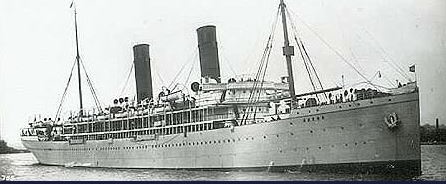
SS Saxon
Union-Castle Line · 1900 · Ship Guide
Overview
SS Saxon was a British Royal Mail steamer built by Harland & Wolff at Belfast for the Union Steam Ship Company’s service between Britain and South Africa. Launched in December 1899 and completed in June 1900, she entered service just as the Union Line and Castle Line were being combined into the Union-Castle Mail Steamship Company.
For most of her working life, Saxon formed part of the regular Southampton–Cape Town mail service. She carried passengers, government mail, valuable cargo, and the ordinary commercial traffic that linked Britain with southern Africa. During the First World War, she was requisitioned as a troopship and served in both the Mediterranean and North Atlantic before returning to civilian work.
This page treats Saxon as the fourth Union/Union-Castle vessel of that name, launched in 1899 and completed in 1900. Earlier company ships also carried the name, so date, builder, dimensions, and route should be checked before attributing material.
Key Facts
Note on machinery descriptions: secondary sources summarize her machinery differently. The dimensions, tonnage, service speed, and twin-screw arrangement are more consistently reported than abbreviated engine descriptions.
Design & Construction Context
Saxon was designed for the demanding mail route between Britain and South Africa. The service required dependable speed, sufficient coal endurance, comfortable passenger accommodation, refrigerated and general cargo space, and the ability to keep a tightly regulated sailing schedule over a long ocean route.
Her balanced two-funnel, two-masted profile reflected the established appearance of turn-of-the-century mail steamers. She was substantial without approaching the scale of the largest North Atlantic liners, and her design was shaped by route reliability rather than the pursuit of records.
Union-Castle Formation Context
Saxon entered service during the 1900 merger of the Union Steam Ship Company and Castle Mail Packets Company. The combined Union-Castle Line inherited the established passenger and mail networks of both firms and developed a highly recognizable service between Southampton and South Africa.
Because the ship was ordered for the Union Line but spent almost all of her working career under Union-Castle, surviving documents may use either identity depending on date. Early builder’s and launch records belong to the Union phase; later timetables and passenger material generally carry Union-Castle branding.
Southampton–Cape Town Mail Service
After the South African War, Saxon became one of the principal vessels maintaining the regular mail run. The route connected Southampton with Madeira and South African ports, although exact calls varied by schedule and period.
The mail contract shaped the ship’s working life. Punctuality had commercial and governmental significance, and the liner carried not only travelers but correspondence, official papers, specie, high-value freight, and refrigerated cargo.
Passenger Experience
Passenger life aboard Saxon reflected the social divisions of the period. First-class travelers occupied the most elaborate public rooms and cabins, while second- and third-class passengers had more modest accommodation. The comparatively limited third-class capacity distinguishes her from the enormous emigrant carriers operating between continental Europe and New York.
The South African route carried colonial officials, military personnel, business travelers, settlers, families, tourists, and returning residents. Passenger lists and contemporary newspapers can therefore provide a richer picture of the ship than fleet summaries alone.
Notable Passengers & Public Role
Saxon carried prominent officials as well as ordinary travelers. Lord Alfred Milner, High Commissioner for Southern Africa, traveled aboard her in 1901 on his return to Britain and again in 1925. Such voyages attracted press attention, but they represent only a small portion of the ship’s broader passenger history.
For research purposes, prominent names should be documented through dated passenger lists, newspapers, correspondence, or official records rather than repeated from undated anecdotal sources.
First World War Service
The British government requisitioned Saxon in January 1917 for troop transport. She first served in the Mediterranean and was later employed on the North Atlantic. In 1918 she carried American troops from New York to France as part of the Allied transport effort.
Compiled accounts credit her with six Atlantic troop voyages between May and October 1918. Her wartime role altered the ship’s accommodation, command arrangements, risk environment, and daily routine, even though she retained her familiar name.
Return to Civilian Service
After the war, Saxon returned to Union-Castle’s South African service. Her restoration to civilian use formed part of the wider effort to rebuild regular passenger and mail schedules after years of requisition and disruption.
She remained a dependable member of the fleet through the 1920s, even as newer ships introduced larger, more modern accommodation and machinery.
The 1921 Fire
In August 1921, Saxon suffered a serious fire after departing Madeira. She was escorted to Freetown, Sierra Leone, where her passengers and mail were transferred to another vessel.
Fire-related accounts should be checked against dated shipping reports and company records. Later summaries establish the broad event, but detailed claims about origin, damage, or individual actions require contemporary evidence.
September 1920 Rudder Damage
In September 1920, Saxon lost her rudder after striking a barge at Cape Town. The incident was comparatively minor and did not end her career, but it provides a useful date marker between postwar restoration and the more serious 1921 bunker fire.
Why Saxon Matters
Saxon is a strong example of the disciplined South African mail liner: designed around schedule reliability, long-distance communications, and mixed passenger-cargo service rather than North Atlantic prestige. Her wartime transport work, 1920 rudder damage, and 1921 fire add identifiable episodes without displacing the much longer civilian mail career.
Final Years & Disposal
By the end of the 1920s, Saxon belonged to an older generation of coal-fired mail steamers. She was withdrawn from regular mail service around 1930 and made her final intermediate sailing in January 1931 before being laid up as a reserve ship.
The liner remained inactive for several years and arrived at Blyth for scrapping in April 1935. She was the last surviving vessel from the original Union Line fleet inherited at the time of the 1900 merger.
Collecting Profile
Surviving material may include Union and Union-Castle postcards, menus, passenger lists, sailing schedules, mail-route notices, photographs, baggage labels, cabin documents, and wartime troop records. Material from her first year may carry pre-merger Union Line identity.
Because four company vessels carried the name, “SS Saxon” should never be treated as a complete attribution by itself. A credible catalog record should include the date, builder, route, dimensions, visual profile, or a passenger and voyage association.
Interpretive Notes
Saxon represents the disciplined working culture of the Royal Mail route. Her historical importance lies in repeated service: voyage after voyage linking Britain and South Africa through scheduled passenger, cargo, and communications networks.
Her wartime service adds another layer, but it should not eclipse the longer civilian career. For most of her life she was not a troopship, but a mail liner whose significance accumulated through ordinary reliability rather than a single dramatic event.
Evidence-first ship guideSources (Selected)
This list is intentionally conservative.