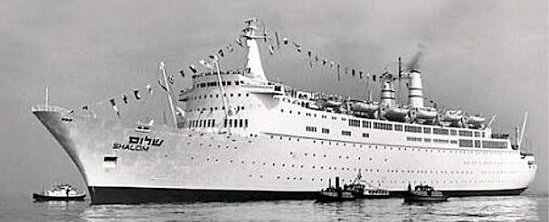
SS Shalom (1964)
ZIM Lines · entered transatlantic service 1964 · Ship Guide
Overview
SS Shalom was the largest and most ambitious passenger liner built for ZIM Israel Navigation Company. Constructed at Saint-Nazaire and delivered in 1964, she was conceived as a modern national flagship linking Israel with Europe and North America while also serving the growing cruise market.
Her timing was difficult. The ship entered service after jet aircraft had already overtaken the North Atlantic passenger trade, and ZIM's attempt to combine prestige liner service with cruising lasted only a few years. Even so, Shalom became one of the most recognizable Israeli passenger ships and later enjoyed a long career under several names, including Hanseatic, Doric, and Royal Odyssey.
Key Facts
A National Flagship at the End of the Liner Era
Shalom belonged to a generation of postwar passenger ships that were expected to represent national identity as much as transportation capacity. ZIM had already developed passenger services between Israel, Europe, and North America, but the new flagship was intended to place the company in a different league. Contemporary reporting emphasized her scale, modernity, art, public rooms, and symbolic role in Israel's merchant marine.
That ambition was immediately complicated by the market into which she arrived. By 1964 the economic center of long-distance passenger travel had shifted decisively toward the airplane. A new liner therefore needed to work not only as scheduled transportation but also as a vacation product, and Shalom was designed and marketed with both purposes in mind.
Design, Interiors, and Israeli Identity
The ship's interiors were notably modern rather than nostalgic. Israeli designer Dora Gad coordinated a decorative program that used contemporary furniture, murals, reliefs, textiles, stained glass, and works by Israeli and international artists. The result was intended to present a confident modern Israel aboard a French-built passenger ship.
The vessel included first- and tourist-class public rooms, swimming pools, enclosed promenades, a theater, library, synagogue, and other amenities associated with a prestige postwar liner. Her visual identity therefore matters historically: Shalom was not simply transportation from Haifa to New York, but a deliberately curated national showcase.
Maiden Transatlantic Voyage
After delivery and introductory cruises from Haifa, Shalom departed on her first transatlantic voyage on 17 April 1964. The routing connected Haifa with Mediterranean ports before continuing to New York. She reached New York at the end of April and received a ceremonial harbor welcome.
Contemporary accounts described the arrival as a major event for ZIM and for Israel's merchant fleet. Yet the voyage also illustrates the commercial problem at the heart of the ship's career: a highly publicized new liner was entering the Atlantic market at almost exactly the moment when scheduled sea travel was losing its mass-market role.
The Stolt Dagali Collision
On 26 November 1964, while outbound from New York for a Caribbean cruise in heavy fog, Shalom collided with the Norwegian tanker Stolt Dagali off New Jersey. The impact severed the tanker, and nineteen members of its crew were ultimately lost. Shalom suffered severe damage to her bow but remained afloat, assisted in rescue efforts, and returned to New York under her own power.
The collision generated extensive litigation in the United States and Sweden. Contemporary parties advanced competing claims about navigation, speed, lookout, and responsibility. For that reason, simplified later statements assigning the entire accident to one vessel should be treated cautiously unless tied to a specific judicial or investigative finding.
Transatlantic Service and Cruising
ZIM used Shalom for both scheduled crossings and cruises. That mixed employment was not unusual in the 1960s, but in her case it became central very quickly. Within months of entering service she underwent alterations intended to improve her usefulness for cruising, including changes to the balance of first-class accommodation.
The ship's operating model nevertheless remained difficult. A single flagship lacked the schedule flexibility of a larger paired service, while high operating costs and declining demand weakened the economics of the transatlantic route. ZIM ultimately withdrew from the passenger-liner business, and Shalom was sold in 1967.
From Shalom to Hanseatic
The sale did not end the ship's career. German Atlantic Line acquired her and renamed her Hanseatic, giving the vessel a second identity in the European cruise and passenger market. Subsequent owners repeatedly rebuilt and repositioned the ship as the passenger industry moved further away from scheduled liner service and toward dedicated cruising.
She became Doric for Home Lines in 1973 and Royal Odyssey for Royal Cruise Line in the 1980s. Later service under the Regency Cruises organization included the name Regent Sun. These successive identities make the vessel a particularly useful example of how a purpose-built postwar ocean liner could survive by being adapted to the emerging cruise industry.
Final Years and Loss
By the mid-1990s the former Shalom had reached the end of practical passenger service. After periods of lay-up and further changes of name and ownership, she was eventually sold for demolition.
In July 2001, while being towed toward the scrapyards of South Asia as Sun 11, the ship took on water and sank off South Africa near Cape St. Francis. Her loss ended a career of nearly four decades under a remarkable sequence of owners and identities.
Why Shalom Matters
Shalom is historically important because she captures several transitions at once. She was a national prestige project, a late entrant to the traditional transatlantic liner trade, an early example of the increasingly necessary liner-cruise hybrid, and ultimately a long-lived cruise ship under other names.
Her short ZIM career should therefore not be read simply as failure. It demonstrates how quickly the economics of passenger shipping had changed by the early 1960s. A technologically modern, visually sophisticated liner could still be obsolete as a business model almost from the moment she entered service.
Collecting Profile
Material relating to Shalom includes ZIM brochures, deck plans, sailing schedules, menus, passenger lists, postcards, luggage labels, photographs, and promotional material emphasizing her Israeli art and interiors. Because the ship later served under several well-known cruise operators, collectors also encounter substantial material from her Hanseatic, Doric, Royal Odyssey, and Regent Sun periods.
Identification should preserve the distinction between the original ZIM configuration and later rebuilds. Photographs of the same hull can represent substantially different passenger-service eras, liveries, layouts, and operators.
Interpretive Notes
“Entered service” and “maiden voyage” can refer to different moments: Shalom reached Haifa and began introductory cruising before departing on her first transatlantic sailing on 17 April 1964.
The collision requires careful attribution: contemporary litigation reflects disputed claims between the owners of Shalom and Stolt Dagali. A concise ship guide should distinguish the documented sequence of events from later simplified blame narratives.
Her later names belong to the same hull, not separate ships: Hanseatic, Doric, Royal Odyssey, and the later Regent Sun lineage were successive identities of the former Shalom.
Evidence-first ship guideSources (Selected)
- Ocean Liner Curator — Sources (master bibliography)
- Jewish Telegraphic Agency — New York arrival of Shalom, 1 May 1964
- Jewish Telegraphic Agency — contemporary report on the Stolt Dagali collision, 27 November 1964
- Pacific Vegetable Oil Corp. v. S/S Shalom, 257 F. Supp. 944 (S.D.N.Y. 1966)
- Palyam & Aliya Bet — ZIM's S/S Shalom
- Shipping Today & Yesterday — Shalom career and design history