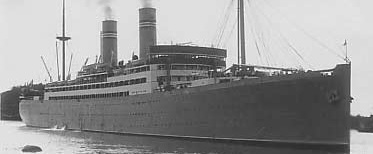
SS Stavangerfjord (1918)
Norwegian America Line · entered regular transatlantic service 1918 · Ship Guide
Overview
SS Stavangerfjord was the third passenger liner of the Norwegian America Line, formed to give Norwegian travelers and emigrants a direct route across the Atlantic under their own national flag. Built at Birkenhead during the First World War, the ship reached completion later than originally planned and went on to serve the line for approximately forty-five years.
Her history brings together Norway–United States migration, changing patterns of travel in the interwar period, wartime occupation of Norway, and the recovery of transatlantic passenger service after 1945. She was not an express-liner record breaker; her importance lies instead in the long continuity of a direct national passenger route.
Key Facts
Construction and an Unusual Beginning
Norwegian America Line ordered Stavangerfjord in 1914, but wartime conditions delayed completion. She was launched at Cammell Laird on 21 May 1917 and completed in April 1918. The voyage that began at Birkenhead on 29 April 1918 was not the same event as her commencement of routine Norway–New York sailings.
After reaching New York, she remained there for months before returning toward Norway in September. Her direct Norwegian transatlantic service was then established in the autumn of 1918. References to a single “maiden voyage” date need to specify whether they mean her first departure from the shipyard, initial arrival in Norway, or first outward voyage from Norway.
A Norwegian Route Across the Atlantic
The line linked Kristiania (later Oslo), Kristiansand, Stavanger, and Bergen with New York. The ship carried several classes of travelers, including emigrants, returning Norwegian Americans, business passengers, and tourists. Her early layout assigned much of the passenger capacity to third class, reflecting the social and commercial importance of migration.
Stavangerfjord joined an enterprise whose ships gave emigrants the option of embarking at Norwegian ports rather than arranging connections through Britain or the European continent. The route itself, not simply the machinery or accommodation, is central to understanding the liner's place in Norwegian maritime history.
Interwar Adaptation
The United States' immigration restrictions of the 1920s helped change the demand for passage. Norwegian America Line adapted through tourist travel and seasonal cruising while continuing scheduled crossings. Stavangerfjord was converted from coal to oil firing in the 1920s, a practical modernization for continued service.
Photographs, postcards, sailing lists, menus, and advertising from this period should be dated carefully: regular liner crossings and cruises could present quite different aspects of the same vessel.
Occupation and Second World War
The ship was laid up in Oslo in early 1940. Following the German occupation of Norway, she remained in Norwegian waters and was used in accommodation and support roles for German forces. This was a sharp break from her peacetime identity as a passenger liner.
Descriptions of this period should distinguish between requisitioned wartime use and her original commercial ownership; the available evidence does not justify treating her occupation-era service as a normal continuation of Norwegian America Line passenger operations.
Postwar Service and Retirement
Stavangerfjord returned to Norwegian America Line sailings in September 1945. A substantial overhaul at Gothenburg in 1946 interrupted her return, after which she continued the Norway–America route while replacement tonnage was still being arranged.
Her long career ended in December 1963. Sold for demolition, she was broken up at Hong Kong in 1964. Her retirement marked the close of a steamship era reaching back to the company's founding generation.
Interpretive Notes
Dates require labels. Construction, initial delivery departure, first Norwegian arrival, and the beginning of ordinary service are separate milestones. Differing published “maiden voyage” dates may reflect these different definitions rather than a single simple contradiction.
Passenger capacity changed with use and refits. Original-class figures are useful for understanding the emigrant era, but should not be projected unchanged onto later tourist and postwar accommodation.
Wartime photographic attribution requires care. A photograph showing the vessel in occupied Norway should not automatically be described as an image of commercial Norwegian America Line service.
Context matters more than prestige. Her lasting historical significance is the national transatlantic service she sustained, not exceptional speed or luxury.
Evidence-first ship guideSources (Selected)
- Ocean Liner Curator — Sources (master bibliography)
- Store norske leksikon — D/S Stavangerfjord (Per Kristian Sebak, Museum Vest)
- Store norske leksikon — Den norske Amerikalinje (line history and context)
- Norway Heritage — S/S Stavangerfjord (voyage chronology and particulars)
- GG Archives — SS Stavangerfjord archival collection