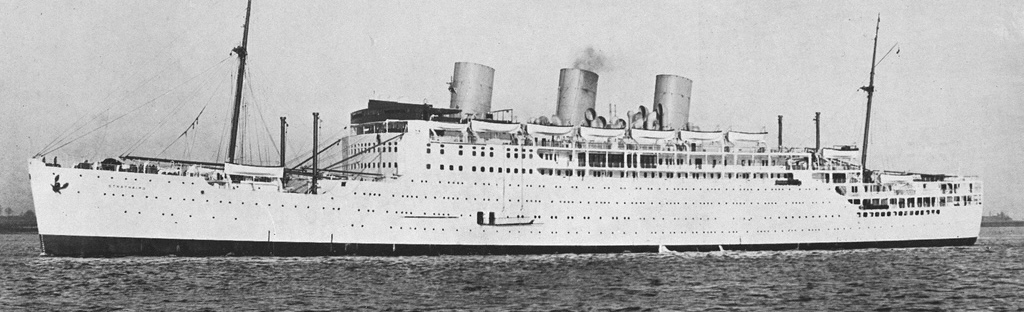
SS Strathaird
P&O · entered service 1932 · Ship Guide
Overview
SS Strathaird was one of P&O’s major interwar liners and the second of the company’s well-known “Strath” class. Built for the long Britain–Australia route, she embodied the company’s modernized interwar image: large scale, white hull, buff funnels, and a route identity tied less to North Atlantic speed rivalry than to imperial-distance passenger service through the Suez Canal. Like several of her sisters, she later had a substantial wartime career as a troopship before returning to civilian use in altered form.
In collecting and interpretation, Strathaird is best divided into four phases: prewar two-class P&O liner service, wartime troopship service, postwar refitted two-class service, and post-1954 single-class tourist service. Material from those phases can look related, but it does not necessarily belong to the same interpretive context.
Key Facts
Design & Construction Context
Strathaird belonged to P&O’s interwar modernization program, which produced the Strath-class liners as a distinctive visual and operational family. These ships departed from older P&O practice by using white hulls and buff funnels, creating a brighter and more contemporary brand image for the Australia route. That visual shift matters for collectors, since brochures, passenger lists, advertisements, and decorative pieces often reflect this “White Sisters” identity very strongly.
Technically, Strathaird was part of P&O’s embrace of turbo-electric propulsion for its large liners. She was not built for the North Atlantic record chase, but for sustained long-distance route service with strong passenger appeal and modern engineering. Her significance lies in the Britain–India–Australia imperial travel world rather than the Atlantic speed-race framework often applied to more famous liners.
Service History (Summary)
1930–1932: Ordered in January 1930, laid down in April of that year, launched in July 1931, and completed in January 1932. She began her maiden voyage from Tilbury on 12 February 1932.
1932–1939 prewar service: Entered P&O’s regular Britain–Australia route via Suez, working alongside sister ships such as Strathnaver. In December 1932 she also became the first P&O ship to undertake a cruise, sailing from Sydney to Norfolk Island, and later made occasional cruises from British ports.
1930s significance: As one of the interwar Strath liners, Strathaird helped define the public image of P&O’s modern long-distance passenger fleet. She belongs to the same broad visual and service family as Strathnaver, Strathmore, and the later surviving “Strath” sisters.
1939–1946 wartime service: Requisitioned as a troopship during the Second World War, she carried troops from Australasia to the Middle East and was also drawn into the emergency evacuation work of 1940. During Operation Aerial in June 1940, she evacuated about 6,000 civilians and troops from Brest.
1941 wartime movements: She also assisted in transporting members of the British Honduran Forestry Unit as part of the broader wartime labor and logistics effort. By the end of the war, her identity had become far more that of a troop carrier than of a luxury passenger ship.
1947–1948 return to civilian service: Returned to P&O at the end of 1946 and refitted by Vickers-Armstrong, with work completed in January 1948. In this refit, her first- and tourist-class capacities were revised, and her two dummy funnels were removed, giving her a noticeably altered appearance more like her later sisters.
1954 refit: Converted to single-class tourist service, abolishing first class and increasing total capacity. This marks an important interpretive break between her prewar and late-career passenger identities.
1961: Withdrawn as P&O introduced newer tonnage and sold for scrap. She left Tilbury on 17 June 1961 for Hong Kong, where she became the first of the Strath-class ships to be broken up.
Interpretive Notes
A Britain–Australia imperial-route liner, not an Atlantic greyhound: Strathaird belongs to the Suez-route passenger world of Britain, India, and Australia rather than the Atlantic prestige-race model.
The “White Sisters” branding matters: P&O’s white-hull presentation was a major part of the ship’s identity and should inform how visual material and passenger ephemera are read.
Her appearance changed materially after the war: post-1948 images lacking the two dummy funnels should not be confused with prewar imagery. For dating photographs and postcards, this is a very useful visual clue.
Late-career tourist-class material belongs to a different passenger economy: after 1954, Strathaird was no longer operating within the same class structure as in the 1930s. Brochures, tariffs, and onboard material from this phase reflect a postwar migration-and-tourist context rather than interwar imperial luxury.
Sistership context without flattening individuality: Strathaird shared the broad P&O design language of the Strath class, including the distinctive dummy-funnel arrangement, but her own voyage history, wartime work, and postwar refits should remain ship-specific. Similar appearance makes it easy to substitute one sister for another in captions or collections.
Her wartime personnel movements and later return to civilian service also created different documentary phases. A troopship image, a prewar Australia-route brochure, and a postwar passenger list may all be authentic records of the same hull while describing very different uses, class structures, and onboard conditions.
The same visual caution applies after refit: changes to funnels, deck arrangements, class configuration, and public spaces can provide stronger dating evidence than a generic caption. Preserving those breakpoints helps prevent sister-ship substitution and keeps prewar, wartime, and postwar material in the correct service phase.
Evidence-first ship guide