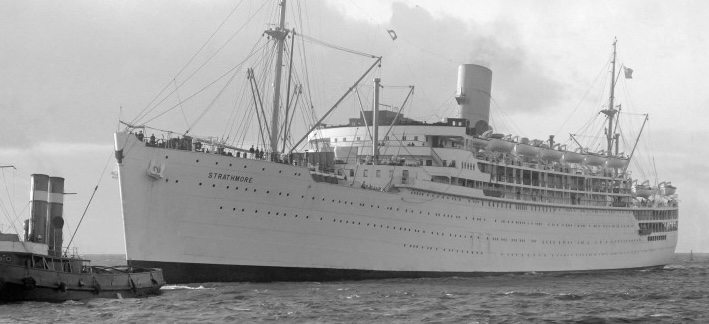
RMS Strathmore
P&O · entered service 1935 · Ship Guide
Overview
SS Strathmore was one of P&O’s best-known interwar liners and the third of the company’s celebrated “Strath” liners. When completed, she was P&O’s largest and fastest passenger ship. Built for the long imperial route structure linking Britain with India and Australia, she combined large size, modern passenger accommodation, and a distinctive white-hulled appearance that helped define the visual identity of P&O in the 1930s. Though remembered as a peacetime mail and passenger liner, an equally important part of her career was her long wartime service as a troopship.
In collecting and interpretation, Strathmore benefits from being understood in three phases: prewar P&O luxury liner service, wartime troopship service, and postwar migrant/tourist service. Material from those phases can look similar at first glance but often belongs to quite different operating contexts.
Key Facts
Length figures vary by source. For collector and catalog purposes, it is often best to preserve the exact wording used by the specific reference at hand rather than force all measurements into one form.
Design & Construction Context
Strathmore belonged to P&O’s interwar effort to modernize and visually refresh its long-distance passenger fleet. As one of the “Strath” liners, she was part of a family that included Strathnaver and Strathaird, associated with white hulls and buff funnels rather than the darker older P&O look. That shift matters both aesthetically and interpretively: ephemera for these ships often leans into brightness, sunshine-route imagery, imperial travel, and a more modern passenger identity than earlier company material.
She was also notable within the class itself. Contemporary accounts emphasized her size and speed, and she stood among the largest and fastest ships P&O had yet built. For a ship guide, this is worth stressing: Strathmore was not merely another route steamer, but a flagship-level expression of the company’s interwar passenger ambitions.
Service History (Summary)
1935: Launched in April 1935 at Barrow-in-Furness, completed that September, and entered service later that autumn for P&O. Her early career placed her on the company’s route system between Britain, India, and Australia.
1935–1939: In prewar service, Strathmore quickly became one of P&O’s best-known liners. She earned distinction on the Mediterranean-to-India run and carried a number of notable passengers, reflecting her prestige within the fleet.
1939–1940 transition: Like many British liners, her peacetime itinerary was disrupted by the worsening European crisis in 1939. In March 1940 she was requisitioned for wartime service and thereafter served as a troopship.
1940–1948 wartime service: During the Second World War she operated in troop transport service without the kind of catastrophic loss that overtook some comparable liners. This makes her wartime identity historically important even if it is less publicly dramatic than that of ships sunk in action.
1948–1949 return to civilian service: Returned to P&O in May 1948, she underwent refit and re-entered passenger service in 1949. In this postwar phase she resumed the Britain–Australia pattern with revised accommodations suited to a changed passenger market.
1950s–early 1960s: Strathmore continued in postwar liner and migrant service, and after a 1954 refit she operated in single-class form with a much larger berth capacity aimed at tourist and migrant traffic rather than old-style luxury hierarchy.
1963–1969: Sold out of P&O service in 1963 to Latsis Lines, she passed through the names Marianna Latsi and later Henrietta Latsi. After lay-up in Greece, she was scrapped in Italy in 1969.
Interpretive Notes
A P&O empire-route liner, not an Atlantic greyhound: Strathmore belongs to the Britain–India–Australia world of long-range mail, passenger, and imperial travel. She should not be read through Atlantic speed-race assumptions alone.
The “White Sisters” identity matters: visual material tied to Strathmore often reflects her place in P&O’s white-hulled interwar image-making. That branding context can help date brochures, passenger lists, advertising, and decorative ephemera.
Postwar material may reflect a different passenger economy: the post-1949 and especially post-1954 ship was serving a changed world of migration and tourist travel. Accommodation language, class distinctions, and route literature should be read with that transition in mind.
Wartime service should not be collapsed into peacetime identity: a troopship reference to SS Strathmore is not the same interpretive object as a P&O prewar passenger artifact labeled RMS Strathmore. Both are valid, but they belong to different historical frames.
Evidence-first ship guide