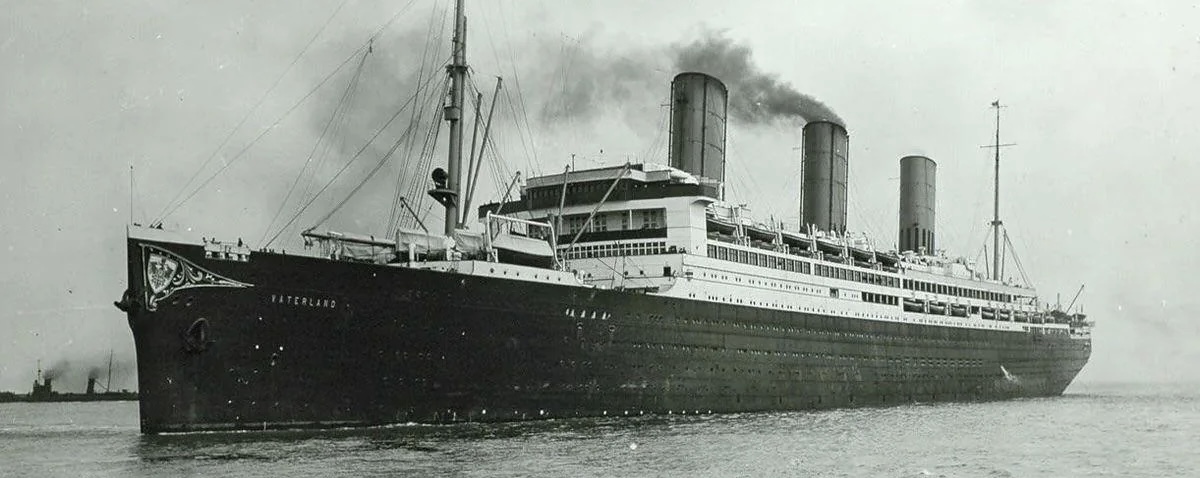
SS Vaterland
Hamburg-America Line · entered service 1914 · Ship Guide
Overview
SS Vaterland was the Hamburg America Line’s flagship-era statement piece: a giant, turbine-driven North Atlantic liner built for prestige and capacity at the height of pre–World War I competition. She entered service in May 1914—briefly holding the “largest ship afloat” kind of headline— only for the war to freeze her civilian career almost immediately.
The ship’s curatorial interest is concentrated in two overlapping stories: (1) the late-imperial “largest liner” era (design, scale, branding), and (2) the wartime disruption that stranded a German superliner at the line’s Hoboken piers in a neutral United States, creating the conditions for seizure when the U.S. entered the conflict.
Evidence-first note: after seizure, the ship enters U.S. administrative naming that can confuse cataloging (“USS Vaterland” appears briefly). This page stops at the documented renaming as USS Leviathan on 6 September 1917.
Key Facts
Design & Construction (Context)
Vaterland belongs to the “scale-as-message” era of ocean travel, when the largest ships were not simply transportation but brand architecture: size, stability, and public-room grandeur were used to project national and corporate confidence. For HAPAG, the Imperator-class program was a prestige instrument as much as a commercial one—intended to dominate headlines and reshape expectations of what an Atlantic liner could be.
Technically, she sat squarely in the early 20th-century turbine transition: fast, smooth, and electrified in ways that mattered for passenger comfort, ventilation, and onboard services. In evidence-first writing, it’s useful to keep “what was claimed in publicity” separate from “what can be verified in registers, plans, and builder documentation.”
Service History (Summary)
May–July 1914: Brief North Atlantic service. Completed in late April 1914, Vaterland sailed her maiden voyage on 14 May 1914. She entered the Hamburg–New York trade at the moment the prewar liner world was reaching a peak in size and confidence.
July 1914–April 1917: War disruption and lay-up at Hoboken. With the outbreak of World War I, the ship was withdrawn from normal service and laid up at the Hamburg America Line piers in Hoboken, New Jersey. This immobilized period is a key evidence context: many surviving photos, postcards, and press items cluster around the presence of German liners in U.S. waters and the political tension surrounding them.
6 April 1917: Seizure by the United States. When the United States entered the war, Vaterland was seized along with other German ships. She moved into U.S. governmental control, and the ship’s paper trail shifts from commercial passenger operations to legal/administrative and naval framing.
July–September 1917: Transition into U.S. Navy use; renamed. The ship was briefly commissioned under U.S. Navy authority and then, on 6 September 1917, renamed USS Leviathan. That rename is the clean cataloging boundary between German HAPAG identity (Vaterland) and U.S. troopship identity (Leviathan).
Interpretive Notes
Collecting Vaterland material is a classic “high reward / high confusion” case. The reward is the flagship documentation: HAPAG brochures, agent materials, passenger lists, menus, and postcards created to advertise the newest and largest liner. The confusion comes from the ship’s short civilian service window (1914) and the dramatic identity shift after 1917.
Evidence-first attribution tips that work well here: (1) anchor the object to a dated sailing (May–July 1914) when possible; (2) separate “Hoboken lay-up” material (often photographic/press) from true onboard-use items; (3) treat anything dated after April 1917 as “U.S. control context” unless it can be proven to be a prewar artifact retained or reused.
The Hoboken lay-up is itself a distinct evidentiary phase. Photographs made between 1914 and April 1917 document a German-owned liner immobilized in neutral American territory, not either normal HAPAG passenger service or later U.S. naval operation. That distinction is easy to lose when the Leviathan story dominates later memory.
For cataloging, 1914 passenger-service material, 1914–1917 lay-up imagery, and post-seizure U.S. records should therefore be treated as three separate evidence categories.
Evidence-first ship guide