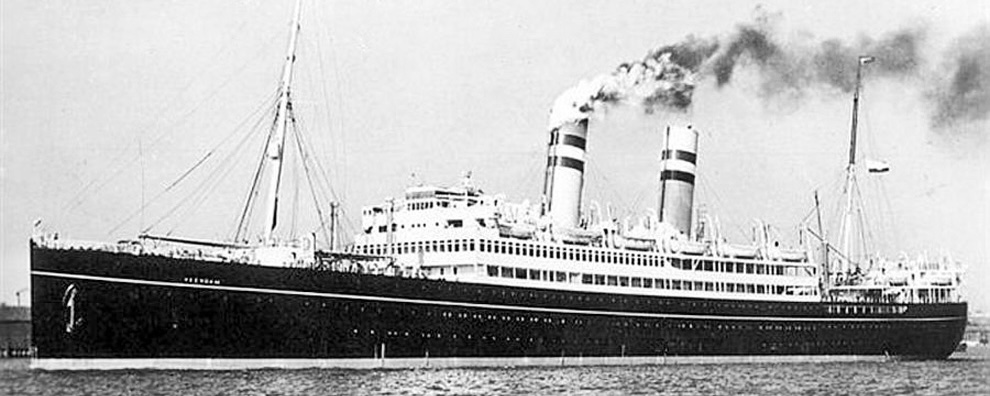
SS Veendam
Holland America Line · entered service 1923 · Ship Guide
Overview
SS Veendam was a Holland America Line liner built for the Rotterdam–New York service and completed in 1923. She belonged to the interwar generation of Dutch transatlantic ships that balanced regular North Atlantic passenger service with a strong emigrant and tourist-class role, helping sustain Holland America’s position in the Atlantic trade after the First World War.
In collecting and interpretation, Veendam is especially useful because she combines several overlapping histories: classic Holland America passenger service, interwar migration and tourist traffic, wartime transport work, and a long enough career to produce multiple documentary phases. Catalog entries should therefore reflect the exact service period represented by the artifact rather than treating the ship as static across time.
Key Facts
Design & Construction Context
Veendam was part of Holland America’s effort to rebuild and modernize its North Atlantic passenger fleet after the First World War. She was not a speed-driven express liner in the Anglo-German prestige mold, but a large, practical, and commercially adaptable ship designed for sustained service between continental Europe and New York.
That makes her especially important for route history. Ships like Veendam carried a mixed passenger world: cabin travelers, migrants, family travelers, and later tourists. They belong to the central social history of the Atlantic even if they are less often foregrounded than the great record-holding liners.
Service History (Summary)
1923–1939: Entered Holland America Line service on May 15, 1923. She became part of the regular Rotterdam–New York operation, often calling at Boulogne and Plymouth and serving a broad transatlantic passenger market.
Interwar role: Veendam belongs to the mature interwar Holland America service pattern, in which Dutch liners helped connect continental Europe to North America outside the more often emphasized British departure system. This is the main collecting era for passenger lists, brochures, menus, baggage labels, and route ephemera tied directly to the ship.
Accommodation evolution: like many interwar liners, her class system adapted over time as the Atlantic market moved away from the older prewar first/second/third model toward more flexible tourist and cabin-class arrangements.
Second World War: she was taken into Allied service and used as a transport / troopship. That phase belongs to a distinctly different documentary world from peacetime Holland America passenger service and should be interpreted separately.
Postwar return: after the war she resumed commercial service, illustrating the durability of many well-built interwar liners even after major wartime disruption. Her postwar life, however, was comparatively short in the face of changing travel economics and newer ships.
1953: withdrawn and scrapped, ending a career that bridged interwar migration, wartime service, and early postwar commercial recovery.
Interpretive Notes
Holland America context is central: Veendam should be interpreted first as a Dutch transatlantic liner serving Rotterdam–New York traffic, not as a generic Atlantic passenger ship detached from its company and route culture.
Route history matters: ships like Veendam are valuable because they show how continental European Atlantic travel operated alongside, but not identical to, the better-known British departure system.
Wartime and peacetime material should be separated: troopship or transport-era documentation belongs to a very different historical setting from a passenger list or menu printed for Holland America Line commercial service.
Do not over-flatten passenger categories: because interwar accommodation systems shifted, it is better curator practice to preserve the wording actually used on the object or source—cabin class, tourist class, third class, and so forth—rather than standardizing everything too casually.
Sister-ship comparison: Veendam and Volendam began as closely related HAL turbine liners, but wartime history separated them sharply. Veendam’s seizure and use as a German accommodation ship produced a provenance phase fundamentally different from her prewar passenger and cruise service.
That contrast is valuable for visual attribution. Similar hull proportions can make the sisters difficult to distinguish in undated photographs, so funnel markings, name evidence, route context, and wartime setting should be used together rather than relying on silhouette alone.
Her prewar cruise work is another reason not to flatten the timeline. A cruise brochure and a Rotterdam–New York passenger list can both be authentic Veendam material while representing different commercial uses of the ship.
Evidence-first ship guide