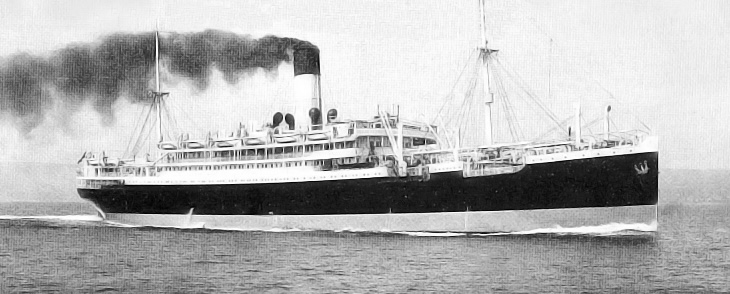
SS Vestris
Lamport & Holt Line · 1912 · Ship Guide
Overview
SS Vestris was a British passenger-cargo liner built for Lamport & Holt and placed in service in 1912. She was designed for long-distance South American work rather than North Atlantic express competition, combining passenger accommodations with substantial cargo capacity on routes linking Britain, New York, the Caribbean, and the River Plate.
In collecting and interpretation, Vestris is especially important because her identity combines two very different histories: a routine but socially significant inter-American and South American passenger-cargo service, and the heavily publicized 1928 sinking that turned her into a byword for maritime scandal. It is useful to preserve both contexts rather than treating the ship only through her loss.
Key Facts
Casualty totals and passenger / crew counts on the final voyage vary slightly among summaries, especially because some accounts differ on last-minute embarkations and rescue tallies. For museum-level precision, it is best to preserve the exact figure used by the source being cited.
Design & Construction Context
Vestris was not an express-liner prestige ship in the Cunard or Hamburg America sense. She was a high-quality mixed passenger-cargo liner built for the commercially important but often less glamorized South American service, where dependable schedules, cargo capacity, and comfortable accommodations mattered as much as raw speed.
That context matters interpretively. South American liners such as Vestris occupied a middle ground between immigrant carriers, luxury liners, and merchant steamers. Their documentary record can include elegant first-class material, business-route ephemera, and evidence of ordinary regional or migrant movement. This gives the ship a wider social range than the phrase “ocean liner” alone might suggest.
Service History (Summary)
1912–1914: Entered service in 1912, first on Liverpool–River Plate work and then on the New York–South America service that became her main identity. This is the earliest collecting period for Lamport & Holt brochures, passenger lists, route notices, and house-style ephemera tied directly to Vestris.
Prewar and interwar route role: along with her near sisters Vandyck and Vauban, she strengthened Lamport & Holt’s New York to River Plate service via Barbados and Trinidad, where these ships were among the largest and most comfortable liners on the route.
First World War: unlike some major liners, Vestris is remembered less for a spectacular wartime identity than for continued transport utility within a shipping world disrupted by war. Her significance remains chiefly commercial and route-based rather than military.
1920s: Continued in South American service during the interwar period, by which time she was an established and familiar ship on the route. This is also the period from which much surviving postcard and publicity material dates.
Final voyage, 1928: Left New York on November 10, 1928, for Barbados and South American ports with passengers, crew, mail, and cargo. In bad weather she developed a severe list, reportedly worsened by shifting cargo, water ingress, and broader concerns about loading and stability.
Sinking and aftermath: she sank on November 12, 1928. Rescue efforts saved many aboard, but more than a hundred people died. The disaster triggered public outrage, investigations, and lasting criticism of safety procedures, cargo handling, distress signaling, and life-saving arrangements.
The Final Voyage in Context
Vestris left New York on 10 November 1928 for Barbados and South America. Heavy weather soon exposed a dangerous list. Contemporary investigations and later accounts focused on a combination of water ingress, cargo and loading questions, stability, and delayed distress action rather than on a single simple cause.
The evacuation became especially controversial because the ship's list complicated the launching of boats and because distress messages were not sent as early as later critics believed they should have been. Vestris sank on 12 November. More than one hundred people died, and the disaster quickly became an international safety scandal rather than being remembered merely as a weather casualty.
Inquiry, Accountability, and Memory
The importance of the Vestris case lies in the questions it forced into public view: how passenger-cargo liners were loaded, how stability was monitored, when a master should transmit distress calls, and how lifeboat arrangements performed when a vessel had already developed a severe list. Newspaper coverage and official proceedings turned technical operational decisions into matters of public accountability.
The rescue story also deserves attention in its own right. Survivors spent many hours in boats and in the water before rescue ships arrived, and individual acts of courage became part of the disaster's memory. That human record should be preserved alongside the engineering and regulatory story without allowing later hero narratives to substitute for the documented sequence of the casualty.
Why Vestris Matters
Vestris is a useful corrective to an ocean-liner history centered only on prestige ships. Her career shows the importance of mixed passenger-cargo liners in linking New York, the Caribbean, and the River Plate, while her loss shows how operational details that seem routine in peacetime—loading, maintenance, signaling, and boat readiness—can become decisive in an emergency.
Interpretive Notes
Do not reduce her only to the disaster: Vestris spent sixteen years in routine passenger-cargo service before the sinking. A passenger list, menu, or route brochure belongs to that everyday commercial history, not solely to retrospective tragedy.
South American route context matters: she was a New York–Caribbean–South America liner, not a classic North Atlantic express ship. That affects how her accommodations, advertising, and passenger mix should be interpreted.
The sinking became a safety scandal: unlike some maritime disasters remembered mainly as weather events, the Vestris loss quickly raised questions about overloading, stability, distress handling, and evacuation. Curator practice should distinguish well-supported findings from later dramatic embellishment.
Mixed passenger-cargo identity is central: this was not a ship built only for luxurious passenger travel. Cargo arrangements were part of her design and part of the final disaster narrative, so they should not be treated as secondary details.
Evidence-first ship guideSources (Selected)