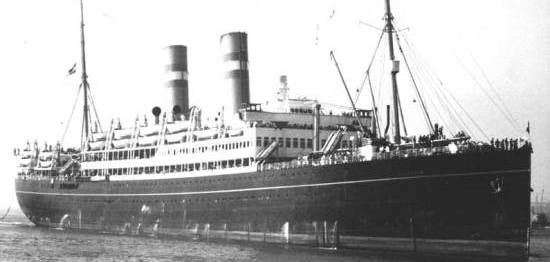
SS Volendam
Holland America Line · entered service 1922 · Ship Guide
Overview
SS Volendam was a Holland America Line liner built for the Rotterdam–New York service and completed in 1922. She belonged to the interwar generation of Dutch transatlantic ships that combined regular passenger service with cargo capacity and flexible class arrangements, helping Holland America rebuild and modernize its fleet after the First World War.
In collecting and interpretation, Volendam is especially important because she spans several distinct documentary worlds: classic Holland America passenger service, interwar migration and tourist traffic, wartime troop transport, and a shorter postwar return to commercial service. Artifacts should therefore be cataloged to the exact phase represented rather than treated as if the ship’s identity remained unchanged throughout her career.
Key Facts
Design & Construction Context
Volendam was one of the two intermediate liners Holland America brought into service in the early 1920s, alongside her near-sister Veendam. These ships were conceived as slower and more commercially practical than the company’s largest express liners, aimed especially at the broad middle-market and emigrant traffic that remained central to Holland America’s business.
That context matters interpretively. Ships like Volendam were not designed primarily for Atlantic prestige contests but for sustained, profitable, and socially important service between continental Europe and North America. Their significance lies in route history, migration history, and the everyday documentary record of transatlantic movement.
Service History (Summary)
1922–1939: Entered Holland America Line service on November 4, 1922. She became part of the regular Rotterdam–Hoboken / New York operation and represented the company’s interwar effort to modernize its North Atlantic service.
Interwar role: Volendam served a mixed Atlantic passenger market that included cabin travelers, emigrants, and later tourist-class passengers. This is the principal collecting era for passenger lists, route brochures, menus, baggage labels, and other Holland America ephemera associated directly with the ship.
Accommodation changes: like many interwar liners, her class structure was adjusted to reflect changing Atlantic demand. The shift from more rigid first/second/third arrangements toward tourist-class language is part of her documentary interest.
Second World War: Volendam was used as a troop transport. Her wartime service forms a sharply different historical phase from her peacetime Holland America passenger career and should be treated as such in cataloging and interpretation.
Postwar return: after the war she resumed commercial service, including postwar transport patterns tied to Rotterdam and, in some summaries, Quebec service. Her return shows the durability of well-built interwar liners, even as the postwar market was already changing rapidly.
1951–1952: withdrawn from service in 1951 and scrapped in 1952, ending a career that bridged interwar passenger service, wartime troop movement, and postwar recovery.
Interpretive Notes
Holland America context is central: Volendam should be interpreted first as a Dutch transatlantic liner serving Rotterdam–New York traffic, not simply as a generic Atlantic passenger ship.
She is a route-history ship as much as a design-history ship: her significance lies in the continental European Atlantic corridor and the social history of middle-market and migrant passenger movement.
Wartime and peacetime materials should be separated: troop transport documentation belongs to a different historical setting from Holland America commercial passenger material, even when both concern the same hull.
Do not flatten the changing class system: because Volendam’s passenger categories evolved over time, it is better curator practice to preserve first class, second class, tourist class, or third class exactly as printed on the object rather than standardizing all phases into one simplified scheme.
Evacuation context: Volendam’s 1940 torpedoing belongs to civilian evacuation history as much as naval warfare. She was carrying children and other evacuees away from Britain when struck, which makes the passenger context central to interpreting photographs, survivor accounts, and contemporary reports.
Her survival after the attack also distinguishes the episode from a simple sinking narrative. The ship was damaged but saved, repaired, and returned to service; artifacts tied to the attack should therefore be separated from later wartime and postwar material rather than treated as the end of her career.
For collectors, the evacuation episode raises the evidentiary bar. A wartime image of Volendam should not automatically be tied to the September 1940 voyage unless date, caption, passenger context, or archival provenance supports that claim. Her subsequent repair and continued service mean many wartime photographs belong to later phases.
That continuity is central to interpreting her record accurately and fully.
Evidence-first ship guide